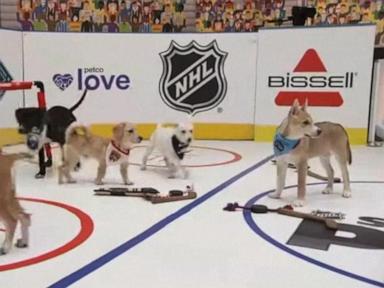
The air inside a professional hockey arena is a very specific brand of cold. It smells of shaved ice, sweat, stale popcorn, and the metallic tang of frozen steel. For decades, this environment has been the exclusive playground of giants—heavy men with missing teeth and scarred knuckles, chasing a vulcanized rubber disc at forty miles an hour. The stakes are legendary. The glory is ancient.
But if you look away from the towering jumbotrons and the thunderous roar of twenty thousand fans, down into a tiny, custom-built miniature rink tucked away from the main ice, the stakes change entirely. The cold air is the same. The intensity is just as fierce. Yet, the reward here is not a name engraved on silver.
It is a home.
The Weight of a Name
Consider a mixed-breed puppy named Macchiato. He does not know about broadcasting rights, syndication deals, or the TruTV premiere on June 8. He has no concept of the Florida Panthers, the team he is temporarily representing under the hockey pseudoname Matthew Fketchuk. He only knows the slippery, confusing texture of the miniature rink under his paws and the erratic bounce of a tiny toy puck.
Macchiato is one of thirty-two rescue dogs participating in the third annual Stanley Pup competition. The event, engineered by the National Hockey League in partnership with the Brandywine Valley SPCA and Petco Love, mirrors the actual Stanley Cup Playoffs. Every single NHL franchise gets a four-legged avatar. There is Sidney Pawsby for the Penguins. There is Taylor Howl for the Hurricanes. Jeremy Spayman skates for Boston.
To the casual viewer flipping through channels or browsing HBO Max during an intermission, it looks like a cute, highly polished marketing gimmick. It features Kenan Thompson acting as a celebrity coach. Legendary broadcaster Doc Emrick lends his iconic, soaring voice to the play-by-play. NHL stars like Devin Cooley and Seth Jarvis show up to smile alongside the puppies.
But look closer at the dogs.
These animals were not selected from high-end breeders. They were not trained from birth to handle the spotlight. Weeks ago, many of them were sitting in dark, crowded shelter runs, listening to the deafening chorus of barking neighbors, waiting for a clock that was ticking toward an uncertain end.
The glitz of the television production is a mask. The reality underneath is a rescue system pushed to its absolute limits.
The Reality Behind the Rubber Puck
Shelter work is a quiet war against numbers. Across North America, millions of animals enter the rescue system every year. The staff at organizations like the Brandywine Valley SPCA deal with the crushing weight of capacity constraints daily. When you walk through a shelter, you feel a heavy, palpable desperation. Every dog looking through the chain-link fence is playing a high-stakes game of chance. Will the next person who walks down this aisle stop? Will they look long enough to care?
The Stanley Pup program is designed to subvert that terrible lottery by utilizing the massive, fiercely loyal engine of sports fandom.
Hockey fans are notoriously tribal. We wear the jerseys, we memorize the stats, and we carry a deep, almost irrational pride for our cities. By assigning a rescue pup to every single market, the program bridges the gap between abstract charity and tribal loyalty. A hockey fan in Chicago might not think about visiting a local shelter on a Tuesday afternoon, but when they see a scruffy terrier mix named Tyler Barktuzzi wearing a miniature Blackhawks sweater, something shifts.
The abstract problem of pet overpopulation suddenly has a face. It has a name. It has a team.
Tracking the Echoes of Success
It is easy to be cynical about corporate charity initiatives. We have been conditioned to expect empty gestures—giant cardboard checks presented at center ice that do little to change the systemic issues on the ground.
That skepticism is healthy. But the data tells a different story here.
For the 2026 broadcast, the production added a new element to the team: Elias Weiss Friedman, the photographer behind The Dogist. His role is not to focus on the flashy game itself, but to anchor follow-up segments tracking the dogs from the previous two years of competition.
Consider what happens next after the cameras turn off: Friedman’s segments follow three specific families who watched past broadcasts and drove to shelters to claim their own "canine players." These are families who weren't planning on adopting a dog that month, but who were pulled in by the narrative of the game.
The ripple effect matters more than the 90-minute special itself. When a high-profile dog like Sidney Pawsby gets adopted from a broadcast, it doesn't just save that one animal. It empties a kennel. That empty kennel represents a literal lifeline for the next stray picked up from a freezing street corner or pulled from an overcrowded municipal facility.
The program claims a perfect success rate for its participants, but the real metric is the spike in local shelter inquiries that occurs in every represented city during the playoff run.
The Final Shift
Watch the way a puppy plays on that miniature rink. There is no strategy. There is no malice. There is only a frantic, joyous explosion of energy—a scramble of paws, a tumble over a teammate, a sudden stop to lick a referee's shoe. They have no idea that their performance is being beamed to millions of homes across the United States and Canada. They do not know that their survival once hung by a thread.
The human players on the main ice bleed for a trophy made of silver and nickel. They push broken bones and torn ligaments through a grueling two-month gauntlet just for the right to hoist it above their heads. It is a beautiful, brutal spectacle.
But the puppies on the small ice are playing for something far more permanent than a championship season. They are playing for a lifetime of quiet mornings, shared couches, and the simple, profound security of a promised tomorrow.
The puck drops. The whistle blows. The game begins, and somewhere in a crowded shelter, a kennel door opens.