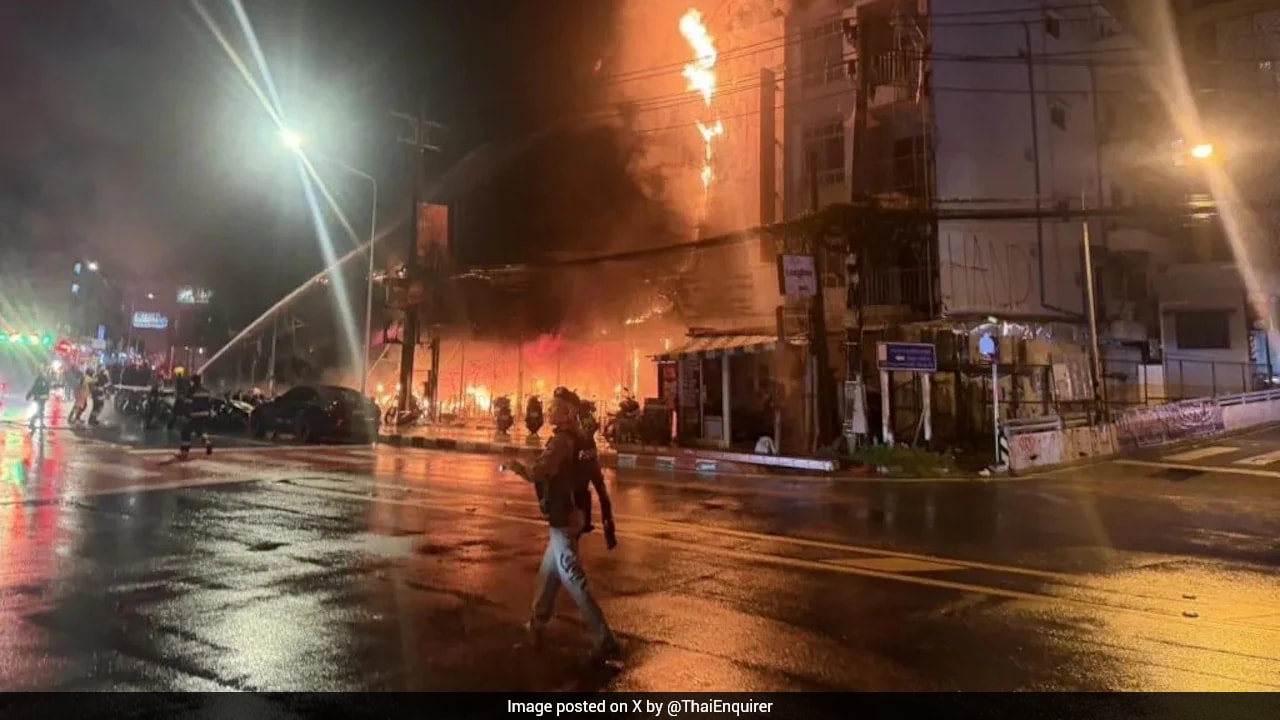
Smoke does not announce itself with a roar. It arrives as a polite, gray fog slipping beneath a hollow-core wooden door, smelling faintly of melted PVC and dust, long before a single orange flame licks the hallway plaster.
By the time a sleeper coughs awake in a densely packed Thai shophouse or an aging low-rise apartment block, the exit stairwell has already become a chimney. Discover more on a related topic: this related article.
Eleven people died. More than a dozen others were pulled from the wreckage with scorched lungs, shattered ankles from second-story leaps, and burns that will take years of skin grafts to quiet. Those are the numbers that scrolled across news tickers after fire tore through a cluster of interconnected buildings in Thailand—a clinical tally reduced to a single headline before the public scrolled on to weather forecasts and celebrity gossip.
Numbers are mercifully numb. They protect us from the heat. Further reporting by Reuters delves into comparable views on the subject.
When a news wire reports that eleven lives ended in an urban blaze, our brains file the tragedy under unfortunate accident and move on. We picture a freak spark, a careless cigarette, or an unpredictable act of nature. We rarely picture the blueprint. Yet in Southeast Asia’s rapidly expanding cities, structural fires are almost never purely accidental; they are architectural inevitabilities waiting for an ignition source.
To understand what happened inside those burning walls, you have to step away from the police tape and walk into the ordinary, everyday anatomy of urban Thailand.
The Anatomy of a Concrete Maze
Consider a hypothetical resident—let us call her Niran, a composite drawn from the thousands of service workers, students, and small-business families who inhabit Thailand’s ubiquitous multi-use buildings. Niran lives on the third floor of a four-story concrete shophouse, the kind of structure that forms the spine of almost every commercial street from Bangkok to Chiang Mai to Hat Yai.
On the ground floor, her landlord runs a wholesale plastics and packaging shop. Rolls of polythene wrap, cardboard cartons, and aerosol cans sit stacked floor-to-ceiling beneath a tangle of overhead electrical wires that look less like an engineering grid and more like black ivy. The second floor serves as a warehouse and makeshift kitchen. The third and fourth floors have been partitioned with thin plywood walls into tiny rental rooms, maximizing monthly yield per square meter.
Nothing about Niran’s building feels dangerous at two o’clock in the afternoon. Sunlight filters through steel security bars bolted tightly across every bedroom window—installed years ago to deter burglars, welded permanently into the concrete frames without interior quick-release latches.
Pause right there. Look at those iron bars.
In the quiet arithmetic of urban survival, security against theft almost always wins out over escape from fire. Families weld themselves inside cages to keep intruders out, forgetting that a locked cage works both ways when the air turns black.
When an overloaded extension cord or an aging transformer sparks on the ground floor at three in the morning, the physics of the building turn lethal within ninety seconds. Think of a traditional Thai shophouse not as a home, but as a vertical brick kiln. Concrete walls trap heat rather than venting it. A single central staircase—narrow, unpressurized, and completely open from the ground floor to the roof—acts like the flue of a fireplace.
Hot gases obey simple laws. They rise, expanding violently as they search for oxygen.
Three Minutes to Midnight
I have walked through the blackened shells of buildings like this days after the fire trucks have packed up their hoses. The smell never leaves your nostrils—a sour, metallic stench of wet ash, charred wiring, and scorched concrete that clings to your clothes for weeks. What haunts you most isn't the destruction of property; it is the geography of where people fall.
You rarely find victims in their beds. You find them three feet from a bolted steel grille. You find them huddled inside tiled bathrooms, hoping a running shower tap will hold back a superheated wall of carbon monoxide. You find them halfway down the stairs, overcome by toxic fumes three steps above the landing.
Let us return to our hypothetical scenario with Niran to trace the timeline that firefighters know by heart.
Minute Zero: A short circuit ignites cardboard packaging near the ground-floor stairwell. There are no interconnected smoke alarms. A standalone battery detector, if one was ever mounted, lost its nine-volt battery two years ago after chirping annoyingly during a rainstorm.
Minute Two: The ground floor flashes over. Burning plastics release hydrogen cyanide and carbon monoxide—invisible, odorless killers that incapacitate the human brain long before heat blisters the skin. Because there is no fire-rated door separating the commercial ground floor from the residential stairwell, superheated smoke surges upward at fifteen feet per second.
Minute Three: Niran wakes up. Her room is dark; the fire has already melted the main breaker box, killing the building’s electricity. She opens her bedroom door to check the hallway. That single reflex—opening a door without feeling the handle for heat—lets a wave of 600-degree smoke rush into her lungs. One breath sears her trachea. Panic replaces rational thought.
She cannot go down the stairs. She runs to the window, slams open the glass louvers, and meets the welded iron bars.
Down on the street below, neighbors are shouting, pointing phone flashlights upward, dragging mattresses onto the asphalt in desperate improvisation. Fire engines are already wailing in the distance, fighting through narrow sois—alleyways choked with parked motorbikes, low-hanging telecom cables, and concrete bollards that force heavy ladder trucks to stop two hundred meters away from the flames.
Every second that a fire crew spends unspooling extra lengths of hose down a gridlocked alley is a second stolen from the people pressing their faces against iron grilles on the third floor.
The History Written in Ash
If this sounds painfully familiar, it is because Thailand has watched this exact script play out across decades of rapid, uneven development.
Veterans of urban safety still speak in hushed tones about the 1993 Kader Toy Factory fire outside Bangkok, where locked exits and collapsed unreinforced steel killed 188 workers, mostly young women. They remember the 2009 Santika Club blaze on New Year’s Eve, where sixty-six celebrants died trapped behind blocked emergency doors and windowless walls. They recall the 2022 Mountain B nightclub fire in Chonburi, where acoustic foam turned a ceiling into liquid fire in seconds.
Each catastrophe triggered a wave of national grief, parliamentary inquiries, and solemn promises to overhaul building inspections. And each time, once the funerals ended, the underlying economic pressures quietly reasserted themselves.
Thailand actually possesses comprehensive building control laws on paper. Newer high-rises, international hotels, and modern shopping malls in central Bangkok boast sprinkler systems, pressurized escape stairwells, fire-rated doors, and rigorous evacuation drills. Step inside a newly built condominium tower along Sukhumvit Road, and you are standing in one of the safest structures in the region.
Step three blocks away into an older neighborhood, however, and you cross an invisible fault line.
Buildings constructed prior to modern safety codes are frequently grandfathered out of strict retrofitting requirements. Even when regulations apply, enforcement stretches thin across hundreds of thousands of aging shophouses, informal dormitories, and mixed-use commercial blocks. Municipal inspectors face immense backlogs, tangled property ownership records, and subtle pressure not to shut down small businesses that employ local families and anchor neighborhood economies.
Safety costs money. Fire-rated doors cost money. Hinged, quick-release security grilles cost more than plain welded steel bars. Hardwired smoke detectors, emergency exit lighting, and rewiring decades-old electrical panels require capital that small landlords simply refuse to spend unless forced.
So the risk stays invisible. Until the night it isn't.
What Happens When Steel Meets Heat
Most people misunderstand how fire kills. Hollywood trains us to fear flames—leaping walls of orange light that chase heroes down corridors. In reality, flames are rarely what claim lives in multi-story building fires.
Smoke is the executioner.
Modern interiors are filled with synthetic materials: polyurethane foam mattresses, polyester curtains, vinyl flooring, plastic electronics casings. Fifty years ago, a room furnished with solid wood, cotton, and wool took nearly twenty minutes to reach flashover. Today, synthetic furnishings ignite faster and burn hotter, pushing a room to flashover in under four minutes while generating thick, greasy black smoke loaded with neurotoxins.
Two breaths of concentrated synthetic smoke can drop a healthy adult to their knees. Disorientation sets in immediately. In pitch darkness, with your eyes streaming tears and your lungs burning, you lose spatial awareness within seconds. People die inches away from unlocked doors simply because they turned left instead of right in the dark.
Then there is the structural domino effect. When fire rips through adjacent buildings—as happened in this latest tragedy—it rarely travels solely through the open air. It creeps through shared attics, unsealed utility shafts, and common partition walls that stop just short of the roofline. A fire that starts in a ground-floor repair shop at one end of a row house can quietly travel across the ceiling void and drop down into the bedrooms of three neighboring buildings before residents even smell smoke.
By the time firefighters breach the front shutters with circular saws, the fire is no longer a single blaze. It is a multi-front furnace.
The Unspoken Burden on Survivors
We tally the dead because death is final and indisputable. We mention the injured in passing—over a dozen hurt—as if survival were a clean, happy ending.
It isn't.
Ask anyone who has survived a severe building fire, and they will tell you that the night of the blaze was only the beginning of their ordeal. Smoke inhalation leaves microscopic scarring deep inside the alveoli of the lungs, turning simple tasks like climbing a flight of stairs into an exhausting struggle for breath for the rest of their lives. Severe burns require agonizing debridement procedures, compression garments worn twenty-three hours a day, and repeated surgeries as scar tissue tightens across joints.
Then comes the silent wreckage: post-traumatic stress. Survivors sleep with the lights on. They wake up gasping at the smell of burnt toast or diesel exhaust from a passing truck. Many lose every document they owned—identification cards, house registrations, family photographs, savings tucked inside drawers—leaving them trapped in bureaucratic limbo while trying to heal.
When eleven people die and more than a dozen are injured in a single night, an entire neighborhood’s social fabric tears open. Breadwinners vanish. Children become orphans. Small shopkeepers who spent thirty years building an inventory watch their life’s work turn into gray sludge on the pavement.
Rewriting the Blueprint Before the Next Spark
It is tempting to look at a tragedy like this with helpless resignation, assuming that dense cities in developing economies must inevitably pay a blood tax for their density.
That is a lie. Density does not kill people; unventilated stairwells, welded window bars, and neglected wiring kill people.
Changing the odds does not require tearing down every historic shophouse in Thailand or bankrupting small business owners with impossible luxury-tower mandates. It starts with ruthless, practical interventions that target the exact failure points exposed by every fatal blaze:
- Outlaw fixed, non-releasable window grilles. Every security bar covering a bedroom window must include a simple interior quick-release latch—a lever or foot pedal that a child or elderly person can open in three seconds without searching for a key in the dark.
- Seal the vertical chimney. Ground-floor commercial spaces that store flammable goods—plastics, textiles, chemicals, paper—must be separated from upper-floor residential stairwells by self-closing, fire-rated doors. Keeping smoke out of the stairwell buys residents fifteen precious minutes to walk out alive.
- Mandate interconnected, sealed-battery smoke alarms. A ten-dollar alarm mounted at the top of a shared stairwell gives sleepers the single resource no fire department can ever manufacture: early warning.
- Enforce clear soi access and overhead wire management. Community fire hydrants, clear emergency lanes, and routine pruning of tangled electrical cables allow rescue ladders to reach upper floors before flashover occurs.
None of these measures require futuristic technology. Every single one is proven, affordable, and already sitting on hardware store shelves across the country. What has been missing is not engineering knowledge, but the collective refusal to treat preventable deaths as bad luck.
Tonight, across Thailand and throughout Southeast Asia, millions of people will lock their front shutters, bolt their bedroom window bars, plug their phones into worn extension cords, and drift off to sleep above storerooms stacked with cardboard and plastic. Most of them will wake up tomorrow morning to the sound of motorbikes and street vendors, entirely unaware of how thin the margin was between a quiet night and a headline.
Somewhere in one of those buildings, a wire is already warming up behind a wall.