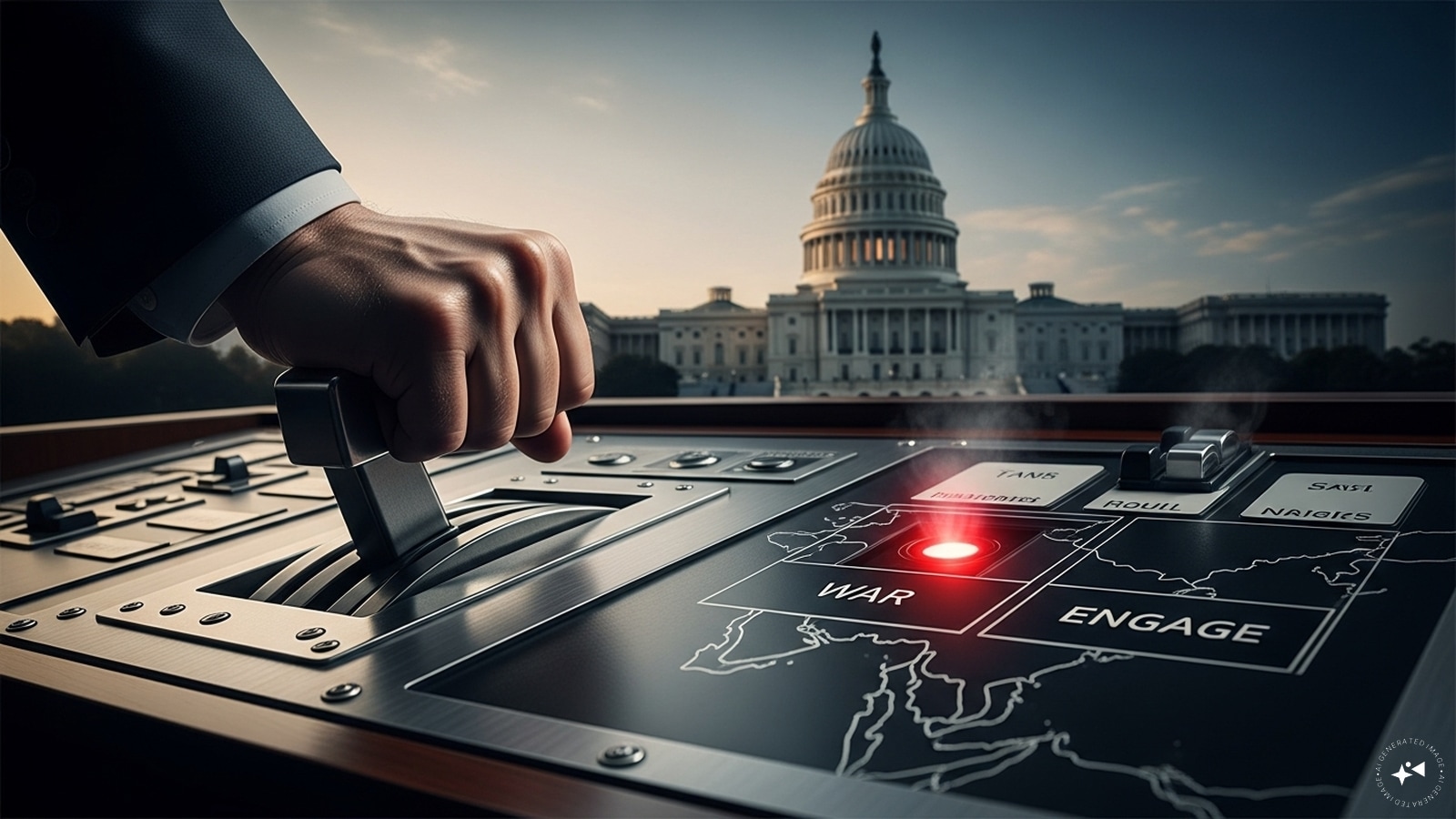
The marble corridors of the United States Senate are built to swallow sound. Echoes of high-stakes arguments, partisan trading, and historic declarations disappear into the vaulted ceilings, leaving a heavy, cathedral-like quiet. But underneath that silence, the machinery of raw power is constantly moving, shifting gears in ways that alter lives thousands of miles away.
Consider a twenty-one-year-old Marine corporal named Marcus. He is a hypothetical composite, but his reality is shared by hundreds of thousands of young men and women. Right now, Marcus is sitting in the cramped, humid hold of an amphibious assault ship somewhere in the Arabian Sea. He is cleaning the grit out of his rifle. He is thinking about his mother’s Sunday pot roast, the transmission fluid leaking from his truck back in Ohio, and whether the sudden escalation in regional rhetoric means he will be going home in two months or going ashore in two days. Marcus does not read the Congressional Record. He does not track the subtle procedural maneuvers of Washington committee chairs. Yet, his immediate survival hinges entirely on whether a few dozen politicians in business suits, sitting in a climate-controlled room in Washington, decide to reassert an old, forgotten constitutional boundary.
That boundary is the power to declare war.
For decades, that power has been slowly, quietly bleeding away from the legislative branch, pooling instead in the Oval Office. A vote in the Senate aimed to yank that power back, specifically curbing executive authority to launch military action against Iran. It was a moment of profound friction between two branches of government, disguised as a dry legislative update. To understand how we arrived at this flashpoint, we have to look past the cable news chyron and into the steady, dangerous erosion of how America goes to war.
The Friction of Founding Intent
The architects of the American republic were deeply terrified of kings. They had just fought a bloody, exhausting revolution to rid themselves of a single ruler who could command armies on a whim, plunging a nation into conflict based on personal grievance or imperial ambition. Because of that fear, they built a deliberate speed bump into the Constitution.
They split the atom of military power.
Under Article II, the President is designated as the Commander-in-Chief, possessing the authority to direct troops and defend the nation from sudden attacks. But Article I gives the sole power to declare war to Congress. The logic was beautifully simple: the person who commands the soldiers should not be the person who decides to send them into the fire. It was designed to force debate, to require consensus, and to ensure that if American blood was to be spilled, the decision would be made by the direct representatives of the people who would be doing the bleeding.
But the world changed. Rockets replaced muskets. Decisions that once took weeks of contemplation now happen in milliseconds on digital screens.
Over the last half-century, Congress willingly stepped away from its most solemn duty. It became politically convenient to let the President make the hard calls. If a military intervention went well, lawmakers could wave the flag and claim a share of the glory. If it devolved into a quagmire, they could blame the White House and shield themselves from the wrath of voters. Through a series of broad, open-ended authorizations passed in the wake of national crises, the legislature essentially handed the executive branch a blank check with a faded signature at the bottom.
The Catalyst in the Desert
The danger of a blank check is that eventually, someone will try to cash it.
The immediate catalyst for the Senate's sudden rush of constitutional anxiety was a sharp, terrifying spike in tension in the Middle East, punctuated by high-profile military strikes and retaliatory drone attacks. Suddenly, the abstract debate over executive overreach wasn't an academic exercise for law professors. It was a live wire.
Imagine the terrifying speed of modern escalation. A drone strikes an American outpost. A targeted missile response eliminates a high-ranking foreign general on a tarmac in Baghdad. Within hours, regional air defense systems are screaming on high alert. Missiles are fueled. Cryptographic networks hum with commands.
During these moments, the path from a localized flare-up to a full-scale regional conflagration is terrifyingly short. A single miscalculation by a lonely radar operator, a misread signal from an intelligence asset, or an overzealous commander can trigger a domino effect that no one genuinely wants but no one can figure out how to stop.
That is the invisible tripwire. When the executive branch possesses the unilateral authority to push the country over the brink without consulting anyone else, the tripwire becomes incredibly sensitive. The Senate vote was a collective, breathless realization that the nation was standing far too close to the edge of a chasm, guided by the calculations of a single office.
The Anatomy of the Pushback
The measure introduced in the Senate was not an act of sudden pacifism. It was an act of institutional self-preservation and constitutional restoration. The core of the legislation was straightforward: it sought to mandate that any hostilities against Iran must be explicitly authorized by Congress, unless the United States was responding to an imminent, direct attack.
The debate on the Senate floor was charged with an unusual energy. The typical partisan theater felt muted, replaced by something heavier. Lawmakers were forced to confront a fundamental question that cuts to the heart of national identity: Who speaks for the country when the stakes are life and death?
Supporters of the measure argued that reasserting congressional authority wasn't about tying the President’s hands in a moment of crisis. It was about forcing a national conversation before the crisis began. They argued that a war fought without the explicit backing of the American people, through their elected representatives, is a war built on sand. It lacks the deep, enduring legitimacy required to sustain a nation through the dark, inevitable sacrifices of conflict.
Consider the alternative perspective argued by opponents of the bill. They maintained that in a world populated by asymmetric threats, terrorist proxies, and hypersonic weaponry, the legislative process is simply too slow, too clunky, and too divided to be effective. They argued that signaling a division between Congress and the White House would project weakness to adversaries like Tehran, emboldening them to test American resolve. In their view, a commander-in-chief must possess unburdened, total flexibility to deter aggression instantly.
This is the central, agonizing paradox of modern democratic governance. How does a society remain agile enough to defend itself against modern threats without sacrificing the democratic guardrails that make it worth defending in the first place?
The Human Weight of Procedural Votes
It is easy to get lost in the vocabulary of Washington. Terms like "cloture," "filibuster," "resolutions," and "amendments" act like an intellectual fog, cooling the hot reality of what is actually being discussed.
To break through that fog, you have to look at the ledger of cost.
Every time a government enters a conflict, a massive, invisible machinery grinds into motion. It is a machinery fueled by billions of dollars diverted from schools, infrastructure, and scientific research. But more importantly, it is a machinery that consumes human potential.
Think back to Marcus on his ship in the Arabian Sea. Think of his counterpart—a twenty-one-year-old Iranian student in Isfahan who has spent his youth studying engineering, who loves Western football, and who worries about his aging father's health. If the tripwire is tripped, these two young men, who have never met, who bear no personal malice toward one another, will be thrust into an arena where their primary objective is each other's destruction.
The Senate’s legislative maneuver was an attempt to inject human deliberation into that cold, mechanical process. By forcing a vote, lawmakers were essentially demanding that if Marcus is to be sent into harm's way, seventy-five, eighty, or one hundred senators must stand up in the light of day, look into a television camera, and tell his mother exactly why it is necessary. They must put their names on the line. They must own the consequences.
The Long Road to Rebalancing
The advancement of this measure was a significant milestone, but it would be an error to view it as a final resolution. Power, once concentrated in a specific office, does not yield easily. The executive branch, regardless of which political party occupies it, naturally resists attempts to curtail its reach. Presidential vetoes loom over such legislative efforts, and the thresholds required to override those vetoes are notoriously difficult to clear in a deeply divided political landscape.
But the true value of the vote extended beyond the immediate legal mechanisms it sought to establish. It served as a vital cultural signal within the halls of government. It demonstrated that the instinct for institutional balance, though dormant for long stretches of time, is not entirely dead. It reminded the nation that the Constitution is not a self-executing document; it is a living framework that requires constant, active defense by the individuals sworn to uphold it.
The vote was a rare moment where the long-term health of the republic took precedence over short-term political expediency. It was an acknowledgment that the process matters just as much as the outcome—that how America decides to deploy its immense, terrifying power across the globe defines its character just as much as the deployment itself.
Away from the spotlight of the Capitol, the sun begins to set over the Arabian Sea. The hold of the amphibious assault ship grows cooler as the night air rolls in. Marcus finishes oiling his rifle, snaps the bolt back into place with a sharp, metallic click, and slides it into his rack. He doesn't know about the tally on the Senate floor. He doesn't know about the intense negotiations over the wording of a specific sub-clause. He simply closes his eyes, listens to the steady, rhythmic hum of the ship's engines cutting through the dark water, and waits for morning, his destiny tied to a fragile piece of parchment preserved beneath glass in Washington.