Two o'clock in the morning smells like cold coffee, ozone from overworked graphics cards, and the faint, metallic tang of panic.
If you have ever worked in the upper tiers of interactive entertainment, you know that specific hour. Your eyes burn from staring at flickering wireframe models or lines of stubborn C++ code. Outside the frosted glass of the studio, the city is asleep. Inside, you and a hundred other people are wrestling a digital world into existence, knowing that millions of fans are counting down the seconds until they can step inside what you built. You tell yourself the exhaustion is worth it. You tell yourself you are making art, or at least history.
Then, one Tuesday morning, your keycard stops working at the front turnstile.
Consider a hypothetical scenario that mirrors what dozens of real developers recently described in a British employment tribunal. Picture a senior environment artist—let’s call him Liam—who has spent six years sculpting the weathered bricks, neon reflections, and cracked asphalt of a sprawling virtual metropolis. Liam isn't a rebel. He likes his job. He takes pride in how the virtual rain pools in the gutters he designed. But over the last year, the overtime crept back in. Promises about flexible work dissolved into sudden mandates. And when Liam and his colleagues began quietly talking in a private messaging channel about forming a recognized trade union to protect their working hours and job security, the air in the building changed.
Suddenly, Liam is sitting across a sterile conference table from a human resources representative he has barely spoken to in half a decade. There is no warning. No performance improvement plan. Just a rehearsed script about restructuring, policy violations, or redundancy, followed by a security escort to the elevator while his personal belongings are packed into a cardboard box by someone else.
Gone.
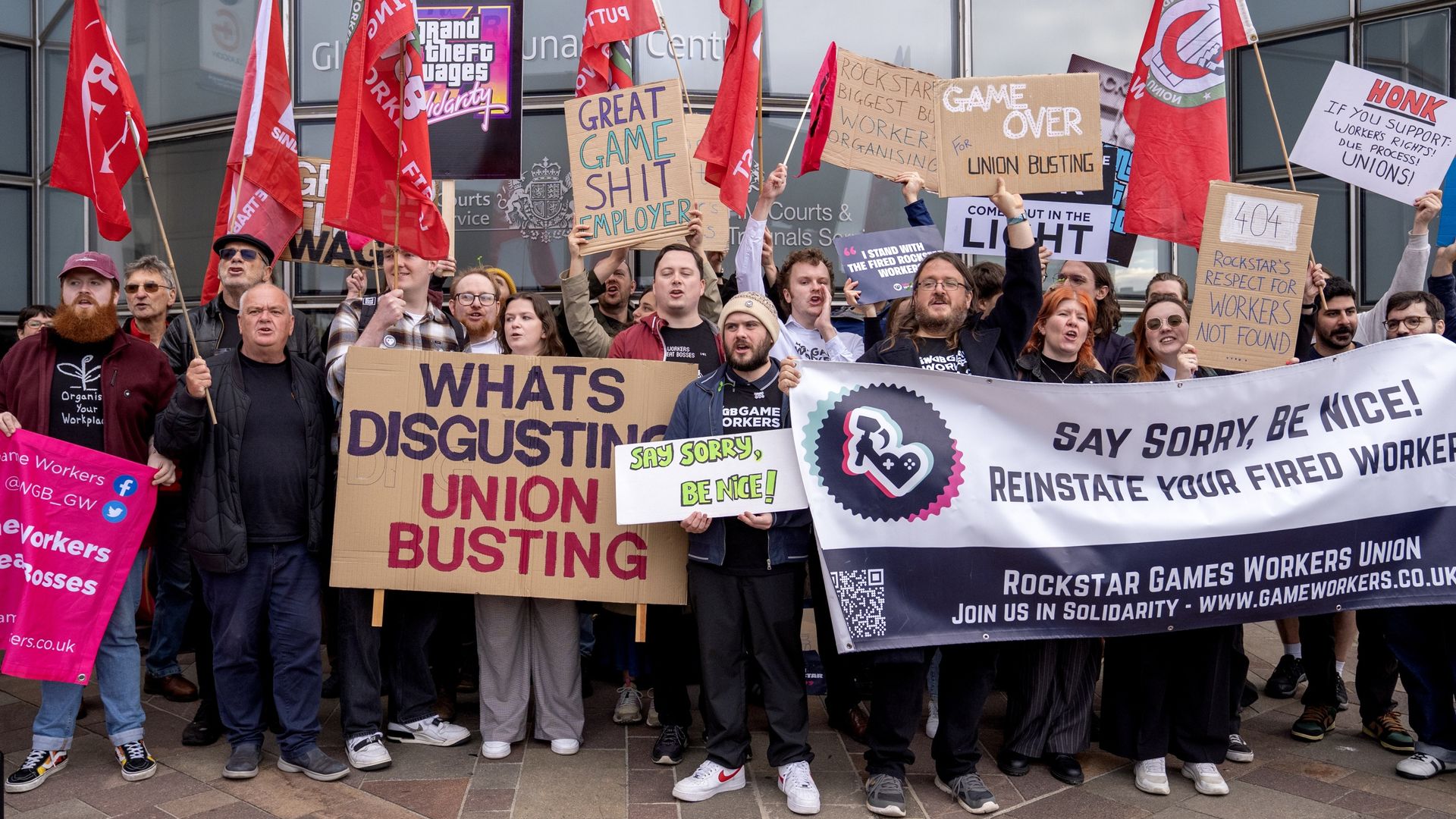
That imagined walk to the elevator captures the exact emotional collision currently playing out in a courtroom over the real-world dismissal of workers at Rockstar Games, the titan behind Grand Theft Auto and Red Dead Redemption. According to allegations laid out before an employment tribunal, Rockstar didn't just let people go for routine corporate reasons. The claim is far starker: the studio sacked workers specifically to prevent a growing union from gaining the collective strength needed to challenge management.
The Architecture of Silence
To understand why a multi-billion-dollar entertainment powerhouse would allegedly risk a public legal battle over a handful of employees, you have to understand the psychology of the modern blockbuster game studio.
Making a title like Grand Theft Auto VI is not like making a film or writing a novel. It is closer to building a suspension bridge while people are already driving across it. Thousands of artists, programmers, writers, and testers across multiple continents have to synchronize their work down to the millisecond. A single broken script in Edinburgh can crash a build in New York or San Diego.
Because the machine is so massive and so fragile, studio executives prize absolute control above almost everything else. Secrecy isn't just a marketing tactic; it is treated like a religion. Leaks are viewed as existential threats. Delays cost tens of millions of dollars. In that high-pressure environment, management often starts to see its own workforce not as a community of creators, but as a collection of variables that must be kept predictable, quiet, and compliant.
A union introduces a variable that executives cannot program.
When workers organize—in this case, through the Independent Workers' Union of Great Britain (IWGB)—they alter the fundamental geometry of the workplace. Instead of one exhausted tester asking a manager for a reasonable deadline and being told to take it or leave it, fifty testers walk into the room together. Suddenly, the studio has to negotiate. It has to justify sudden policy shifts, explain crunch periods, and answer for how profits are shared when a single release generates billions of dollars in revenue within days of hitting digital storefronts.
Before the tribunal, representatives for the dismissed workers argued that Rockstar’s leadership saw this organizing effort gaining momentum and decided to cut the roots before the tree could grow. The accusation is that management targeted active organizers and vocal union members, removing them from the studio floor to send an unmistakable chill through everyone who remained behind.
Think about what happens to the survivors when a colleague vanishes overnight.
You don't need a memo from the executive suite telling you to keep your head down. The empty chair next to you does all the talking. You stop asking questions in all-hands meetings. You mute the union chat on your phone. You accept the extra weekend shift without pushing back, because you have a mortgage, a partner, or a visa tied to your employment, and you just watched someone with a spotless record get erased from the company directory before lunch.
The Myth of the Passion Tax
For decades, the video game industry has run on an unspoken bargain that insiders call the "passion tax."
It works like this: companies know that millions of young people dream of making games for a living. Because the work looks glamorous from the outside, studios have historically paid less than comparable tech firms while demanding far more hours. If you complained about sleeping under your desk or missing your kid's birthday to finish a game's lighting pass, the subtle implication was always the same. If you don't have the stomach for it, there are ten thousand kids fresh out of university who would kill for your seat.
I remember the first time I felt that pressure firsthand, early in my career, watching a lead designer quietly cry in a stairwell because a milestone deadline had been moved up by three weeks with zero additional resources. None of us walked out. None of us even raised our voices. We went back to our desks, put on our headphones, and absorbed the damage, convinced that enduring misery was simply the price of admission to an industry we loved.
Rockstar itself became the poster child for this culture back in 2018, when reports surfaced of developers working hundred-hour weeks to finish Red Dead Redemption 2. To the company's credit, that public reckoning forced real changes. Rockstar overhauled its management structure, curtailed extreme crunch, and earned praise from across the industry for treating its staff more humanely. For a few years, it looked like the old guard had finally learned that sustainable working conditions actually produce better art.
Which makes the current tribunal claims hit so hard.
If a studio spends years rebuilding its reputation as a reformed, worker-friendly environment, only to allegedly turn around and fire employees the moment they try to formalize their rights through a union, it exposes the fatal flaw of corporate goodwill. Benevolence granted by management can be revoked by management at any time. A new quarterly target, a delayed release window, or an impatient parent company—in Rockstar's case, Take-Two Interactive—can erase years of progressive HR policies with a single signature.
A union isn't built on the hope that executives will stay kind. It is built on the reality that businesses prioritize profit, and workers need an independent mechanism to protect themselves when those priorities collide with human wellbeing.
What Happens Inside an Employment Tribunal
Strip away the headlines and the emotional weight, and a British employment tribunal is a remarkably methodical, unglamorous place. There are no dramatic Hollywood outbursts. Instead, there are thick binders of emails, internal Slack logs, HR timelines, and witnesses under oath being asked to explain why certain decisions were made on specific dates.
Under UK employment law, dismissing an employee because of trade union membership or legitimate union activities is automatically unfair. Unlike standard unfair dismissal claims, which usually require two years of continuous service before a worker can bring a case, protection against union-related firing applies from day one. Furthermore, tribunals can grant "interim relief"—a rare legal mechanism where a judge orders an employer to keep paying a sacked worker's salary until the full case is heard, provided the worker can show they have a strong likelihood of proving they were fired for union organizing.
That legal threshold is why the language used at the tribunal matters so much.
When the workers' legal team told the tribunal that Rockstar sacked staff to stop the union from gaining "leverage or power," they weren't just delivering a punchy soundbite for the press. They were aiming straight at the heart of the legal test. Rockstar, for its part, has denied the allegations, maintaining that its actions were lawful and rooted in legitimate business or conduct reasons rather than anti-union animus.
This is where almost every modern labor dispute gets tangled in gray areas. Very few corporate executives are foolish enough to write an email that says, Fire Sarah because she joined the union. Instead, when management wants to neutralize an organizing drive, scrutiny suddenly intensifies. Minor infractions that were ignored for years suddenly become fireable offenses. A team reorganization conveniently eliminates the exact roles held by the most active union stewards. Security audits find reasons to revoke access for the very people who were organizing petition drives.
The tribunal's job is to look past the polished corporate explanations and examine the timeline, the patterns, and the internal communications to decide what actually drove the decision. Did the axe fall because of genuine business necessity, or did it fall because workers were starting to speak with a single, organized voice?
The Stakes Reach Far Beyond One Studio
You might be tempted to look at this dispute as an isolated squabble inside a famously secretive game developer. That would be a mistake.
The global video game industry is currently trapped in a brutal contradiction. On one hand, the biggest franchises make more money than Hollywood blockbusters and major sports leagues combined. On the other hand, tens of thousands of game developers have been laid off across the globe over the past two years as studios overcorrected from pandemic-era hiring booms and buckled under soaring development budgets.
In an environment where massive studios can shutter overnight and profitable companies routinely slash ten percent of their workforce to appease shareholders, workers across the tech and gaming sectors have woken up to a hard truth: individual loyalty offers zero protection. You can ship a masterpiece, win Game of the Year, and still find your role eliminated in a Tuesday morning email.
As a result, unionization in the gaming industry—once considered nearly impossible—has surged. From QA testers at Activision Blizzard and ZeniMax to developers across Europe and North America, workers are realizing that collective bargaining is the only tool capable of securing severance protections, transparent pay bands, remote-work guarantees, and safeguards against unchecked generative AI replacing creative roles.
Rockstar is the heavyweight champion of the medium. What happens inside its offices sets the temperature for the entire industry.
If a giant with Rockstar's financial cushion and cultural prestige can successfully crush an organizing drive—or drag legal proceedings out for years until the momentum dies and the organizers move on to other careers—every other studio executive watching from the sidelines takes notes. They learn that the financial penalty of a tribunal loss is simply a rounding error compared to the long-term cost of sharing decision-making power with their staff.
Conversely, if the tribunal holds the studio accountable and workers see that the law actually has teeth when companies retaliate against organizers, the dynamic shifts. Fear loses some of its grip. The empty chair next to your desk stops being a warning and starts becoming a rallying point.
The Human Cost of a Delayed Launch
There is an irony at the center of all this that rarely makes it into financial reports.
Players love Rockstar games because they feel alive. When you walk down a street in Red Dead Redemption 2 or Grand Theft Auto V, every alleyway has a story, every background character reacts to the weather, and every radio station crackles with sharp, satirical wit. That level of detail doesn't come from corporate directives or shareholder presentations. It comes from thousands of individual human beings caring deeply about tiny, invisible details that ninety percent of players will never even notice.
When a studio wages war against its own organizers, it poisons the very culture that makes that craftsmanship possible.
Trust is an fragile currency in creative work. Once employees believe that management views their collective wellbeing as a threat to be neutralized, people stop bringing their best ideas to the table. They do the bare minimum required to avoid attracting attention. They protect themselves instead of elevating the project. You can still ship a blockbuster product that way—marketing budgets and brand loyalty will guarantee massive opening-week sales—but something vital hollows out behind the scenes.
In the end, this story isn't really about labor law statutes or corporate restructuring jargon. It is about what happens when the people who build the worlds we escape into decide they deserve a say in the real world they inhabit forty, fifty, or sixty hours a week.
Late at night, long after the courtroom doors lock and the legal briefs are filed away, someone is still sitting in front of a glowing monitor, tweaking the reflection of a neon sign in a digital puddle, wondering whether speaking up for the person sitting beside them will cost them everything they spent years building.


