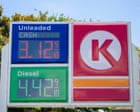
The mainstream financial press is taking a victory lap over sub-$4 retail gasoline. They credit a pen stroke, a diplomatic photo-op, and the sudden cessation of Middle Eastern hostilities. It makes for a comforting, linear narrative: peace breaks out, Iranian crude floods the global market, and drivers save fifty cents a gallon at the pump.
It is an absolute fairy tale.
Believing that a political agreement suddenly re-engineered global energy markets is not just naive; it is dangerous for anyone managing capital, supply chains, or corporate budgets. The reality of oil infrastructure, refining capacity, and macroeconomics laughs at political headlines. Retail fuel prices did not drop because of geopolitical goodwill. They dropped because a massive, slow-moving structural shift in global demand coincided with a cyclical buildup in domestic inventory—factors that were set in motion long before anyone signed a treaty.
The Myth of Instant Iranian Supply
Every major network wants you to think there is a giant valve in Kharg Island that operators simply cracked open the moment the ink dried on the page.
Having spent twenty years analyzing energy supply chains and watching trading desks react to empty political theater, I can tell you exactly how the physical market works. Crude oil does not travel at the speed of Twitter.
- The Logistical Bottleneck: Re-certifying tankers, securing maritime insurance through Lloyd's syndicates, and clearing financial compliance hurdles takes months, not minutes.
- The Quality Misalignment: Iranian Heavy crude is highly sour. You cannot just dump it into any refinery and expect gasoline to come out the other side.
Refineries are highly specialized, multi-billion-dollar chemical plants. Many Gulf Coast facilities are optimized for heavy, sour barrels, but they operate on strict, long-term supply contracts. They do not drop their existing partners overnight because a new diplomatic press release dropped.
Imagine a scenario where Iran suddenly has permission to export an extra 1.5 million barrels per day. Where does it go? It sits in floating storage or moves slowly toward independent teapot refineries in Shandong that were already buying it covertly anyway. The physical volume hitting the Western hemisphere in the immediate aftermath of a deal is functionally zero. The price drop we are seeing today is purely psychological, driven by paper traders covering long positions in the futures market, not actual physical abundance.
The Refining Bottleneck Everyone Ignores
People frequently ask: "If crude oil prices drop, why doesn't my local gas station drop its prices by the same percentage the next day?"
The premise of the question is completely flawed because it treats crude oil and retail gasoline as the exact same commodity. They are not.
The spread between a barrel of crude oil and the wholesale products refined from it—known in the industry as the crack spread—is the true dictator of what you pay at the pump. You can have a world awash in cheap crude, but if you do not have the refining capacity to convert that crude into finished, summer-blend gasoline, retail prices will stay stubbornly high.
Crude Oil (Input) ---> Refining Capacity (The Bottleneck) ---> Retail Gasoline (Output)
The United States has not built a major, greenfield refinery with significant capacity since 1977. Instead, the industry has focused on expanding existing facilities and maximizing efficiency. We are operating at near-total capacity utilization. When a single refinery in Indiana or Texas suffers an unplanned outage due to a mechanical failure or a weather event, regional gas prices spike, regardless of global crude supply.
By fixating on the Iran deal, commentators are ignoring the structural reality: our refining system is brittle, overstretched, and completely indifferent to foreign policy triumphs.
The True Culprit: Destruction of Global Demand
The hard truth nobody wants to admit is that sub-$4 gas is an indicator of economic deceleration, not diplomatic genius.
While the public celebrates saving a few bucks at the pump, smart money is looking at the underlying data. Freight volumes are down. Domestic diesel consumption—the literal lifeblood of commercial shipping and industrial production—has been flagging for three consecutive quarters. Eurozone manufacturing PMI data is hovering in contraction territory, and Chinese industrial growth is failing to meet internal targets.
Gas prices fell because the global consumer is starting to tap out.
When central banks around the world aggressively raised interest rates to combat inflation, they set a timer. We are now seeing the results of that lag. Higher borrowing costs have chilled capital expenditure, slowed housing starts, and reduced discretionary driving.
Higher Interest Rates ---> Reduced Capital Expenditure ---> Lower Freight Volumes ---> Dropping Fuel Demand
The drop in fuel prices is a symptom of a cooling macro environment. It is the market pricing in a slowdown. If you are a business owner celebrating cheaper fuel while ignoring the fact that your B2B order books are thinning, you are focusing on the wrong line item.
The Danger of Capital Starvation in Fossil Fuels
The downside of this artificial price drop is that it perpetuates the illusion that the energy crisis is solved. It starves the very sector that requires massive reinvestment.
When retail gas dips below $4, political pressure to approve new drilling permits, pipelines, and export terminals vanishes. Institutional investors, already pressured by ESG mandates, pull capital out of traditional oil and gas exploration and redirect it into heavily subsidized alternative energy projects that cannot yet carry the baseline load of our industrial grid.
I have watched public exploration and production companies yield to Wall Street demands for immediate share buybacks and dividends rather than reinvesting cash flow into long-cycle production.
This creates a highly predictable, vicious cycle:
- Prices drop due to temporary demand destruction or macroeconomic cooling.
- Capital investment in new reserves and infrastructure dries up.
- Economic growth eventually resumes, or a severe winter hits.
- Demand surges against a permanently degraded supply base.
- Prices skyrocket to historic highs.
By celebrating this temporary dip as a policy win, we ensure the next supply crunch will be far more severe. The current price level is completely unsustainable over a five-year horizon because it does not incentivize the production of the next barrel of oil required to sustain global growth.
Stop Reading the Headlines and Watch the Spread
If you want to know where the economy is actually heading, stop looking at the spot price of West Texas Intermediate on the evening news. Stop tracking the political theatre of international agreements.
Look at the physical spreads. Look at the prompt-month futures contract relative to the six-month out contract—a mechanic known as backwardation or contango. When the market is in deep backwardation, near-term supply is tight. When it flips to contango, physical oil is piling up in storage tanks at Cushing, Oklahoma.
Right now, the inventory build tells us that supply is temporarily outstripping a weakened demand profile. The political signatures are merely a convenient excuse for a market that already needed to reprice.
The policy didn't save you money at the pump. The macroeconomy forced the market's hand. Treat this temporary relief exactly for what it is: a brief window of lower operational costs before the realities of an under-invested, highly volatile energy grid reassert themselves with a vengeance.