The coffee in the bunker is always cold by midnight. You learn to drink it anyway, the bitter sludge a minor friction compared to the low, rhythmic hum of the generators keeping the screens alive. Outside, somewhere in the frozen mud of the eastern front, the air smells of diesel and old snow. Inside, the map glows in eerie neon shades of blue and crimson, marking the arteries of a nation bleeding slowly under a relentless iron rain.
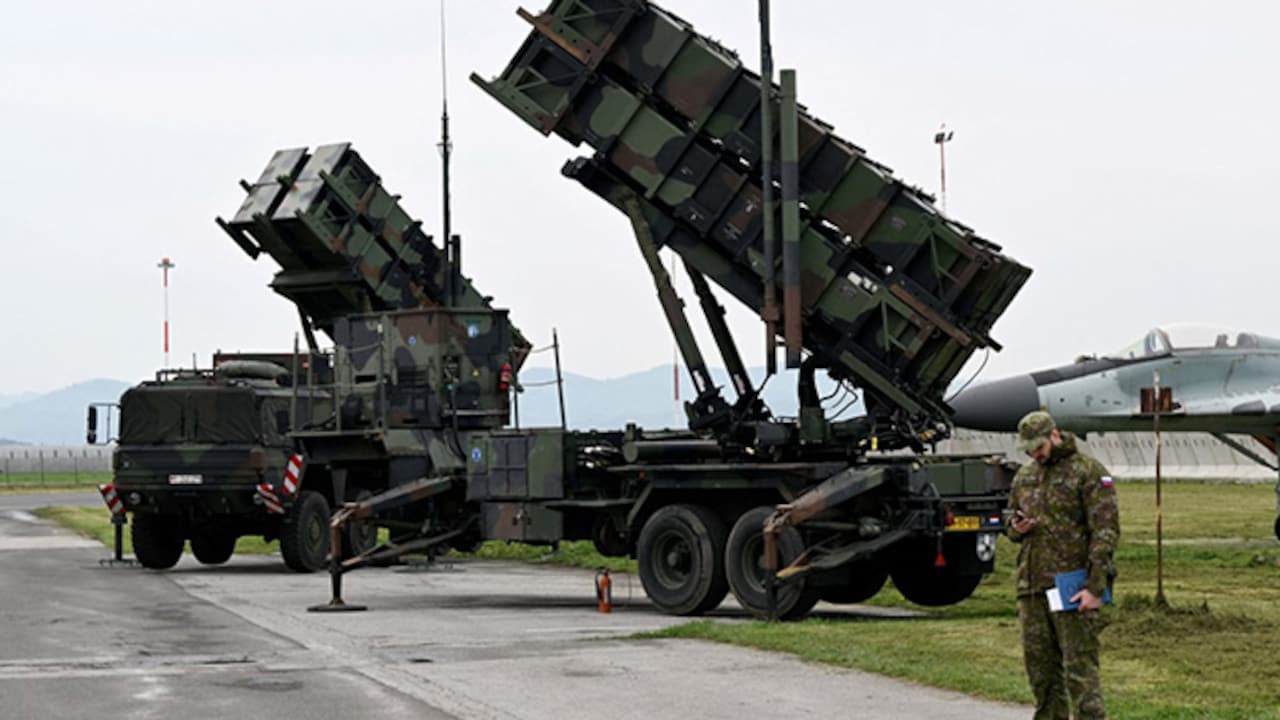
When Volodymyr Zelenskyy stepped away from the secure line, his face carried the weariness of a man who has spent a thousand nights measuring time not in hours, but in incoming missile warnings. The news from across the Atlantic was not merely a diplomatic update. It was a pivot point. Donald Trump, back in the sprawling theater of American political gravity, had reportedly made a final decision on a question that had lingered like smoke over every allied capital for months: the path was cleared for Ukraine to acquire and manufacture Patriot missile systems.
To understand the weight of this moment, you have to forget the sterile terminology of defense contracts and geopolitical chess. You have to look at the sky.
For over three years, civilians in cities like Kharkiv, Odesa, and Kyiv have lived under a cruel arithmetic. A siren sounds. A phone app pings with a red banner. You have minutes—sometimes seconds—to decide whether your basement is deep enough, whether your children’s school has reinforced concrete, or whether today is simply a matter of statistical luck. The missiles screaming down from the stratosphere are not simple artillery shells; they are hypersonic darts designed to outrun human reflexes.
Against that kind of speed, conventional air defense is like trying to catch a falling cleaver with a butterfly net.
Enter the Patriot.
To the engineers who built it, the Patriot battery is a marvel of phased-array radar and guidance computers. To the soldier standing beside its launch canister in the freezing wind, it is something much simpler: a very narrow window of survival. Each launcher is a towering promise, a multi-million-dollar pillar of high-altitude defense that can track dozens of incoming threats simultaneously and pick them out of the sky with terrifying mathematical precision.
Yet, for a long time, the Patriot was wrapped in a labyrinth of hesitation. Every battery deployed was a nervous diplomatic negotiation, a delicate dance between deterring escalation and preventing catastrophic devastation. Western capitals worried over red lines drawn in shifting sand. Every month of delay was written in shattered glass and empty school desks.
Now, the landscape of that hesitation has shifted. Trump’s reported green light—unorthodox, transactional, and entirely characteristic of his singular approach to foreign policy—cuts through the bureaucratic fog. It replaces endless committee reviews with a blunt reality: the capability is unlocked.
But unlocking the technology is only the first act of a very long play.
Consider what happens next on the ground. You cannot simply drop a Patriot battery into a muddy field like a tent and expect it to work. It requires a small city of specialists: radar operators who can interpret electronic ghosts in milliseconds, maintenance crews who can fix micro-fractures in hydraulic lines while sub-zero winds bite at their fingers, and supply chains that stretch across half the globe.
This is where the human element collides with cold industrial logistics. Ukrainian engineers and technicians have proven themselves astonishingly adept at mastering complex Western hardware at warp speed. They have learned to patch German-supplied Gepards and American-supplied HIMARS with the frantic ingenuity of people fixing a sinking boat while still in the middle of a storm. Adapting to the full ecosystem of advanced missile defense requires an entirely new tier of institutional muscle.
And then there is the economic reality. These interceptor missiles are astonishingly expensive. Every time a Patriot battery fires to swat down a barrage of cheap, Iranian-designed drones or supersonic cruise missiles, an invisible ledger is balancing cost against human lives. It is an unsustainable financial imbalance if borne by one nation alone. Which is precisely why the conversation has quietly evolved toward domestic co-production, foreign financing, and creative industrial partnerships. If Ukraine can manufacture components, repair systems locally, and sustain its own shield, the dynamic changes from perpetual dependency to hardened resilience.
Critics will point to the political friction, the unpredictable shifts in Washington, and the sheer escalation risks inherent in supplying top-tier offensive and defensive weaponry to a frontline state. They are not wrong to look at the map with caution. Every escalation breeds a counter-escalation. The shadow of the broader confrontation between nuclear powers never truly lifts from the room.
Yet, spend an hour talking to a mother waiting out an air raid in a damp subway station, and the abstract debates over geopolitical escalation tend to burn away into ash. To her, escalation is not a political theory; it is the sound of the roof caving in. When the tools to stop the falling metal are finally authorized, the only relevant question is how fast they can be bolted into place.
History is rarely made in grand, sweeping declarations in sunlit halls. More often, it is forged in the dark, over cold coffee, by leaders wrestling with terrible choices and soldiers waiting for the next blip on a green radar screen.
The iron bargain has been struck. The batteries are coming. But the true test will not be written in Washington or debated on television cable networks. It will be decided in the quiet, tense seconds between the sound of the siren and the blinding, beautiful flash of an interceptor rising to meet the dark.