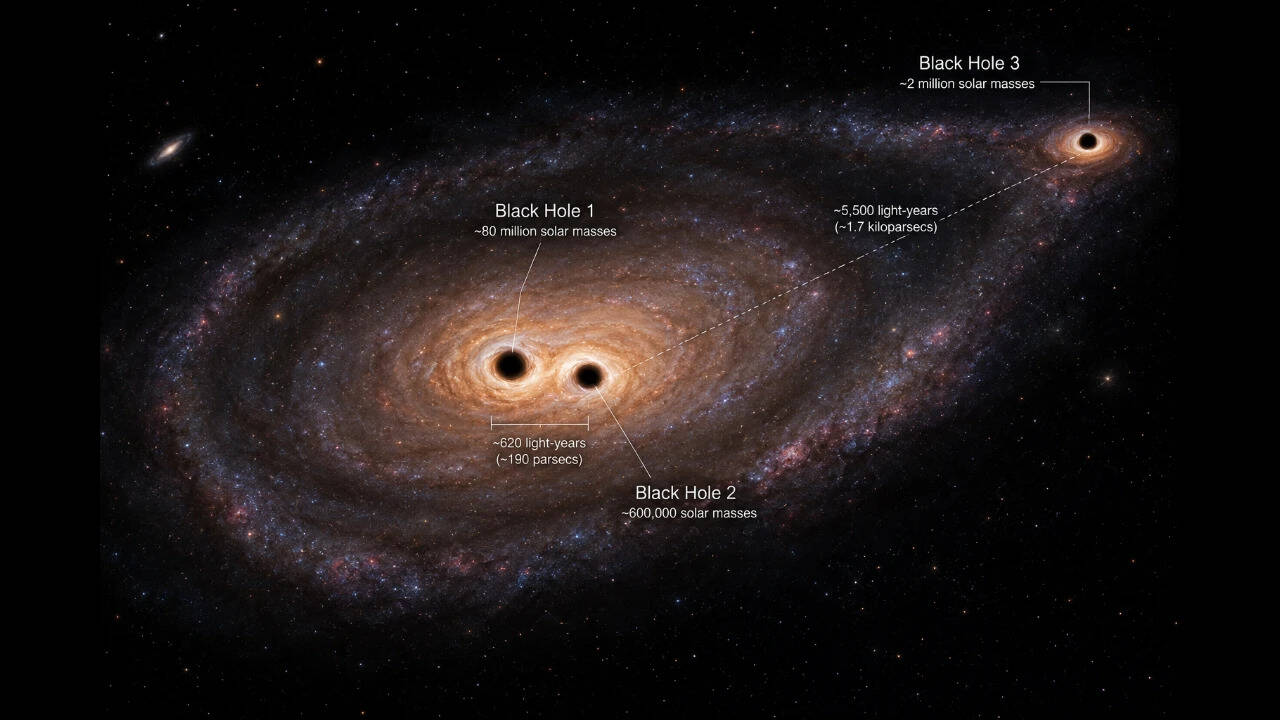
The universe was never supposed to spawn monsters this early. When astronomers pointed the James Webb Space Telescope deep into the cosmic dark, they expected to find the faint, struggling seeds of infant galaxies stumbling toward maturity. Instead, they found heavy metal.
Deep within an ancient system known as JADES-GS-z13-0, the infrared eye of humanity's most expensive machine detected three supermassive black holes packed tightly together. They formed less than a single billion years after the Big Bang, a cosmic epoch where standard astrophysics dictates that entities of this magnitude simply cannot exist. If you enjoyed this article, you might want to read: this related article.
Standard cosmology rests on a comfortable, orderly timeline. Gas cools, stars ignite, galaxies merge over billions of years, and the massive gravitational wells at their centers slowly feed on dust and stellar debris to become behemoths millions or billions of times the mass of our Sun. That slow-growth model is officially broken. Finding three fully formed galactic engines packed into a pocket of the early universe forces a brutal reckoning with how structure first assembled in the cosmos.
The Timeline Problem That Keeps Astrophysicists Awake
Mathematics has no patience for miracles. When you calculate the Eddington limit—the absolute maximum rate at which a black hole can consume matter before its own radiation pressure pushes the surrounding fuel away—growth has a hard speed limit. For another angle on this event, refer to the recent update from Wired.
To reach masses exceeding a million solar weights when the universe was only four to five hundred million years old, these objects had to bypass normal evolutionary channels entirely. They did not grow up. They were born huge.
This discovery shatters the traditional hierarchy of cosmic formation. For decades, the academic consensus assumed that stars came first, supernova remnants came second, and supermassive black holes arrived fashionably late as the culmination of billions of years of mergers. The JADES-GS-z13-0 observations flip that sequence entirely on its head. The anchors appear to have dropped before the ships were even built.
Inside the Observation Data
The data returned by the Near-Infrared Spectrograph aboard the space observatory is uncompromising. Researchers are not looking at blurry artifacts or statistical anomalies. They are reading unmistakable emission lines from gas swirling at nearly the speed of light around three distinct gravitational epicenters.
The proximity of these three objects is just as disturbing as their mass. They are not isolated titans sitting in the middle of vast, empty voids. They are crowded into a space smaller than the distance between neighboring galaxies in our local group.
Imagine walking into a nursery and finding three fully grown adult silverback gorillas crammed inside a crib built for premature infants. That is the spatial and temporal reality of this triple system. The gravitational interaction between them must be violently chaotic, tearing gas clouds apart and funneling raw material into their respective maws at rates that defy standard hydrodynamic models.
How Seed Black Holes Bypass the Rules
If standard accretion cannot build these objects in time, alternative physics must step into the light. Theorists are now dusting off models that were once dismissed as science fiction.
The leading alternative is the heavy seed hypothesis. Instead of starting from the collapse of the first generation of massive stars, these titans might have originated from the direct collapse of massive primordial gas clouds. When the universe was young, pristine hydrogen and helium pools could grow immense without the cooling interference of heavier elements like carbon or oxygen.
When these massive primordial clouds destabilized, they did not shatter into millions of individual stars. They collapsed instantly into dense pockets with masses equivalent to thousands or tens of thousands of suns.
Even with a heavy head start, pushing those seeds to supermassive status within a few hundred million years requires continuous, high-density feeding frenzies. The dense environment of the early universe provided that fuel in abundance, acting like a cosmic firehose pumping matter straight into the dark hearts of these ancient galaxies.
What This Means for the Rest of the Cosmos
We are witnessing a paradigm shift in real-time. Every textbook published before the deployment of the James Webb Space Telescope is now functionally obsolete regarding the first billion years of cosmic history.
This is not an isolated incident. As astronomers peer deeper into the infrared spectrum, more of these impossible structures keep appearing. The universe is teeming with ancient heavyweights that refuse to respect the timeline we constructed for them.
The search is now on to find the even earlier precursors. If three supermassive black holes can operate in tight quarters at that redshift, they represent a symptom of a much broader, highly efficient mechanism for mass concentration that we have entirely missed.
The dark side of the universe is far more aggressive, and far more organized in its infancy, than our brightest minds ever dared to calculate.