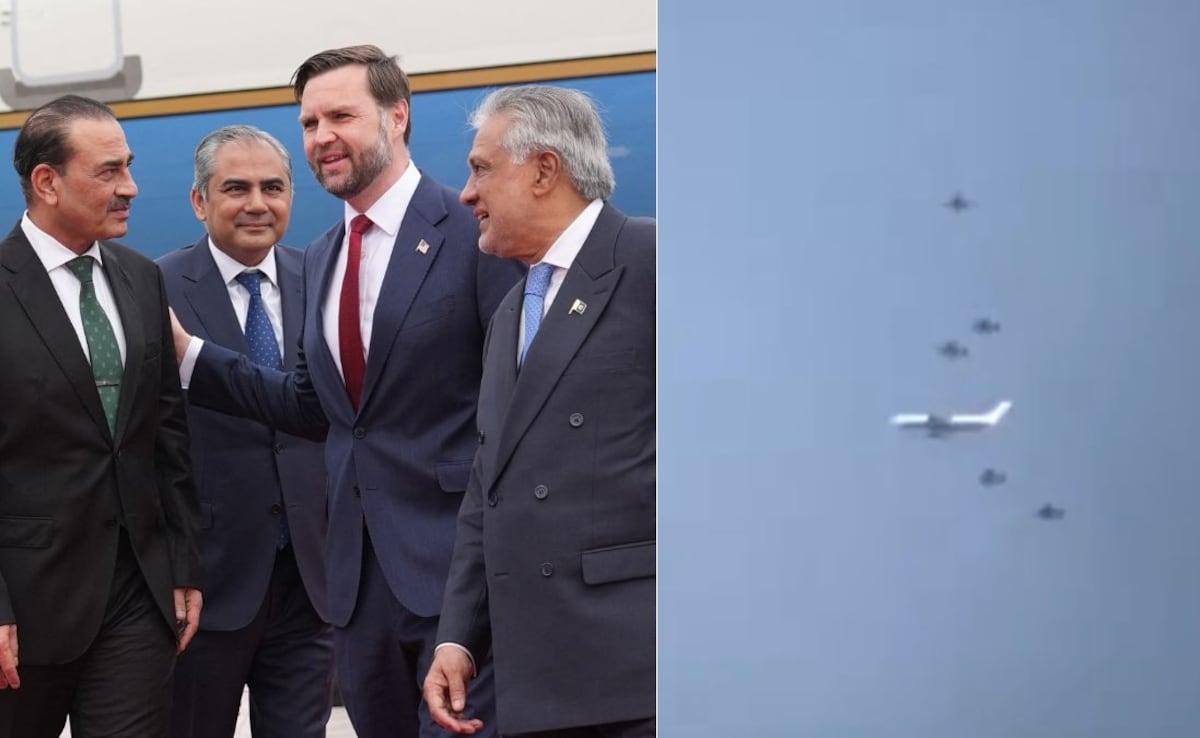
The sight of Pakistani F-16s flanking a modified Boeing 737 carrying the Vice President-elect isn't a sign of ironclad bilateral security. It is a desperate PR stunt by a cash-strapped military establishment trying to prove it still matters in a world that has largely moved on.
Mainstream outlets are salivating over the "high-stakes" optics of JD Vance landing in Islamabad for talks regarding Iran. They see the roar of the Pratt & Whitney F100 engines as a symbol of regional stability. They are wrong. What we are actually witnessing is a relic of the Cold War being used as a backdrop for a diplomatic mission that faces near-certain failure before the first handshake.
The Myth of the Iron Escort
Standard reporting suggests that providing a fighter escort is a supreme gesture of honor and security. In reality, it is an expensive, unnecessary drain on a defense budget that Pakistan can ill afford. From a tactical standpoint, an F-16 escort for a VIP transport in friendly, controlled airspace provides zero additional safety against modern threats like MANPADS or sophisticated electronic warfare.
If there were a legitimate kinetic threat to the Vice President-elect’s aircraft, two F-16s flying in close formation would be little more than extra targets. Real security happens in the radar bands and the intelligence cycles weeks before the wheels touch the tarmac. This is "security theater" at 30,000 feet, designed specifically for the cameras and the domestic Pakistani audience.
I have spent years analyzing regional defense procurement. I’ve seen officials burn through a month's worth of jet fuel just to ensure a specific photo op makes the evening news. The F-16s themselves—block 52 models that the U.S. essentially monitors via strict end-use monitoring (EUM) agreements—are the ultimate irony. Pakistan is using American technology to escort an American leader to discuss an Iranian regime that the U.S. is trying to isolate.
The Iran Problem Nobody Wants to Admit
The "lazy consensus" among the press corps is that Pakistan serves as a "bridge" to Tehran. This is a fundamental misunderstanding of the sectarian and political friction in the region.
- The Saudi Factor: Pakistan cannot move an inch toward Iran without checking the pulse of Riyadh.
- The Baluchistan Border: The frontier between Iran and Pakistan is a chaotic mess of insurgent groups. They aren't "talking"; they are barely containing a low-boil conflict.
- The Sanctions Reality: No matter what JD Vance discusses in Islamabad, the U.S. Treasury Department holds the actual cards.
Asking Pakistan to mediate with Iran is like asking a neighbor who is currently fighting a kitchen fire to help you negotiate a real estate deal three blocks away. It looks busy, but it produces nothing.
F-16s Are a Distraction From Tech Obsolescence
While the world stares at the sleek lines of the Fighting Falcon, the actual "great game" has shifted to the electromagnetic spectrum and autonomous systems.
The Pakistani Air Force (PAF) is clinging to its F-16 fleet because it represents the last vestige of Western-tier prestige. However, in the context of the modern Iranian threat or the rise of drone swarms, these jets are becoming increasingly irrelevant. If the goal of the Vance visit was truly about regional security, we should be talking about integrated air defense networks and cyber-security cooperation, not 1970s airframe designs.
People often ask: "Does the F-16 escort show that the U.S.-Pakistan relationship is back on track?"
The answer is a resounding no. It shows that both sides are comfortable with a status quo that prioritizes optics over outcomes. The U.S. gets a shiny video of its leader being protected; the Pakistani military gets to show its taxpayers that it still has the keys to the American tech shed.
The Cost of the Stunt
Let’s talk numbers. The flight hour cost for an F-16 is roughly $8,000 to $10,000. For a multi-jet escort, including the scramble, loitering time, and recovery, you are looking at a six-figure bill for a five-minute video clip.
In a country currently navigating an IMF-mandated austerity path, this is a fiscal middle finger to the population. It’s the geopolitical equivalent of buying a Ferrari when you can’t pay the rent, just so the neighbors think you’re still rich.
Why Vance is the Wrong Messenger
JD Vance’s "America First" pedigree suggests a pivot toward isolationism or, at the very least, a radical pragmatism. Sending him to Islamabad to talk about Iran is a contradiction. If the goal is to reduce American involvement in foreign entanglements, why start by engaging in a diplomatic dance with two of the most complicated actors in the Middle East and South Asia simultaneously?
The contrarian truth is that the U.S. doesn't need a mediator for Iran. It needs a clear policy. Using Pakistan as a middleman only adds layers of obfuscation and allows Tehran to play both sides.
The Mirage of Stability
The media wants you to believe this is a "pivotal" moment. It isn't. It is a choreographed performance.
- The Arrival: The jets peel off.
- The Handshake: Standard platitudes about "mutual interests."
- The Departure: No signed treaties, no change in Iranian proxy behavior, and a massive fuel bill.
If you want to understand the reality of the situation, ignore the cockpit footage. Look at the trade balances. Look at the energy pipelines that aren't being built. Look at the drone strikes that continue regardless of who is being escorted by F-16s.
We are watching a high-definition broadcast of a ghost relationship. The F-16s are real, the fuel they burn is real, but the diplomatic weight they are supposed to represent is a vacuum.
Stop falling for the roar of the engines. Start looking at the silence in the actual negotiations. The escort isn't a sign of strength; it’s a noisy mask for a vacuum of influence.
The next time you see a fighter jet flanking a diplomat, ask yourself why they need so much theater to sell a script that hasn't changed in thirty years.