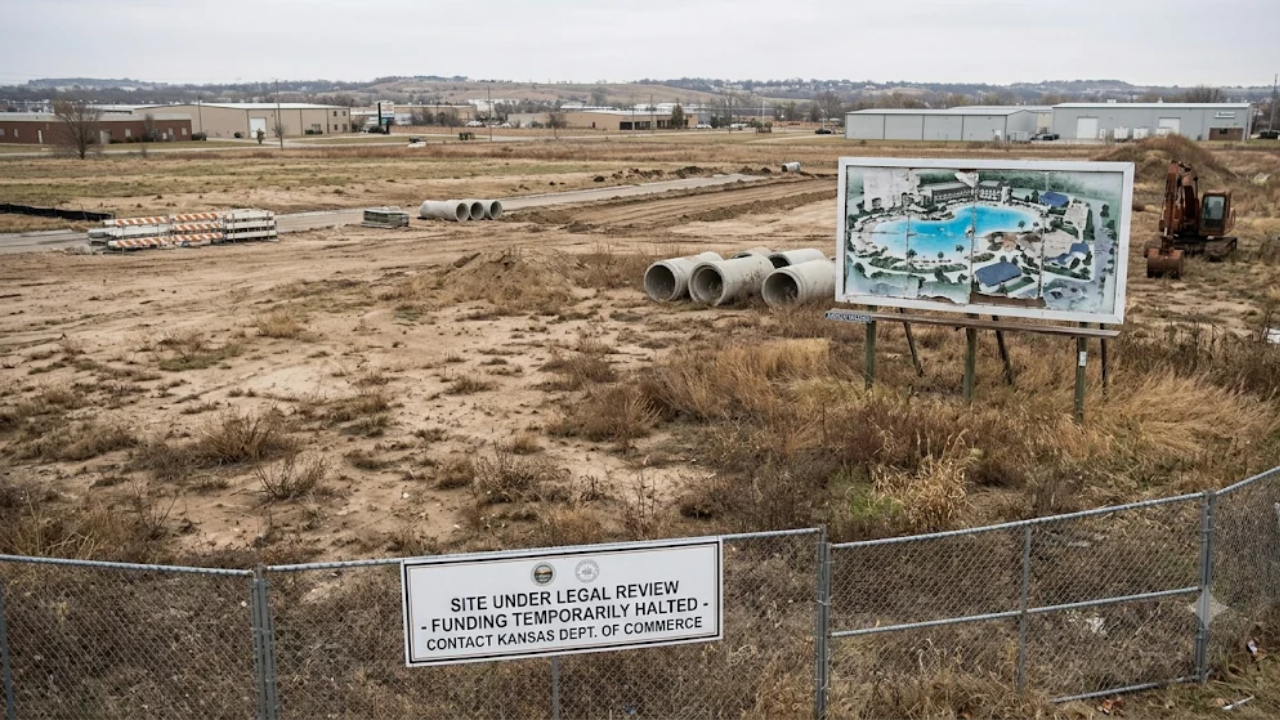
Everyone loves a good public-money scandal. You see the headline about Kansas moving to halt funding for a $160 million lagoon resort that still has zero buildings standing, and your blood pressure spikes. Taxpayers getting fleeced. Developers dragging their feet. Dirt sitting empty while bureaucrats write checks.
It is an easy story to write. It is also completely missing the point.
If you look at the conventional coverage of the Kansas STAR bond dispute—specifically the legal pushback against delayed commercial developments like the massive Crystal Lagoons-anchored projects in the Midwest—you will find the same lazy consensus repeated ad nauseam. Reporters point at an empty lot, look at the calendar, and scream fraud or incompetence. They treat a nine-figure, multi-phase water-anchored real estate development like a suburban strip mall that should have been framed out in six months.
They are wrong. The real story is not that the buildings aren't up yet. The real story is how states fundamentally misunderstand capital stacks, infrastructure sequencing, and the brutal math of modern hospitality finance.
The Empty Lot Illusion
Let’s dismantle the biggest visual lie in commercial real estate journalism: the "nothing is built yet" photograph.
When a municipality or state backs a massive mixed-use project using Sales Tax and Revenue (STAR) bonds—Kansas’s favorite, and most controversial, economic development weapon—the public expects immediate vertical construction. People want to see steel beams and drywall. When they see graders pushing mud around for two years, they assume the developer pocketed the cash and fled to the Caymans.
Here is the reality of heavy civil engineering. Before a single hotel room or retail storefront can go vertical around a multi-acre synthetic lagoon, you have to build an artificial ecosystem underground.
We are talking about:
- Massive geotechnical soil stabilization so millions of gallons of water don't sink into the Kansas prairie.
- High-capacity filtration pump houses and proprietary chemical-treatment conduits.
- Deep-trench municipal water, sewer, and high-voltage electrical trunks capable of supporting a small city.
- Stormwater retention basins engineered to handle hundred-year Midwest flash floods without contaminating the main water feature.
This horizontal infrastructure routinely eats 30% to 45% of a project’s initial capital expenditure and takes 18 to 36 months before a single concrete slab for a building is poured. I’ve watched municipalities panic at month twenty-four of dirt work, pull the plug on bond disbursements, and end up owning a half-dug pit that costs ten million dollars just to fill back in so kids don't drown in it.
Suing to halt funding when a project is stuck in the dirt phase doesn't save taxpayers money. It guarantees the state is left holding a worthless hole in the ground instead of a revenue-generating asset.
Why STAR Bonds Are Flawed By Design
Does this mean the developers are blameless saints? Hardly.
If you want to attack this deal, stop whining about the construction timeline and look at the mechanism Kansas used to finance it. STAR bonds are an inherently distorted financial instrument, and both the state and the developers walked into a trap they built together.
How STAR Bonds Actually Work
Unlike traditional municipal bonds backed by the general taxing power of a city, STAR bonds are paid off strictly through the new sales tax revenue generated within a designated district. On paper, it sounds risk-free for the average taxpayer. No new sales, no tax burden on locals.
In practice, it creates a perverse incentive structure:
- Hyper-Inflated Projections: To get the bonds issued, developers and their hired consultants must project astronomical retail and hospitality spending. Nobody gets $160 million in bond authority by promising modest, realistic foot traffic.
- The Retail Cannibalization Trap: In states like Kansas, a massive chunk of "new" sales tax revenue inside a STAR bond district isn't new economic activity at all. It is just locals driving twenty minutes east to buy their groceries, eat dinner, and shop at the new development instead of the old mall down the highway.
- The Anchor Dependency: A lagoon resort isn't a standalone business; it’s a loss-leader magnet. The lagoon itself rarely turns a high margin. It exists solely to justify higher room rates at the adjacent hotels and higher rents for the surrounding restaurants.
When interest rates exploded between 2022 and 2025, the private debt required to build those vertical hotels and restaurants suddenly doubled in cost. Developers couldn't close their private construction loans, even though the public bond money for the infrastructure was sitting there waiting.
So the project stalled right at the transition from horizontal dirt to vertical steel. Kansas officials looked at the calendar, saw missed statutory milestones, and reached for a lawsuit.
The Brutal Math of Post-2023 Hospitality Finance
Let’s look at what the mainstream coverage completely ignores: the capital stack freeze.
Imagine a scenario where you are a master developer in 2021. You pitch a $160 million lagoon resort. Debt is cheap—floating around 3.5% to 4%. Construction materials are spiking, sure, but institutional lenders are throwing money at "experiential real estate" because everyone believes post-pandemic consumers only care about vacations and outdoor amenities.
Fast forward to the actual construction window. Construction lending rates hit 8.5% to 10%. Regional banks—the exact lenders who finance mid-market hotels and retail pads in states like Kansas—pull back entirely due to commercial real estate exposure on their balance sheets.
Suddenly, your financial model is upside down. The public STAR bond money covers the lagoon and the roads, but the private equity and senior debt needed to build the 300-room resort hotel won't pencil out unless you inject another $30 million in cash equity.
You go back to your equity partners. They stall. You try to re-engineer the hotel to cut costs without violating the development agreement you signed with the state. That takes nine months of architectural revisions and municipal permitting reviews.
Meanwhile, the Attorney General’s office or state commerce department looks at the original contract, sees that you missed your "substantial completion" benchmark, and files a lawsuit to claw back or freeze the public funds.
That is not a simple story of developer greed. That is a textbook collision between rigid government contract timelines and violent macroeconomic shifts.
Answering the Questions Nobody Wants to Ask
When news like this breaks, the public immediately jumps to a few predictable questions. Most of them are built on a flawed premise.
"Why doesn't the state just take the money back and spend it on schools or roads?"
Because that money doesn't exist in a checking account waiting to be spent on textbooks. STAR bonds are future tax revenue diversions, not cash grants pulled from the state’s general fund. Halting the bond issuance or freezing the project doesn't free up $160 million for public schools; it simply kills the mechanism that would have captured future sales taxes from that specific plot of land. You can't spend sales taxes that never get generated.
"Shouldn't developers use 100% of their own money for private resorts?"
In a pure free-market fantasy, yes. In actual American real estate development, almost zero large-scale destination resorts get built without public-private infrastructure partnerships. Cities compete aggressively for tourism dollars. If Kansas refuses to subsidize the dirt work and water infrastructure, the developer takes the exact same pitch deck to Texas, Missouri, or Oklahoma—states that will happily hand over Tax Increment Financing (TIF) or sales tax rebates to steal the tourism revenue.
"Is a giant man-made lagoon even viable in the Midwest?"
This is the one question where the skeptics actually have a point, and it’s the one thing the lawsuit won't fix.
Crystal lagoons work brilliantly in year-round warm climates like Florida, Texas, or Southern California. In Kansas, you are dealing with hard freezes, high winds, and a five-month outdoor swimming window. Developers pitch "year-round waterfront ambiance" and heated indoor-outdoor pools to justify the investment, which sounds great in a glossy brochure.
However, operating a multi-acre open-air water feature through a brutal plains winter requires massive ongoing maintenance budgets. If the surrounding retail and hotel density isn't built at full scale, the lagoon becomes an expensive, freezing albatross that drains the project's operating reserves before summer even arrives.
The Real Mistake Kansas Made
If state officials wanted to protect taxpayers, filing a lawsuit years into the process is the worst possible play. Litigation freezes the asset completely. No private bank on earth will lend a dime to a development currently being sued by the state government that issued its bonds. By suing to halt funding, the state didn't protect its investment; it actively destroyed the developer's ability to secure the private financing needed to finish the buildings.
Here is how smart municipalities actually structure these deals so they never end up in court looking foolish:
- True Pay-As-You-Go Disbursements: Never release bond proceeds based on projected dirt work or promises of future vertical construction. Tie every single dollar of public reimbursement to issued Certificates of Occupancy on the revenue-generating buildings. No open hotel doors, no bond payouts.
- Clawback Escrows Over Lawsuits: Instead of relying on slow, value-destroying litigation when milestones are missed, require developers to post irrevocable letters of credit or cash completion bonds upfront. If they miss a deadline, the state draws on the bank guarantee immediately without tying the land up in court for three years.
- Kill the Retail Cannibalization: Stop approving STAR bond districts that rely on standard big-box retail and chain restaurants to pay off the debt. If the project isn't pulling at least 60% of its visitors from outside a 100-mile radius, it isn't a destination—it’s just subsidized local sprawl.
The Downside of Standing Your Ground
Let’s be honest about the flaw in my own argument. If states give developers endless grace periods every time interest rates spike or supply chains hiccup, you create massive moral hazard. Developers will chronically underbid, overpromise, and treat public deadlines as polite suggestions, knowing the state is too terrified of an empty lot to ever pull the plug.
At some point, a government has to enforce its contracts, or the contracts aren't worth the paper they're printed on. If a developer signed an agreement promising vertical buildings by a hard date and failed to deliver, the state has every legal right to pull the funding.
Legal right and financial competence are two very different things.
Right now, Kansas has traded a delayed construction schedule for a guaranteed legal stalemate. The lawyers will bill millions, the dirt will sit untouched for another two years while motions bounce around district court, and the surrounding private capital will pack its bags and move to a state with fewer headaches.
When the dust finally settles, the taxpayers won't have a $160 million resort, and they won't have their money back. They will just have a fenced-off mud pit and a stack of legal bills.



