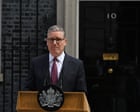
Winning a 411-seat majority in the House of Commons is supposed to buy a British prime minister at least five years of absolute political security. Keir Starmer got less than two. His resignation outside 10 Downing Street on June 22, 2026, marks one of the most spectacular collapses in modern political history.
How does a leader go from a historic landslide victory to the political exit ramp so fast?
The truth is that Starmer’s downfall wasn’t an overnight accident. The cracks were baked into his victory from the very beginning. His spectacular collapse provides a brutal object lesson in what happens when a government mistakes voter exhaustion with the opposition for a genuine mandate for change.
The Loveless Landslide
Look at the raw numbers from the July 2024 general election. The seat count suggested absolute dominance, but the popular vote told a completely different story. Labour took power with just 34% of the vote. That is a lower share than Jeremy Corbyn achieved in 2017 when Labour lost.
Voters didn't fall in love with Starmer’s vision. They simply wanted to punish the Conservatives after 14 years of compounding chaos, Boris Johnson’s scandals, and Liz Truss’s mini-budget meltdown. Starmer walked into Downing Street with a historic parliamentary majority built on a foundation of sand.
When a prime minister lacks deep public affection, they have no political capital to spend when things get rough. Without an ideological core or a passionate base of support, Starmer’s polling numbers collapsed the moment his government faced its first real policy tests. By late 2025, his net approval rating plummeted to an unprecedented -46%. By January 2026, YouGov tracked his favorability down to a dismal -57%, a depth of unpopularity previously reserved only for Liz Truss.
Missteps and Freebies
A major part of the problem was the immediate contrast between Starmer’s promised "government of public service" and the messy reality of his administration.
The trouble began with basic lapses in political judgment. Starmer accepted thousands of pounds worth of high-end personal gifts, including designer spectacles and luxury Taylor Swift concert tickets. While not illegal, the optics were disastrous for a leader who had spent years hammering the previous administration for entitlement and sleaze.
Things got worse when these personal perks coincided with severe fiscal decisions. Chancellor Rachel Reeves quickly moved to axe winter fuel payments for millions of pensioners, citing a multi-billion-pound fiscal black hole left by the Tories. Forcing older citizens to choose between heating and eating while the prime minister accepted free luxury clothing killed the government’s moral authority before its first hundred days were up.
Subsequent policy shifts and clumsy attempts to slash welfare spending triggered open rebellions among his own backbenchers. Labour MPs, many of whom held volatile seats with incredibly slim majorities, grew increasingly terrified of their own constituents. They watched the anti-immigration Reform UK party steadily rise in the polls, eating directly into Labour’s working-class heartlands.
The Mandelson Calamity
If welfare disputes and free tickets weakened Starmer, it was his decision to appoint Peter Mandelson as the UK’s ambassador to the United States that definitively shattered his leadership.
Mandelson, the veteran political operator nicknamed the "Prince of Darkness," was brought back to help Starmer navigate a highly unpredictable international environment, specifically dealing with Washington during Donald Trump’s second term. Mandelson’s deep trade expertise and high-level global networking were viewed by Downing Street as indispensable assets.
The appointment backfired catastrophically. In September 2025, unsealed documents exposed the deep, historic nature of Mandelson's ties to convicted sex offender Jeffrey Epstein. The documents revealed that Mandelson had remained close with Epstein long after the financier’s 2008 conviction for offenses involving a minor.
Starmer fired Mandelson immediately in September 2025, but the damage was done. The scandal intensified in January 2026 when subsequent leaks alleged that Mandelson had shared sensitive, market-moving government information with Epstein back in 2009 while serving in a previous Labour cabinet. Mandelson was subsequently detained and questioned by police on suspicion of misconduct in public office.
The final, fatal blow dropped in April 2026. Reports emerged showing that UK Security Vetting had actually denied Mandelson a security clearance back in January 2025. Starmer had bypassed the official security warnings to push the appointment through anyway.
For an electorate and a parliamentary party already exhausted by Starmer's tanking poll numbers, this was the end. The man who campaigned on strict competence, forensic detail, and clean government had committed a catastrophic error of judgment.
The Regional Revolt
The political consequences of these compounding crises arrived swiftly in the May 2026 local and regional elections. The results were an unmitigated disaster for Labour.
Nigel Farage’s Reform UK routed Labour across municipal councils, while opposition leader Kemi Badenoch’s Conservatives saw a steady stabilization in their polling fortunes. Panic turned into active rebellion inside the Labour Party. Scottish Labour leader Anas Sarwar publicly called for Starmer to resign, openly stating that the prime minister’s leadership had become a toxic distraction that was actively sabotaging the party's future.
The internal collapse accelerated rapidly from there:
- On May 14, 2026, Health Secretary Wes Streeting resigned from the cabinet, using his exit letter to openly call for a new leadership election.
- The same day, a tactical vacancy was created in the safe seat of Makerfield when sitting MP Josh Simons stepped down.
- This vacancy allowed Andy Burnham, the highly popular former Mayor of Greater Manchester, to easily contest the subsequent by-election and return to Parliament.
Burnham had long been the public’s clear favorite to replace Starmer, consistently outperforming the prime minister on measures of competence, likeability, and providing hope for the future. With Burnham successfully back on the green benches at Westminster, Starmer’s position became entirely untenable. Recognizing that nearly half of the public and a massive portion of his own cabinet wanted him gone, Starmer walked out to the Downing Street podium to announce his exit.
Survival Guide for the Next Leader
The next Labour leader, whether it is Andy Burnham or another challenger emerging from the upcoming leadership contest, inherits a deeply fractured party and a cynical electorate. Turning this around requires an immediate, total shift in strategy.
Stop managing the country like a corporate legal firm. Starmer treated politics like a series of court cases to be won on technicalities. It alienated voters. The next prime minister must communicate a clear, optimistic vision for Britain’s economic future that extends beyond mere fiscal tightening and belt-weaving.
Rebuild trust through transparent governance. The Mandelson vetting scandal proved that voters will not tolerate backroom political fixes that bypass established integrity procedures. Stick to the rules you promise to enforce on everyone else.
Address the threat on the flanks. Labour lost its grip because it ignored the economic anxieties of working-class voters who migrated to Reform UK. The government must deliver tangible improvements to public services, local infrastructure, and the cost of living crisis, rather than focusing purely on Westminster policy white papers.
The 2024 landslide was a rejection of the Tories, not an endorsement of Labour. Starmer forgot that basic reality, and it cost him the premiership.


