The introduction of turbojet-powered loitering munitions into European airspace marks a fundamental shift in the cost-to-attrition calculus of modern air defense. Conventional counter-unmanned aerial systems (C-UAS), optimized for low-speed, propeller-driven platforms, face structural obsolescence when confronted with munitions operating at triple the velocity. Deconstructing this shift requires an examination of kinetic physics, sensor architecture limitations, and the systemic bottlenecks governing capital allocation in modern defensive operations.
The Kinematics of Acceleration
Traditional propeller-driven drones, exemplified by baseline Iranian-designed models, typically cruise at speeds between 150 and 180 kilometers per hour. This velocity profile enables a wide defensive response window, permitting engagement by acoustic sensors, optical tracking, and distributed mobile fire groups equipped with heavy machine guns or light cannon systems.
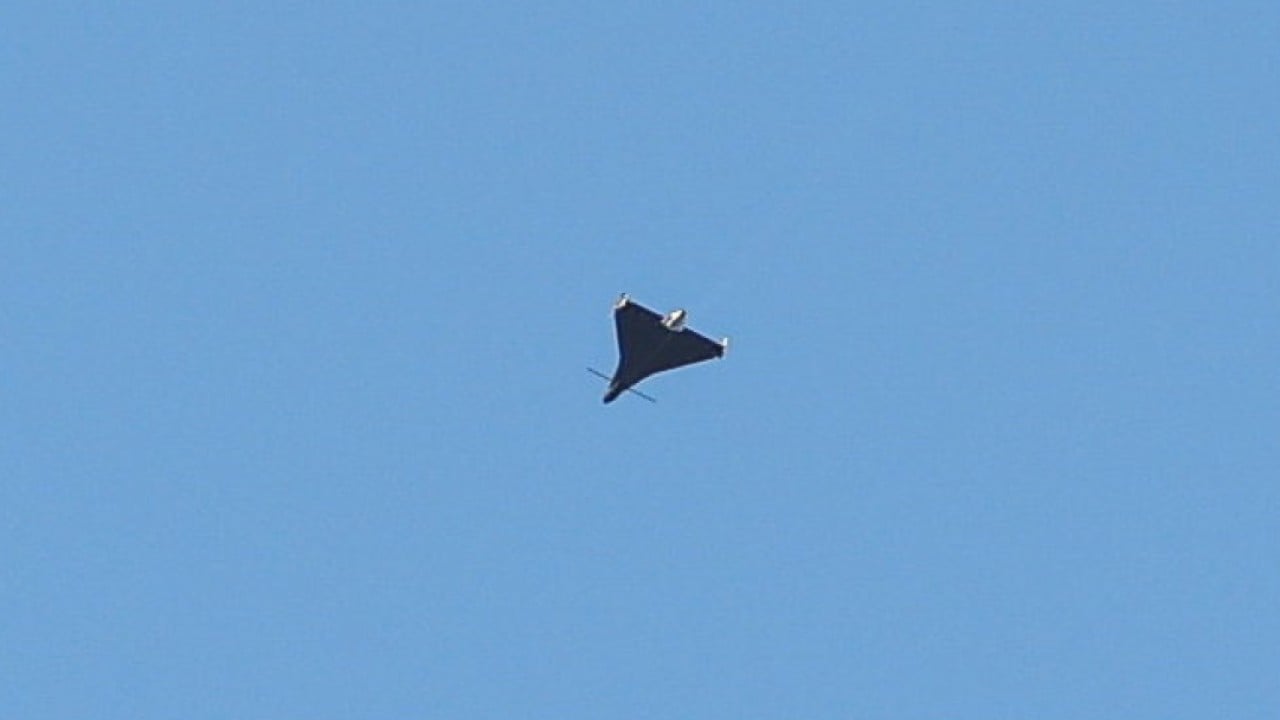
The integration of turbojet propulsion into platforms such as the Geran-5 series alters this paradigm entirely. Operating at speeds approaching 600 kilometers per hour, these assets compress the operational timeline across every phase of the kill chain:
- Detection Latency: Radar cross-sections remain modest, but the velocity vector dramatically reduces the time-to-target upon horizon clearance.
- Tracking Complexity: High angular velocity rates saturate traditional electro-optical and infrared tracking gimbals, requiring predictive lead algorithms typically reserved for cruise missile defense.
- Engagement Window: Mobile fire groups experience a contraction of their firing arc from minutes to seconds, rendering manual sighting systems largely ineffective.
Consequently, interception rates drop significantly. While Ukrainian military authorities report baseline interception efficiencies exceeding 90 percent against slow propeller systems, success rates against jet-powered variants contract toward the 55 to 70 percent band. This delta represents the direct operational penalty exacted by velocity.
The Sensor Integration Bottleneck
Defending distributed territorial infrastructure against high-speed, low-altitude vectors relies on persistent, wide-area telemetry. This requirement exposes dependencies on commercial and military-grade satellite communication architectures, notably low-Earth orbit constellations.
When network operators impose operational velocity or bandwidth restrictions—such as the speed caps implemented on military-grade variants of satellite internet systems—the degradation cascades directly into the tactical command-and-control layer:
- Data Backhaul Failure: Real-time telemetry required to cue interceptor assets experiences packet loss or latency spikes.
- Decentralized Fragmentation: Mobile intercept teams operating without continuous situational awareness revert to isolated, line-of-sight engagement, losing the force-multiplier effect of networked radar data.
- Early Warning Deficits: Without predictive vector data transmitted prior to horizon breach, air defense units are forced into reactive postures, increasing expenditure of high-cost surface-to-air missiles against targets meant for cheaper kinetic disposal.
This friction illustrates a broader principle of asymmetric warfare: minor administrative or technical adjustments to critical third-party infrastructure can induce disproportionate degradation in sovereign defensive networks.
The Attrition Cost Function
Beyond immediate tactical interception metrics lies the macro-economic reality of defense procurement. The conflict has evolved into a war of industrial output, where the primary constraint is not merely tactical courage, but financial and manufacturing throughput.
Jet-powered loitering munitions carry a higher bill of materials than their piston-driven predecessors, primarily due to the inclusion of turbojet engines—frequently sourced through global supply chains—and advanced guidance electronics. However, their cost remains a fraction of the traditional air defense interceptor missiles required to neutralize them reliably.
When state actors scale production to thousands of units monthly, the economic equation pressures the defender's inventory depth. If a defender must expend a scarce, high-tier missile to destroy a jet drone, the long-term expenditure curve favors the attacker. This financial asymmetry forces defenders to adopt a tiered mitigation strategy:
- Tier One: Pre-emptive strikes on manufacturing plants, supply chains, and forward launch infrastructure to disrupt production loops at the source.
- Tier Two: Electronic warfare and localized suppression systems designed to disrupt guidance links without expending physical kinetic mass.
- Tier Three: Distributed interceptor networks utilizing specialized, lower-cost kinetic effectors designed to match the speed profile of the threat.
The Operational Adaptation Imperative
Mitigating the structural threat of high-speed drone saturation requires abandoning reliance on legacy stopgap measures. Defensive resilience depends entirely on compressing the sensor-to-shooter loop through automated cueing, localized artificial intelligence processing at the edge, and the domestic scaling of interceptor manufacturing capacity.
As long as the velocity and volume vectors continue to scale, survival demands a parallel industrial mobilization that treats air defense not as a static shield, but as an elastic, software-defined industrial ecosystem capable of absorbing high-volume attrition without exhausting its strategic reserves.