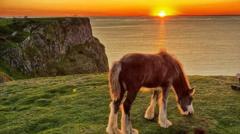
The wind up there does not just blow. It strips. It comes screaming off the Atlantic, vaulting over jagged limestone precipices before slamming into the salt-bitten turf of the cliffs. It is a place where gravity feels like a personal opinion, and nothing survives unless it knows how to anchor itself to the bone of the earth.
Except for the horses.
For more than a century, they stood against that gale. They were not sleek, pampered thoroughbreds meant for a collector’s stable or a manicured racetrack. They were rough-coated, heavy-chested survivors. Their ancestors had been dropped onto these coastal ledges generations ago, left to figure out how to winter through horizontal sleet and summer on meager, salt-stung grass. To anyone walking the sheep tracks along the edge, they were part of the geography. You saw the silhouette of a dark mare against a bruised evening sky, and you knew where you were. You knew the weight of the land.
Then came the paperwork.
The Collision of Bureaucracy and Breath
We love to imagine that our modern world is run by logic. We draw lines on maps. We write bylaws. We debate grazing rights in wood-paneled rooms where the coffee is warm and the wind never rattles the windowpanes. But paper is fragile. Muscle and breath are something else entirely.
The dispute did not start with a stampede or a crisis. It started with a dispute over ancient permissions. A grazing rights row. Words like liability, compliance, and unauthorized occupation began to float through local council chambers. To the men and women who sign the documents, the cliff tops are a designated zone. They are a liability matrix. They are a set of variables to be managed, regulated, and ultimately sterilized.
Consider what happens next: the trucks arrive.
I remember talking to an old hill farmer whose family had watched those horses for three generations. He didn't use big words. He just spat into the dirt and shook his head. He said, "They think the land belongs to the paper it’s printed on. They don’t know that the land belongs to who can stand the winter."
When the authorities finally moved to clear the cliffs, they brought stock trailers and steel hurdles. They brought the cold certainty of the state. More than a hundred years of an unbroken line—descendants of beasts that had earned their right to the sod through sheer, stubborn endurance—were rounded up and trucked away. Just like that. A century of wild history erased to satisfy an insurance policy and a boundary dispute.
What We Lose When the Wild Goes Quiet
There is a distinct kind of silence that follows an eviction. It is heavier than normal quiet.
When you remove the animals that shaped a landscape, the landscape changes. The grass grows rank and tangled where short-cropped paths used to be. The dung beetles lose their home. The hawks lose a marker in the vast, indifferent air. But more than that, something human breaks inside us.
We look at our cities of glass and concrete, and we feel a low-grade, persistent ache. We crave wildness. We pay small fortunes to fly to distant reserves or watch high-definition documentaries about creatures we have systematically evicted from our own backyards. We mourn the loss of nature while actively legislating its remaining corners into submission.
Think of it as a slow erosion of the soul. Every time we prioritize a tidy spreadsheet over a messy, breathing reality, we narrow our own world. We trade the thundering rhythm of hooves on stone for the bureaucratic hum of a filing cabinet.
The official statements called it a resolution. They called it clearing up an anomaly. They spoke of agricultural standards and statutory duties. Not a single bureaucrat mentioned the way a stallion's mane catches the salt spray. Not a single notice board accounted for the ghost prints left in the mud.
The Unforgiving Edge
Down in the valley, away from the spray, the world keeps turning. Traffic lights change. Coffees are sipped. Emails are answered. But up there, on the ledge where the earth drops three hundred feet straight down into white water, the wind feels lonelier now.
The cliff horses are gone. Their pasture is quiet. The grazing rights have been sorted, filed, and closed. The human victors sit in their offices, breathing climate-controlled air, satisfied that the rules have been obeyed and the boundaries restored to order.
Yet, somewhere in the dark, beneath the roar of the surf, the rocks still remember the weight of iron and muscle. The earth does not care about our bylaws. It only remembers who stayed. And as the mist rolls in off the grey water, the cliffs stand empty, waiting for a freedom we no longer have the courage to allow.


