Silence.
In a boardroom thirty-five thousand feet above the Pacific, or inside a glass-walled conference room in Santa Clara where the hum of server farms feels less like machinery and more like a heartbeat, silence is the most expensive commodity on earth. When you are steering a company worth more than the gross domestic product of most nations, nobody interrupts you. Nobody asks you twice. You speak, and markets bend.
For years, that was the gravitational reality around Jensen Huang.
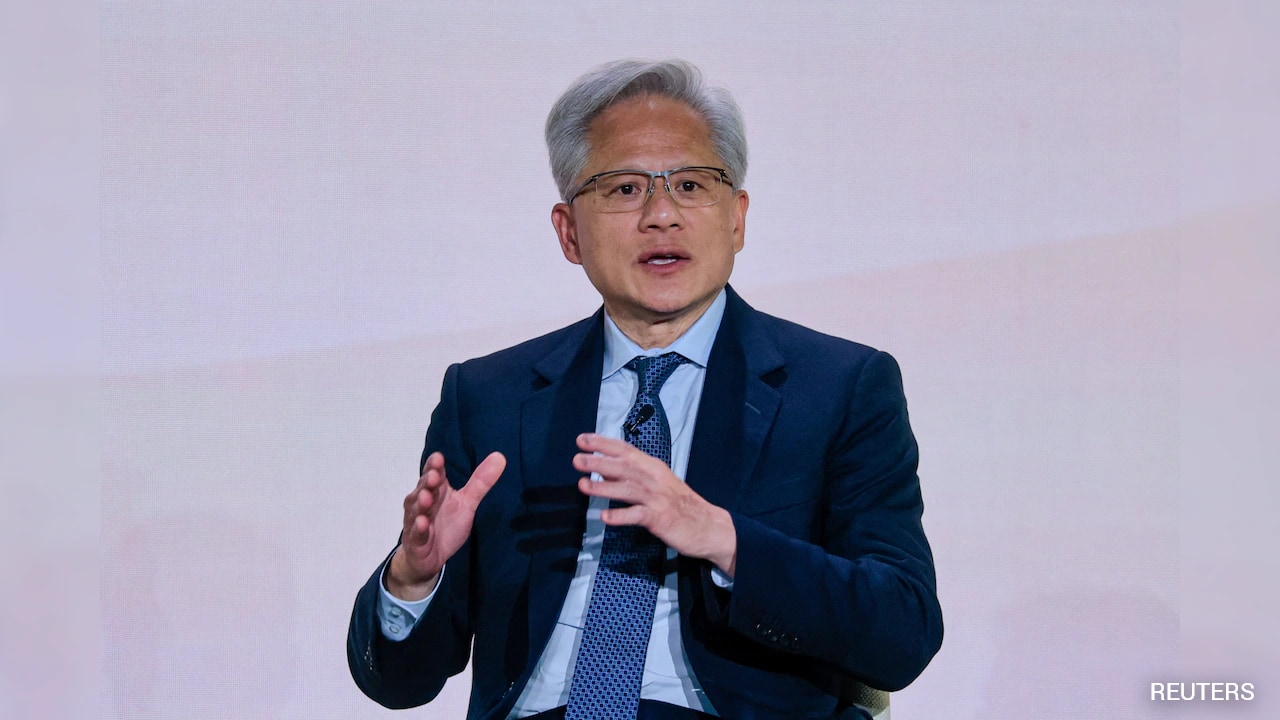
You know the silhouette. The black leather jacket, worn even under the blinding stage lights of packed arenas. The easy, self-deprecating laugh. The founder who stayed when almost every other Silicon Valley pioneer from the early nineties had either burned out, cashed out, or been pushed out by suits who didn't understand silicon. Nvidia wasn't just a company he built; it was an extension of his nervous system. When he told his inner circle that everything was under control, they didn't just believe him. They breathed easier.
Until the day the silence broke, and the people closest to the throne realized they had been looking at a carefully curated shadow instead of the real thing.
To understand what happens when a titan bends the truth to his own lieutenants, we have to look past the stock tickers and the breathless press releases about artificial intelligence. We have to look at the anatomy of trust inside an empire, and what happens when a personal connection—specifically, Huang's undisclosed and misrepresented relationship with a prominent Chinese businesswoman—collides with the most sensitive geopolitical fault line of the twenty-first century.
The Architecture of a Blind Spot
I spent a decade watching executive teams fracture from the inside out, sitting in rooms where the fluorescent lights buzzed a little too loudly and the air smelled of stale espresso and unspoken panic. And if there is one thing those years taught me, it is this: companies rarely die from a single catastrophic wound. They bleed out from small, polite omissions.
Imagine, for a moment, a hypothetical scenario inside any high-stakes enterprise. Call it the "Inner Ring Trap." You are a senior vice president. Your entire professional identity, your net worth, and the livelihoods of ten thousand engineers beneath you depend on the unimpeachable integrity of one visionary founder. One afternoon, a rumor surfaces—a connection between your CEO and an external figure tied to a rival market. You bring it up, gently, over a quiet lunch. The CEO waves a hand, offers a brisk, reassuring explanation that minimizes the contact, frames it as purely incidental, and moves on to the next quarter's roadmap. You want to believe him. Believing him lets you sleep at night. So you file the doubt away in a drawer and lock it.
Now strip away the hypothetical and step into the cold, hard reality of Nvidia.
In late 2026, reports and internal revelations began peeling back the layers on how Jensen Huang handled questions surrounding his relationship with a Chinese businesswoman—a figure whose proximity to both the tech executive and networks within China carried profound regulatory and strategic weight. According to accounts detailing the friction at the highest levels of the chipmaker, Huang didn't simply keep his private life private. He actively misled Nvidia's own top executives about the nature, depth, and ongoing reality of the connection.
Let that sink in. Not the press. Not Washington regulators. Not retail investors refreshing their brokerage apps at three in the morning. He misled the very people tasked with protecting the company from existential risk.
Why? Why would a man who already possesses unimaginable wealth, cultural immortality, and near-total operational control risk the bedrock of his executive team's trust over a personal entanglement?
When Geopolitics Enters the Bedroom
To answer that, you have to understand the suffocating pressure cooker Nvidia has inhabited over the last few years.
Think of Nvidia not as a normal corporation, but as a narrow bridge spanning a widening canyon between two nuclear superpowers. On one side sits Washington, tightening export controls on high-end graphics processing units—the exact chips required to train frontier artificial intelligence models—with the urgency of a wartime mobilization. On the other side sits Beijing, desperate for compute power, viewing access to Nvidia's architecture as a matter of national survival and technological sovereignty.
Huang has spent years walking that tightrope without a net. Publicly, he has played the ultimate diplomat: flying to Taipei, charm-offensive-ing through Washington, insisting that Nvidia follows the letter and spirit of every export restriction while simultaneously designing modified, compliant chips to keep the lucrative Chinese market from slipping entirely into the hands of domestic rivals like Huawei.
In an environment that volatile, a CEO's personal relationships aren't gossip. They are intelligence vectors.
When a chief executive maintains an undisclosed, deep-rooted relationship with a Chinese businesswoman—and then misrepresents that bond to his own general counsel, his compliance officers, and his senior lieutenants—he isn't just indulging in a personal lapse. He is blinding his own defense system.
Consider what happens next inside a corporate boardroom when a leader obscures the truth about a foreign entanglement:
- Compliance becomes theater. Legal and risk teams build guardrails based on the facts they are given. If the CEO feeds them a sanitized fiction, the compliance framework is engineered to protect against a phantom threat while leaving the real door wide open.
- Board oversight turns hollow. Directors cannot fulfill their fiduciary duty if the primary source of information is editing the script before they read it.
- Paranoia replaces candor. Once top executives discover they were fed a convenient lie, every past assurance—about supply chains, about regulatory handshakes, about succession—suddenly carries an asterisk.
It is easy, from the outside, to judge those executives for not digging harder sooner. Frankly, I used to think the same way when reading about corporate governance failures. I used to wonder how brilliant, battle-hardened leaders could miss obvious red flags right in front of them. Then I watched a mentor of mine—a sharp, cynical operator who could spot a cooked balance sheet from across a crowded room—get completely blindsided by a founder he had trusted for fifteen years. Loyalty isn't stupidity. Loyalty is a biological anesthetic. When someone has made you rich, made you famous, and proven you wrong every time you doubted their vision, your brain actively resists the idea that they might be lying to your face.
The Anatomy of Executive Deception
Let's look closely at the mechanics of what went wrong, because the details matter more than the headlines.
In corporate governance, there is a vast canyon between privacy and deception. Every executive, even one running a multi-trillion-dollar bellwether, is entitled to a private life. Nobody expects a CEO to file a memorandum every time they have dinner with an acquaintance or maintain a personal friendship outside the office.
The line is crossed the exact second a personal relationship intersects with corporate vulnerability—and the executive chooses misdirection over disclosure.
When top executives at Nvidia confronted or inquired about Huang's ties to the Chinese businesswoman, they weren't prying into his soul. They were doing the job they were paid millions of dollars to do: scanning the horizon for anything that could trigger a Department of Justice inquiry, a Securities and Exchange Commission investigation, a congressional subpoena, or a catastrophic collapse in investor confidence. In an era where national security hawks in Washington scrutinize every flight manifest and every joint venture touching mainland China, an undisclosed personal tie at the very top of America's most critical semiconductor company is pure nitroglycerin.
By downplaying the relationship, obscuring its timeline, or misrepresenting its scope to his own leadership team, Huang effectively unilaterally decided that his personal judgment outweighed the collective risk management of the entire enterprise.
It is the classic founder's fallacy.
We see it repeat across industrial history like a recurring fever. Think back to the early twentieth century, or look at the modern pantheon of tech titans—from Henry Ford refusing to update the Model T until the company nearly imploded, to modern founders who treat corporate bylaws like suggestions meant for lesser mortals. When a founder builds something unprecedented from nothing, a subtle psychological shift occurs. They stop seeing the company as an institution they serve, and start seeing it as a possession they own.
If the company is yours, then rules about disclosure feel like an insult. Questions from your own executives feel like insubordination. And bending the truth to keep people off your back doesn't feel like dishonesty—it feels like efficiency.
The Invisible Toll on the Machine
What does it actually feel like inside a building when that illusion shatters?
It doesn't happen with screaming matches in the lobby. Real corporate trauma is quiet. It shows up in the way senior vice presidents suddenly start documenting every conversation in follow-up emails. It shows up in the subtle hesitation before a general counsel signs off on a routine regulatory filing. It shows up when a room full of people who used to finish each other's sentences suddenly start speaking in careful, lawyerly clauses.
I remember the exact afternoon a similar realization hit a leadership team I worked alongside. The air in the room didn't turn angry; it turned cold. People stopped looking at the founder when he spoke and started looking at each other, silently calculating their own exposure, wondering what else they had signed their names to without knowing the full story. That kind of fracture doesn't show up on an earnings call the next week. Revenues still climb. Chips still ship. Analysts still slap "buy" ratings on the stock.
Beneath the surface, though, the connective tissue has torn.
For Nvidia, the stakes of that tear are uniquely terrifying because the company's competitive moat isn't just its CUDA software ecosystem or its next-generation Blackwell and Rubin architectures. Its real moat has always been its ferocious, unified execution. While competitors like Intel drowned in bureaucracy and internal politics, Nvidia moved like a single organism. Huang famously eliminated traditional corporate hierarchies, flattening the organization so dozens of executives reported directly to him, creating a culture of radical transparency where bad news was supposed to travel at the speed of light.
Radical transparency.
Think about the bitter irony of that phrase. A management philosophy built entirely on the demand that subordinates hide nothing from the boss, fractured because the boss hid something critical from his subordinates.
What People Get Wrong About Corporate Scandals
Whenever a story like this breaks—combining a celebrity CEO, geopolitical tension, and a personal relationship—the public conversation almost immediately drifts toward tabloid sensationalism. People want salacious details. They want a simple villain or a melodramatic romance.
That misses the entire point.
If you strip away every shred of personal drama, you are left with a cold, structural truth that affects every shareholder, every employee, and every policymaker watching the artificial intelligence boom: concentration risk.
For the past three years, global financial markets have bet trillions of dollars on the assumption that Nvidia is an unstoppable, frictionless machine. Pension funds, sovereign wealth funds, and everyday retirement accounts are heavily weighted toward a single ticker symbol. When you invest in Nvidia, you aren't just buying silicon patents; you are underwriting the governance of a single individual who holds near-absolute authority over the company's direction.
Let's be honest about the uncertainty here. We don't yet know every downstream consequence of Huang's misdirection. Will it trigger formal inquiries from U.S. regulatory bodies examining whether material risks or conflicts of interest were withheld from the board? Will institutional investors demand an independent governance overhaul, stripping away some of the informal autonomy Huang has enjoyed for three decades? Or will the sheer, blinding velocity of AI demand wash over the controversy like a wave over footprints in the sand, leaving the stock price untouched while the board quietly rewrites the rules behind closed doors?
Nobody knows for sure. Anyone claiming they can predict how Washington or Wall Street will price a governance failure six months from now is selling certainty they don't possess.
What we do know, with mathematical certainty, is that trust operates on an asymmetric curve. It takes thirty years of late nights, near-bankruptcies, and flawless product launches to build it, and thirty seconds of calculated misdirection to crack it.
Beyond the Leather Jacket
Walk through any tech conference today and you will still see the cult of the founder in full bloom. We love our heroes singular. We want to believe that progress happens because one brilliant mind sees further than everyone else and refuses to be slowed down by committees, compliance officers, or uncomfortable questions.
It is a seductive myth. It makes for great magazine covers and thrilling keynote speeches.
Yet history keeps handing us the same invoice. Whenever an institution becomes indistinguishable from the ego and impulses of one person, the blind spots of that person become the blind spots of the entire system. When Jensen Huang misled his top executives about his relationship with a Chinese businesswoman, he didn't just compromise a personal boundary. He exposed the fragility of an empire built around one man's word.
Picture that conference room in Santa Clara again. The lights are dimmed. The slides are projected onto the glass wall, glowing with projections of unimaginable computing power, sovereign AI clouds, and revenue curves bending straight toward the sky. Around the table sit the sharpest minds in engineering, finance, and law. They are looking at the numbers, nodding along to the vision of a future they are building together.
And sitting right there in the room, invisible on every chart and absent from every spreadsheet, is the single variable none of them can model anymore: what happens the next time the man at the head of the table says, "Trust me."