The air smells of salt, rusted wire, and the particular, heavy dust that clings to the skin when you have walked fifty miles with nothing in your pockets.
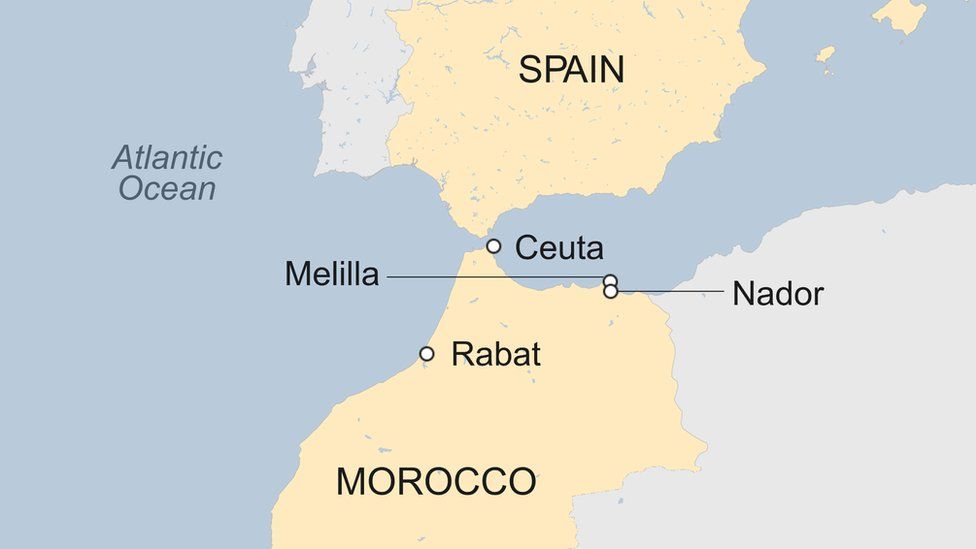
Dawn does not break softly here. It cuts across the Mediterranean horizon like a blade, turning the slate-gray water into a sheet of hammered silver before slamming brutally against concrete. Above the shoreline, the double fence of Ceuta rears up—six meters of galvanized steel topped with loops of razor wire that glisten like wet teeth in the morning light.
To the bureaucrats in air-conditioned offices hundreds of miles away, this is a border. To the hundreds of individuals huddled tonight in the scrubland and makeshift shelters of the Moroccan hills, it is the final, trembling threshold between desperation and a lottery ticket called Europe.
We call these events crackdowns. The official reports are clinical, washed clean of blood and heartbeat. They speak of operational coordination, perimeter reinforcement, and hundreds arrested. Numbers. Statistics neatly arranged in columns to reassure a continent that the gates are holding.
Look closer.
(Note: The following narrative composite is constructed from documented testimonies of border crossers, humanitarian aid workers, and local residents in northern Morocco.)
Imagine Amin. He is twenty-four, though the sun and hunger have aged him into something older, harder, and entirely hollowed out. Back in Conakry, he taught himself basic electrical repair by fixing broken radios under a corrugated tin roof. He left when the options narrowed to a choice between starving quietly or running toward a rumor. The rumor said that if you could touch the European soil of Ceuta—just a tiny scrap of Spain clinging to the northern coast of Africa—you stepped into a sanctuary governed by laws that promised due process, shelter, and a chance to send money back to a mother whose medicine costs more than a month’s wages.
Amin spent eight months living in the shadow of Mount Gurugu. He learned how to sleep with one eye open, how to filter muddy water through a tattered t-shirt, and how to outrun the swift, heavy boots of auxiliary forces when the camp was raided in the dead of night.
He knew the odds. Everyone knows the odds. When you have nothing left to lose, probability ceases to be a mathematical concept and becomes a distant constellation you steer by.
The crackdown did not begin with sirens. It began with silence.
At three in the morning, the usual chatter among the trees died down. The scouts came back running, their breath coming in ragged gasps. The coordinated sweep had started. Moroccan and Spanish security forces, linked by bilateral agreements and thermal-imaging drones humming quietly in the starry sky, closed the net from both sides.
There is a specific terror in the sound of approaching batons hitting riot shields. It is a rhythmic, deadened thud that vibrates through the soles of your feet before you even see the flashlights.
Amin ran. He ran through the thick thornbushes that shredded his jacket and tore deep, stinging gashes into his forearms. He didn't feel the pain then; adrenaline is a powerful, temporary anesthetic. He scrambled up a steep embankment, his fingers tearing at loose dirt and sharp shale, aiming for the outer perimeter of the fence where a weak point had been rumored three days prior.
He reached it just as a thermal drone swept overhead, bathing the hillside in an eerie, pale-green wash.
An instant later, the searchlights blinded him.
The arrest was remarkably efficient. No shouting match. No negotiation. Just strong hands grabbing his shoulders, forcing him face-down into the dry dirt, plastic zip-ties biting brutally into his wrists. As they hauled him up, his cheek pressed against the cold gravel, Amin caught one final glimpse of the city lights twinkling across the water. So close he could almost smell the exhaust of European cars. So far away it might as well have been the moon.
The Architecture of Separation
To understand why hundreds are arrested near Ceuta with grim regularity, one must abandon the comforting illusion that borders are simply lines on a map. They are living, breathing pressure valves.
Ceuta and its sister enclave, Melilla, represent the only land borders between the European Union and the African continent. For decades, this geographic accident has turned them into magnetic poles. They draw people from the Sahel, from the Horn of Africa, from war-torn corners of the Middle East, all driven by a singular, unshakeable conviction: if I can just get across, my life changes.
The European Union pours hundreds of millions of euros into these enclaves. High-definition cameras, motion sensors, anti-climbing mesh, and razor wire form a technological wall designed to make the crossing physically punishing and statistically improbable. When migrant groups—often numbering in the hundreds—attempt mass rushes, known locally as saltos, they are confronting an apparatus engineered to repel them with overwhelming force.
Yet, every deployment of razor wire is met with a matching escalation in desperation. When land routes are heavily fortified, people take to the sea on flimsy rubber dinghies that disintegrate in the November swells. When the sea is locked down, they try the fence again. It is a hydraulic system of human movement. Block one valve, and the pressure simply builds somewhere else, finding the next weakest seam.
The numbers reported in the aftermath of these crackdowns—three hundred arrested here, five hundred pushed back there—are treated by the media as data points in an ongoing administrative crisis. But every single digit represents an intricate, fragile human universe extinguished or indefinitely paused.
Consider the legal limbo that follows. Those caught are often subjected to rapid expulsions or held in overcrowded detention centers where legal representation is scarce and translation services are stretched impossibly thin. Under international law, the principle of non-refoulement prohibits countries from returning individuals to nations where they face persecution or torture. Human rights organizations have repeatedly argued that mass pushbacks at the borders of Ceuta violate these fundamental protections, turning legal gray zones into places where rights are suspended simply because they are inconvenient to enforce.
The Invisible Stakes
We live in an era obsessed with walls. We build them out of concrete, out of legislation, and out of indifference.
The story of Ceuta is not merely a local border dispute between Spain, Morocco, and the desperate souls knocking at their gate. It is a stress test for our collective humanity. It forces a deeply uncomfortable question onto the table: What are affluent societies willing to do to maintain their comfort in a world fractured by staggering inequality?
When we read that "hundreds were arrested in the latest crackdown," the passive voice does heavy lifting. It conceals agency. It makes the arrests sound like weather—a sudden storm that swept in from the sea, unavoidable and neutral.
The storm is human. The batons are forged in factories. The policies are written by men and women sitting in comfortable chambers, voting on budgets that measure human desperation in meters of steel and megabits of surveillance data.
And what happens to Amin after the dust settles?
He won't make the evening news again tomorrow. He will be loaded onto a bus, driven hundreds of kilometers south into the interior of Morocco to deter him from returning immediately, and released into a town where he knows no one, has no money, and possesses only the clothes on his back—clothes now stiff with dried sweat and dirt.
Will he try again?
If you ask the border guards, they will tell you it's a game of deterrence. If you make the penalty harsh enough, the risk high enough, the flow will stop.
If you ask Amin, sitting on a curb in a strange city as the sun climbs high into the afternoon sky, looking down at his scarred hands and wondering where he will sleep tonight, the answer is altogether different.
The instinct to survive, to seek a better life for those you love, is not a variable that can be engineered out of existence. It is the most permanent feature of the human landscape.
The sun beats down on the razor wire tonight. Somewhere out in the dark hills, another young man is lacing up his sneakers, looking north toward the lights, and taking his first quiet step into the dust.