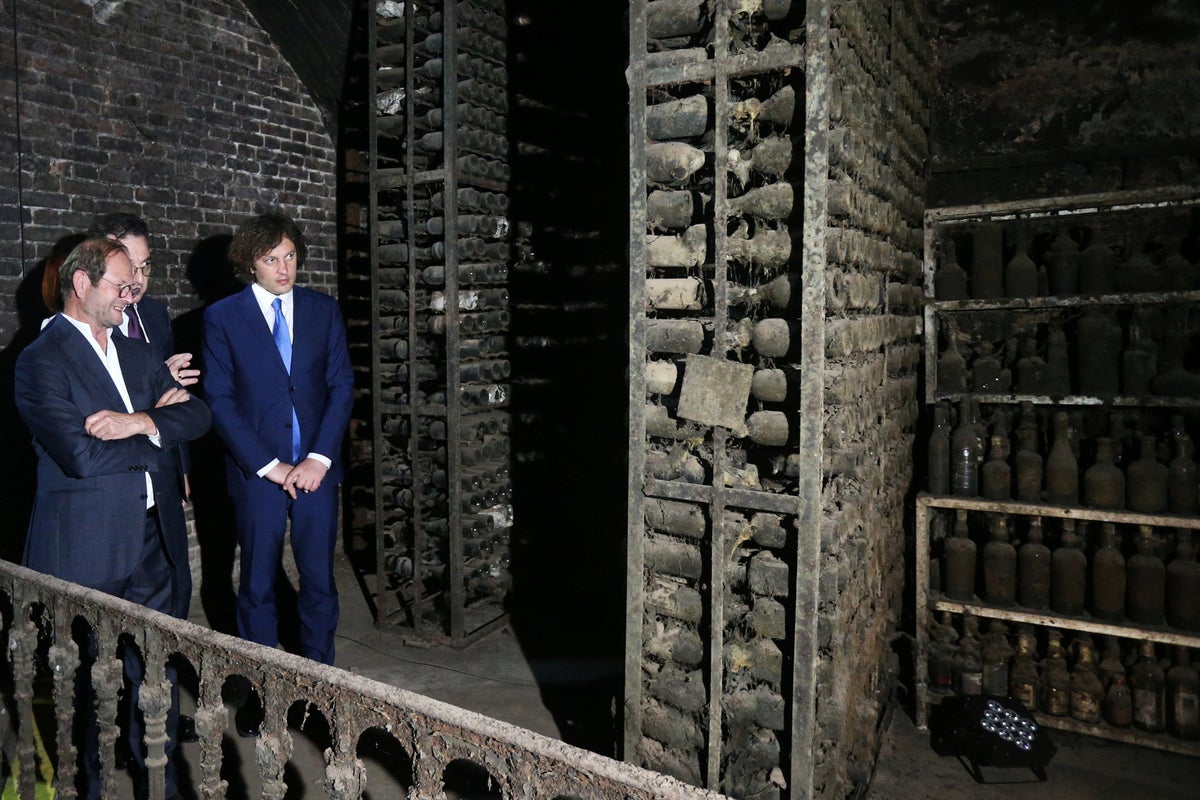
The dust inside the subterranean vaults of Massandra does not settle like ordinary dust. It clings. It has had decades of undisturbed silence to master the art of suffocation. Deep beneath the Crimean hills, carved into the jagged rock by the forced labor of imperial miners, the air smells of damp limestone, ancient fungus, and the sharp, vinegar tang of evaporating history.
For nearly a century, a specific iron gate within these tunnels remained sealed. Behind it sat 40,000 bottles of wine.
They were not just any bottles. This was the private sanctuary of Joseph Stalin.
When the news broke that this legendary redoubt had finally been unsealed, the reporting was clinical. Outlets listed the numbers. Forty thousand bottles. Dates spanning from the late 19th century to the mid-20th century. Estimated auction values. But listing the inventory of Massandra by its volume is like measuring the tragedy of the Soviet Union by the weight of its paperwork. It misses the heartbeat. It misses the terror.
To understand what those bottles mean, you have to imagine a man who trusted absolutely no one, sitting alone in the dark, drinking the blood of a dead empire.
The Geography of Fear
Wine is an exercise in optimism. You plant a vine today because you believe that five, ten, or fifty years from now, someone will be there to uncork the bottle and celebrate the passage of time. It is an act of faith in the future.
Joseph Stalin did not believe in the future. He engineered it through sheer, bloody force of will. Yet, he was obsessed with Massandra.
Originally built for Tsar Nicholas II in the 1890s, the Massandra winery was designed to supply the imperial Romanov family with liquid luxury during their summers on the Black Sea. The architecture was deliberately medieval—a fortress of stone tunnels driven deep into the mountain to maintain a flawless, unchanging temperature of 13 or 14 degrees Celsius. Perfect for aging. Perfect for hiding.
When the Bolsheviks executed the Tsar and seized the state, they didn't destroy the cellar. They expanded it.
Consider the psychological dissonance of that moment. A regime built on the glorification of the proletariat, systematically cataloging and protecting thousands of bottles of the world’s most decadent, aristocratic vintages. During the purges of the 1930s, while millions starved or disappeared into the Gulag system, elite couriers were regularly dispatching crates of sweet Krymskiy Muscat and heavy, dark Saperavi from Crimea to the Kremlin.
The wine was a tool. Stalin used it to break men.
The Dinner at Kuntsevo
Picture a hypothetical dinner at Stalin’s dacha in Kuntsevo, constructed from the real, documented accounts of survivors like Nikita Khrushchev and Foreign Minister Vyacheslav Molotov.
The table is groaning under the weight of heavy Georgian dishes. The air is thick with tobacco smoke from Stalin’s pipe. And the wine is flowing. Not because it is a celebration, but because it is an interrogation.
Stalin rarely drank to excess himself, often diluting his glass with water or sipping a light Khvanchkara. But he forced his guests—his generals, his politburo, his closest allies—to drink until they vomited. He watched them. He noted who grew sloppy, who grew quiet, who let slip a word of doubt. In the Soviet court, sobriety was viewed with suspicion. It meant you had secrets. Drunkenness, however, stripped away the mask.
The bottles pulled from the Massandra cellar were the fuel for these psychological executions. A bottle of 1923 Pedro Ximénez wasn't opened to pair with dessert; it was uncorked to see if a Commissar would weep after his third glass, revealing a soft, counter-revolutionary center.
Then came 1941.
The German Wehrmacht was tearing through Ukraine. The Romanian allies of the Nazis were marching toward Crimea. The order from Moscow was absolute: scorched earth. Nothing of value was to be left for the fascist invaders. Factories were blown up. Crops were burned.
But Massandra was different.
The winemakers and curators faced a horrific dilemma. If they destroyed the collection, they were destroying the cultural heritage of Europe and the private pride of their dictator. If they left it, the Nazis would drink Stalin’s private stash.
In a frantic, desperate race against the advancing front line, the workers didn't smash the bottles. They packed them. Thousands of priceless wines, including bottles dating back to the 1700s, were loaded onto ships and trains under bombardment. They were evacuated to secret locations in Georgia and the Ural Mountains. Men died shielding crates of sherry with their bodies.
That is the paradox of total tyranny. The state had stripped these people of their freedom, their property, and often their families. Yet, they risked their lives to save the dictator's wine.
The Unsealing
When the heavy doors were finally unlocked recently, revealing the core of the 40,000-bottle collection that had returned to Crimea after the war, the preservation was haunting.
The bottles were thick with a gray, velvety mold. This isn't the mold of spoilage; it is the Penicillium that thrives in the high humidity of the tunnels, sealing the corks from the outside air and protecting the liquid within. To look down those long, arched corridors is to look at a graveyard of specific years.
- 1891: The year the construction of the deep cellars began.
- 1917: The year the world broke, and the Tsar’s crest was ground into the dirt.
- 1945: The year of victory, stained with the bitter ash of twenty-seven million Soviet dead.
What does a wine from 1945 taste like? It doesn't taste like fruit anymore. The primary notes of cherry or plum have long since evaporated into the chemical ether. Instead, it tastes of tertiary complexities—leather, wet earth, dried tobacco, and a sharp, metallic finish that clings to the back of the throat. It tastes like survival.
The modern market looks at these unsealed bottles and sees an investment asset. High-net-worth individuals in London, Shanghai, and New York will eventually bid on these lots. They will pay tens of thousands of dollars to place a bottle of Stalin’s Massandra collection in their temperature-controlled glass cases. They will show it off to friends over steak.
They will miss the point entirely.
The True Cost of the Bottle
Every bottle in that hidden cellar is a monument to an era where human life was the cheapest commodity available. The glass itself is heavy, hand-blown, imperfect. If you hold one up to the light, you can see the air bubbles trapped inside the material.
The true weight of the Massandra unsealing isn't the financial value of the liquid. It is the realization that these bottles outlived the empire that stole them, outlived the dictator who hoarded them, and outlived the system that killed millions while keeping its wine at a perfect 14 degrees.
The iron gate is open now. The air from the outside world is rushing into the tunnels, disturbing the dust that took eighty years to settle. The bottles are being cataloged, moved, and sold.
But if you stand in those tunnels long enough, before the tourists and the auctioneers take over, you can still feel the cold, heavy hand of the twentieth century pressing against your chest. You realize that some secrets aren't kept to protect the past.
They are kept because the past is too terrifying to look at without a glass in your hand.