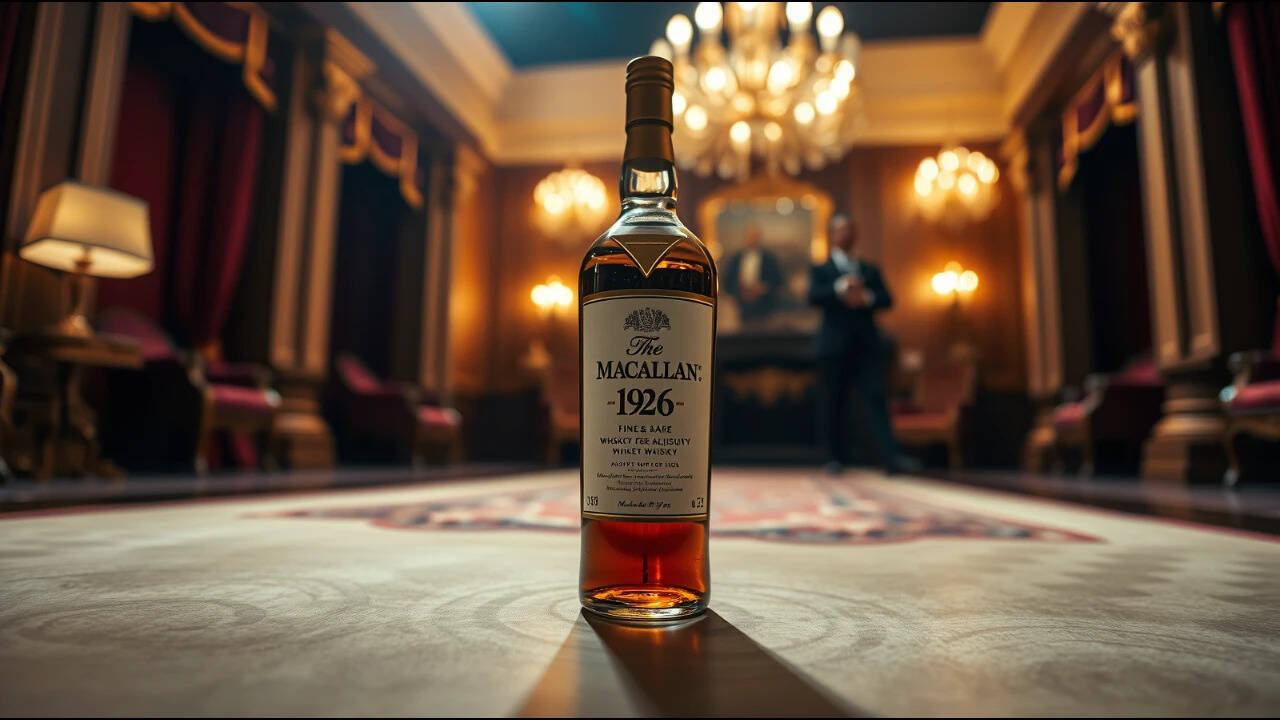
A bottle of The Macallan 1926 single malt Scotch whisky recently fetched £2.125 million (roughly $2.8 million USD) at a Sotheby's auction held directly on the historic Speyside estate. This staggering figure answers the primary question of what ultra-luxury spirits command in the current market, but it masks a far more complex financial and cultural reality.
For decades, rare spirits have transitioned from niche collector hobbies into high-yield alternative asset classes. Yet, treating a bottle of six-decade-old spirit like a stock portfolio ignores the precarious mechanics driving these astronomical valuations.
Cask 263 was filled in 1926 and left to slumber for sixty years before yielding precisely forty bottles in 1986. Back then, nobody anticipated a cultural obsession with liquid antiquity. The initial release price sat at a modest £5,000. Fast forward through decades of market shifts, and these bottles have become mythical artifacts. But the £2.125 million hammer price achieved at the distillery is not merely a reflection of barley, oak, and time. It is a masterclass in manufactured scarcity and elite psychological positioning.
Consider the distribution of those original forty bottles. Twelve featured labels designed by pop artist Sir Peter Blake, another twelve bore artwork by Italian painter Valerio Adami, a single bottle was hand-painted by Irish artist Michael Dillon, and fourteen received the austere Fine and Rare label. By embedding blue-chip contemporary art into the packaging, the brand ensured these vessels transcended the category of consumable goods. They became sculptures that happened to contain alcohol.
This brings us to the uncomfortable truth about alternative asset speculation in high-end consumables. Unlike corporate equity or sovereign debt, a bottle of ultra-rare whisky generates no cash flow. Its entire economic momentum relies on the Greater Fool theory, the absolute conviction that another ultra-wealthy buyer will step up tomorrow to pay an even steeper premium. When liquidity tightens globally, luxury collectibles are often the first assets to experience valuation freezes.
The auction at the Macallan Estate also signaled a shifting demographic among top-tier bidders. While Asian markets dominated the multi-million dollar spirit surges of the late 2010s, geographic concentration has diversified. Wealth creation is fragmenting across new global epicenters, creating a broader, fiercely competitive pool of buyers chasing a strictly finite supply of historic bottles. When supply is permanently capped at zero net growth, even marginal increases in global ultra-high-net-worth populations trigger exponential price corrections upward.
Skeptics often argue that nobody can possibly taste a £2 million difference between a standard decanter and a century-old relic. They are entirely correct. Taste is largely irrelevant at this altitude. Buyers are acquiring institutional provenance, bragging rights, and a physical manifestation of exclusivity.
The market for ultra-rare Scotch remains an unregulated frontier. Unlike traditional securities, there is no central exchange, no circuit breaker, and no standardized liquidity mechanism. If an economic downturn hits institutional buyers, the secondary market for million-dollar bottles can experience severe liquidity droughts. Sellers may find themselves sitting on pristine liquid assets with zero active buyers willing to clear the bid-ask spread.
As long as wealth inequality expands globally and trophy assets remain scarce, prices for historical unicorns will continue defying conventional gravity. Just remember that the paper value of a record-breaking auction means very little until the hammer falls and the cash actually clears.