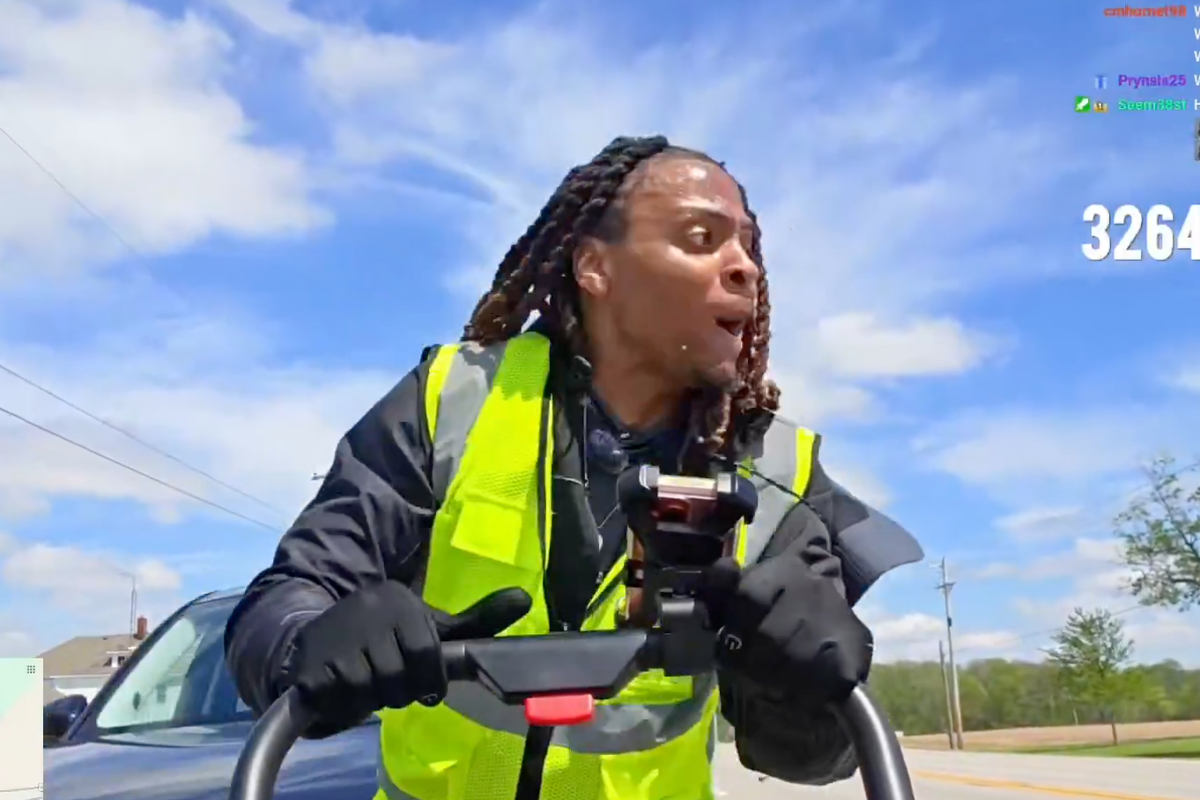
The Cognitive Dissonance of Real Time Broadcasting
The incident involving a social media personality struck by a vehicle during a charity walk highlights a critical failure in human-computer interaction: the collapse of situational awareness under the weight of high-bandwidth digital engagement. When a creator bridges the gap between physical exertion and digital performance, they enter a state of split-focus where the environment is no longer a physical reality to be navigated, but a backdrop to be curated. This transition shifts the creator’s cognitive load from environmental scanning to audience retention, creating a specific vulnerability where the latency between a physical threat and a digital reaction becomes a fatal gap.
The mechanics of this failure are rooted in the Attensional Bottleneck Theory. Human processing power is finite. In a standard walking environment, the brain allocates resources to spatial mapping and auditory cues. However, a livestreamer introduces three additional layers of cognitive demand:
- Visual Feedback Loops: Monitoring the frame to ensure lighting, composition, and personal appearance remain within brand standards.
- Auditory Interaction: Processing the text-to-speech (TTS) donations or reading a scrolling chat, which requires linguistic decoding that competes with the brain's ability to process ambient noise, such as an approaching engine or tire friction.
- Performative Pressure: The "Charity Effect" creates a moral imperative to ignore physical discomfort or environmental warnings to maintain the flow of donations.
The Kinematics of Roadside Vulnerability
Pedestrian safety on active roadways relies on a feedback loop of visual looming and auditory localization. A vehicle traveling at 45 mph (approximately 66 feet per second) provides a very narrow window for a pedestrian to identify a trajectory conflict and execute an evasive maneuver.
The presence of a gimbal-mounted smartphone or a "backpack" rig creates a physical and psychological barrier. Physically, the equipment often obscures the peripheral vision—the primary system for detecting motion. Psychologically, the screen acts as a "focal anchor." Research into inattentional blindness suggests that when an individual focuses intensely on a screen, the brain can fail to register unexpected stimuli in the visual field, even if those stimuli represent an immediate threat.
The physics of the impact are governed by the transfer of kinetic energy, expressed as $E_k = \frac{1}{2}mv^2$. Because velocity is squared, even minor increases in vehicle speed result in exponential increases in the force applied to the human body. In these livestreamed "horror moments," the lack of bracing—caused by the creator being unaware of the impending impact—prevents the activation of protective reflexes, leading to higher rates of traumatic brain injuries and internal hemorrhaging compared to pedestrians who see the vehicle and attempt to roll or jump.
The Architecture of the Creator Economy Risk Profile
Livestreaming is a business model built on continuous presence. Unlike recorded content, which allows for post-production safety checks, live content incentivizes the removal of all filters between the creator and the environment. This creates a specific "Risk-Reward Asymmetry" in the creator economy:
The Engagement Multiplier
Algorithms on platforms like Twitch, Kick, and YouTube prioritize high-engagement events. Extreme environments or grueling physical challenges (like long-distance walks) drive peak viewership. The creator is economically incentivized to push closer to the edge of safety because "dead air" or mundane segments result in viewer churn.
The Parasocial Obligation
During a charity event, the creator is not just a performer; they are a fiduciary for their community's donations. This increases the psychological cost of stopping. If a creator pauses to check a dangerous intersection or moves away from a road to ensure safety, they risk breaking the "immersion" that drives the donation cycle. The result is a systematic prioritization of the digital stream over physical security.
Technical Failure Points
The hardware used for mobile broadcasting often requires manual adjustment. A creator struggling with a dying battery, a dropped 5G signal, or a glitching chat interface will focus their manual dexterity and visual attention on the device. At a walking pace of 3 mph, five seconds of troubleshooting results in 22 feet of unmonitored movement. In a high-speed traffic environment, this is a catastrophic lapse.
Structural Vulnerability in Roadside Infrastructure
The specific incident type—a vehicle "plowing" into a pedestrian—often exposes the limitations of rural and semi-rural infrastructure. When charity walks or "IRL" (In Real Life) streams move away from urban centers, they lose the protection of sidewalks and signalized crossings.
Creators often walk against traffic to see oncoming vehicles, a standard safety practice. However, the use of a wide-angle lens on many smartphone cameras creates a false sense of spatial depth. The creator may perceive a vehicle as being further away than it truly is, or they may misjudge their own proximity to the fog line (the white line marking the edge of the lane).
Roadway geometry plays a secondary role. Horizontal curves and vertical crests limit the sight distance for both the driver and the streamer. If the streamer is engaged in a high-energy interaction with their chat while navigating a "blind" curve, the reaction time required by the driver to avoid the pedestrian is often greater than the available sight distance.
Systematic Failure of the "Charity Walk" Framework
The "Charity Walk" is a staple of digital fundraising because it provides a clear narrative arc: a protagonist overcoming a physical trial for a greater good. However, from an operational standpoint, these events are often poorly planned compared to sanctioned athletic events.
- Lack of Support Vehicles: Professional roadside events utilize "follow cars" with hazard lights to create a buffer zone. Solo or small-team streamers rarely use these due to cost or the desire for an "authentic" solo aesthetic.
- Routing Errors: Streamers often choose routes based on cellular signal strength rather than pedestrian safety. A route with 5G coverage but no shoulder is prioritized over a safer route with a dead zone.
- Fatigue Management: Long-distance walking induces physical exhaustion and cognitive decline. Dehydration and muscle fatigue further slow the neural processing speed required to react to environmental hazards.
The Role of the Digital Audience as an Unwitting Catalyst
In a traditional broadcast, a producer monitors safety. In a livestream, the audience takes on a pseudo-producer role. Through the chat, they provide feedback and direction. However, this "crowdsourced production" lacks a safety mandate. In many cases, the audience may see a hazard before the creator does, but the latency of the stream (often between 2 and 10 seconds) ensures that any warning typed into chat arrives too late to be actionable.
Furthermore, the "gamification" of these events—where certain donation tiers trigger specific actions—can lead to dangerous behavior. If a creator is "tasked" by their audience to walk a specific distance or reach a landmark by a certain time, the pressure to meet that goal overrides the instinct to seek safety during inclement weather or high-traffic periods.
Reforming the IRL Broadcasting Protocol
To mitigate the risk of catastrophic physical injury during mobile broadcasts, the industry must move toward a professionalized safety standard that accounts for the reality of cognitive tunneling.
1. The Mandatory Safety Buffer (Human in the Loop)
Any broadcast involving movement through active traffic or high-risk environments should require a non-broadcasting safety officer. This individual’s sole responsibility is environmental scanning and hazard identification, allowing the creator to focus on the digital interface without sacrificing physical awareness.
2. Visual-HUD Integration
Instead of looking down at a screen or a gimbal, creators should transition to Heads-Up Displays (HUDs) or audio-only chat feeds that allow them to keep their eyes on the horizon. Maintaining a "natural head position" is essential for the vestibular system to function correctly and for the eyes to maintain peripheral awareness.
3. Geo-Fencing and Route Auditing
Professionalize the planning phase by using tools like Strava Heatmaps or DOT (Department of Transportation) safety data to identify high-accident corridors. Avoidance of these zones should be a non-negotiable part of the event's logistical framework.
4. Latency-Aware Warning Systems
Platforms could implement automated "hazard alerts" based on GPS data. If a streamer's coordinates overlap with a known high-speed roadway, the app could trigger an audio warning or force the screen to dim, prompting the creator to re-engage with their surroundings.
The "horror moment" described in the article is not a random accident; it is the logical conclusion of an environment where digital attention is the primary currency and physical safety is a secondary, unmanaged variable. The evolution of the creator economy requires a shift from "raw" authenticity to "managed" production, recognizing that the human brain was never designed to navigate a high-speed physical world while simultaneously managing a global digital dialogue.


