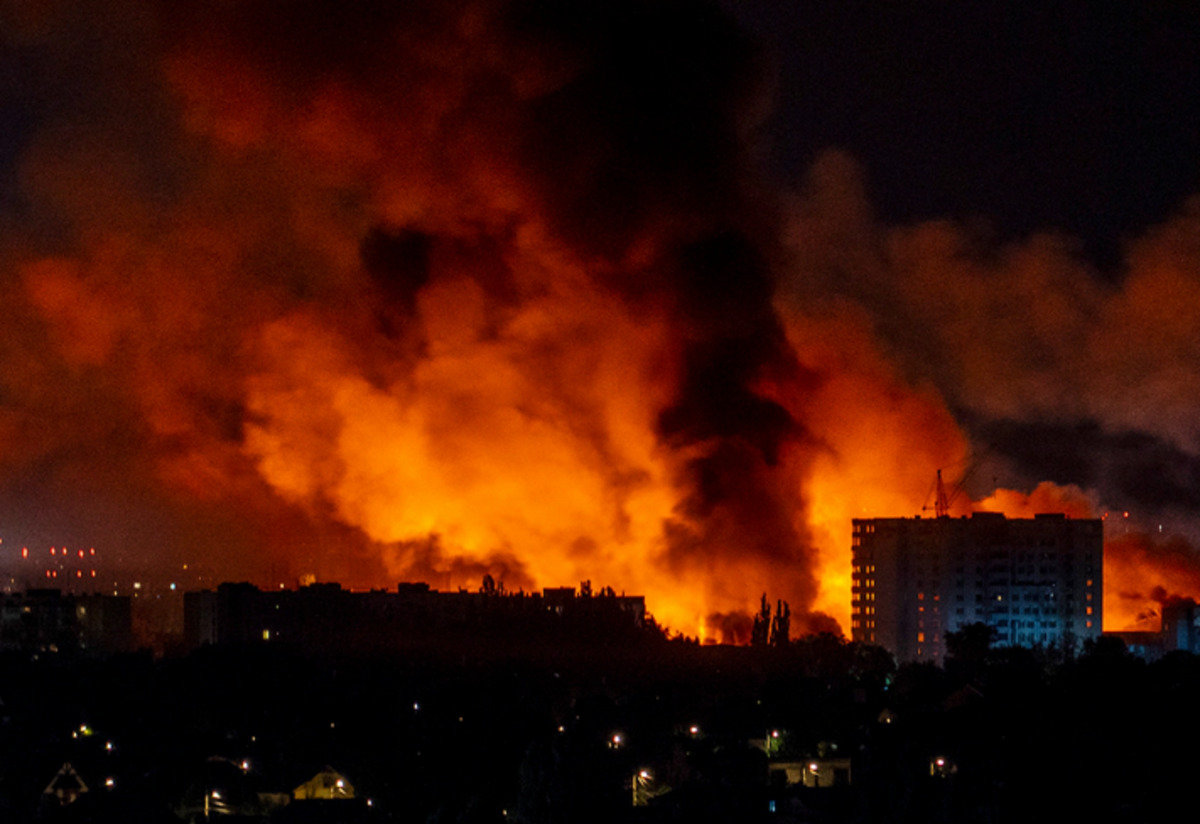
Strategic infrastructure destruction relies entirely on cost asymmetry. When a facility in Moscow ignites following a long-range unmanned aerial vehicle strike, the operational metric of interest is not the immediate thermal energy released or the structural steel deformed. The true variable is the capital expenditure required to intercept a low-cost ordinance compared to the replacement cost of the target asset. Conventional air defense architecture is economically asymmetric against low-altitude, mass-producible loitering munitions. This structural vulnerability dictates the modern attrition model of infrastructure warfare.
Urban logistics nodes, fuel depots, and defense-industrial facilities form concentrated nodes within centralized state economies. Decentralized supply chains absorb shocks through distributed redundancy. Centralized nodes do the opposite. They concentrate risk. When a drone penetrates perimeter defenses to detonate inside a municipal fuel storage hub, the cascading effects ripple through municipal transit, emergency services, and primary power generation. The physics of fuel fires dictate that secondary containment berms limit geographic spread, but they cannot preserve the refined product. Every liter consumed by uncontrolled combustion represents an immediate drain on regional strategic reserves. For an alternative view, read: this related article.
The Cost Function of Asymmetric Interception
Defending a high-value asset against aerial incursions involves a harsh financial equation. A surface-to-air missile interceptor routinely costs between one million and four million dollars per unit. A long-range reconnaissance or strike drone constructed from commercial composite materials, off-the-shelf microcontrollers, and small two-stroke engines costs a fraction of that expenditure, often under twenty thousand dollars.
Defender Cost per Intercept: $1,500,000 - $4,000,000
Attacker Cost per Unit:     $10,000 - $50,000
Economic Ratio:             30:1 to 400:1 favoring the attacker
This expenditure disparity forces defensive strategists into a catastrophic optimization problem. If a defender fires missiles at every incoming signature, military budgets exhaust long before enemy manufacturing capacity throttles down. If the defender holds fire to conserve interceptor inventory, high-value assets suffer direct kinetic impacts. Similar reporting on this trend has been published by The Washington Post.
The structural response to this financial imbalance requires a shift toward electronic warfare, localized kinetic hard-kill systems such as mobile anti-aircraft artillery, and directed-energy platforms. Yet, electronic countermeasures face continuous iteration cycles. Attackers integrate autonomous terminal guidance algorithms that ignore GPS-jamming or radio-frequency spoofing entirely, utilizing optical scene matching to lock onto targets during the final seconds of flight. Consequently, physical hardening of storage tanks, installation of blast walls, and dispersion of inventory become the only reliable mitigations against high-accuracy low-cost vectors.
The Operational Anatomy of Long-Range Strikes
Executing a successful long-range strike across hundreds of kilometers of hostile airspace requires a multi-tiered operational framework.
- Route Planning and Terrain Masking: Flight paths must exploit radar horizons by hugging ground contours, utilizing river valleys, and weaving through low-density population sectors to minimize active radar cross-section exposure.
- Telemetry and Command Link Security: Modern autonomous navigation systems utilize pre-loaded digital elevation models and inertial measurement units backed by satellite navigation waypoints, reducing reliance on constant command-and-control datalinks that can be intercepted or jammed.
- Payload Optimization: Warhead design prioritizes shaped-charge or high-explosive incendiary payloads engineered to pierce secondary containment vessels and ignite volatile vapors rather than relying on massive gross weight that degrades flight range.
The recent incidents in the Moscow region demonstrate that industrial zones and municipal infrastructure lack the point-defense density of primary military command centers. Critical infrastructure historically optimized for throughput and efficiency rather than defensive hardening presents an expansive surface area for precision penetration.
Secondary Systemic Shocks
Physical destruction at a primary node triggers secondary economic and operational fractures across interconnected sectors.
Transportation Bottlenecks
Fuel distribution centers supply municipal transit and freight logistics. Localized combustion halts regional transport vectors for hours or days while safety inspections and fire suppression operations run their course. The secondary effect manifests as driver shifts timing out, perishable goods expiring in transit, and localized fuel rationing.
Insurance and Capital Reallocation
Capital markets price infrastructure risk dynamically. Each successful penetration of a capital-region facility drives up risk premiums for industrial operators across the entire economic zone. Reinsurance firms reassess regional risk portfolios, leading to higher credit costs for industrial modernization and storage expansion.
Resource Reallocation Pressures
Protecting every square kilometer of an expansive state territory is a logistical impossibility. Defense planners must pull mobile air defense units away from front-line tactical engagements to create concentric rings around interior political and economic centers. This reallocation directly degrades front-line operational capability, trading tactical defense for strategic interior security.
The Industrial Capacity Loop
Attrition warfare ultimately reduces to an industrial race between manufacturing throughput and structural destruction rates. If a state can fabricate long-range platforms faster than an opponent can manufacture, deploy, and restock interceptor missiles, the defender faces an unsustainable resource depletion curve.
Traditional military procurement relies on multi-year validation cycles, rigorous mil-spec compliance, and low-volume production lines. Asymmetric drone operations bypass these constraints entirely by utilizing commercial-off-the-shelf industrial supply chains. Carbon fiber tubes, brushless electric motors, hobbyist flight controllers, and civilian communication modules bypass traditional defense primes. This democratization of military hardware turns standard commercial supply chains into dual-use arsenals.
Mitigating this threat requires moving away from the paradigm of matching expensive interceptors to cheap vectors. True balance arrives only when point defense adopts directed-energy solutions or autonomous kinetic interceptors whose marginal cost matches or undercuts the attacking platform. Until defense economics achieve parity at the unit level, long-range aerial strikes will remain the premier instrument for imposing asymmetrical strategic costs on centralized state economies.
Reallocate capital reserves toward distributed, underground fuel storage nodes and localized kinetic point defense arrays, while accelerating the procurement of high-energy laser systems to break the prohibitive cost ratio of traditional interceptor missiles.