A child coughs in a crowded clinic in Chennai. It is a wet, heavy sound that any pediatrician learns to fear. For decades, that sound meant a hidden executioner was at work. Tuberculosis.
When the disease strikes a child, it does not just assault the lungs. It goes for the brain. It goes for the bones. It hides. For years, the global scientific community treated pediatric tuberculosis as a footnote, a minor variable in a ledger dominated by adult statistics. Testing tools were designed for grown adults who could produce sputum on demand; infants could not. The medication doses were guesswork, scaled down from adult weights like miniature clothes cut from a heavy, ill-fitting cloth.
But guessing kills.
In the late twentieth century, a young Indian doctor refused to guess. Dr. Soumya Swaminathan walked into those clinics not with the detachment of an academic, but with the quiet fury of a woman who knew that a country’s future is only as secure as its most vulnerable child. She did not just look at data points on a clipboard. She looked at mothers who were running out of time.
Her journey did not begin in the sterile halls of Geneva or the historic chambers of London. It began at the bedsides of sick children, in the sweltering heat of southern India, decoding the molecular secrets of HIV and tuberculosis co-infections. It was grueling, unglamorous, and desperately necessary work.
Consider what happens when that level of localized grit meets global calamity.
Decades after her early clinical battles, the world cracked open. The COVID-19 pandemic did not care about national borders, economic status, or political speeches. Fear became the default global currency. As the Chief Scientist of the World Health Organization, Swaminathan was suddenly thrust onto a stage where a single misspoken sentence could trigger global panic or dangerous complacency.
The pressure was suffocating. Millions of people were locked in their homes, scanning their phones for a shred of certainty, while a deluge of misinformation threatened to drown out reality. Swaminathan became the voice that steadying the room. Twice a week, she stepped up to the microphones, her calm demeanor serving as an anchor against an ocean of anxiety. She pushed for rigorous genome sequencing, fought for equitable vaccine distribution, and demanded that policy be driven by cold, hard evidence rather than political expedience.
But the real problem lies elsewhere, far beyond the immediate terror of a single virus.
True public health is not merely about stopping a pandemic after it breaks out. It is about the invisible scaffolding that prevents the collapse in the first place. Today, the battlefield has shifted again. The air we breathe is getting warmer, heavier, and more toxic. Climate change is no longer a distant threat for the next generation; it is a current health crisis rewriting the transmission patterns of infectious diseases and threatening food security for millions.
Now, look at the grand library of the Royal Society in London.
The air inside is cool, smelling of old leather, heavy paper, and three and a half centuries of intellectual history. The walls are lined with the ghosts of giants. Isaac Newton. Charles Darwin. Albert Einstein. For hundreds of years, this room has been the ultimate repository of human curiosity.
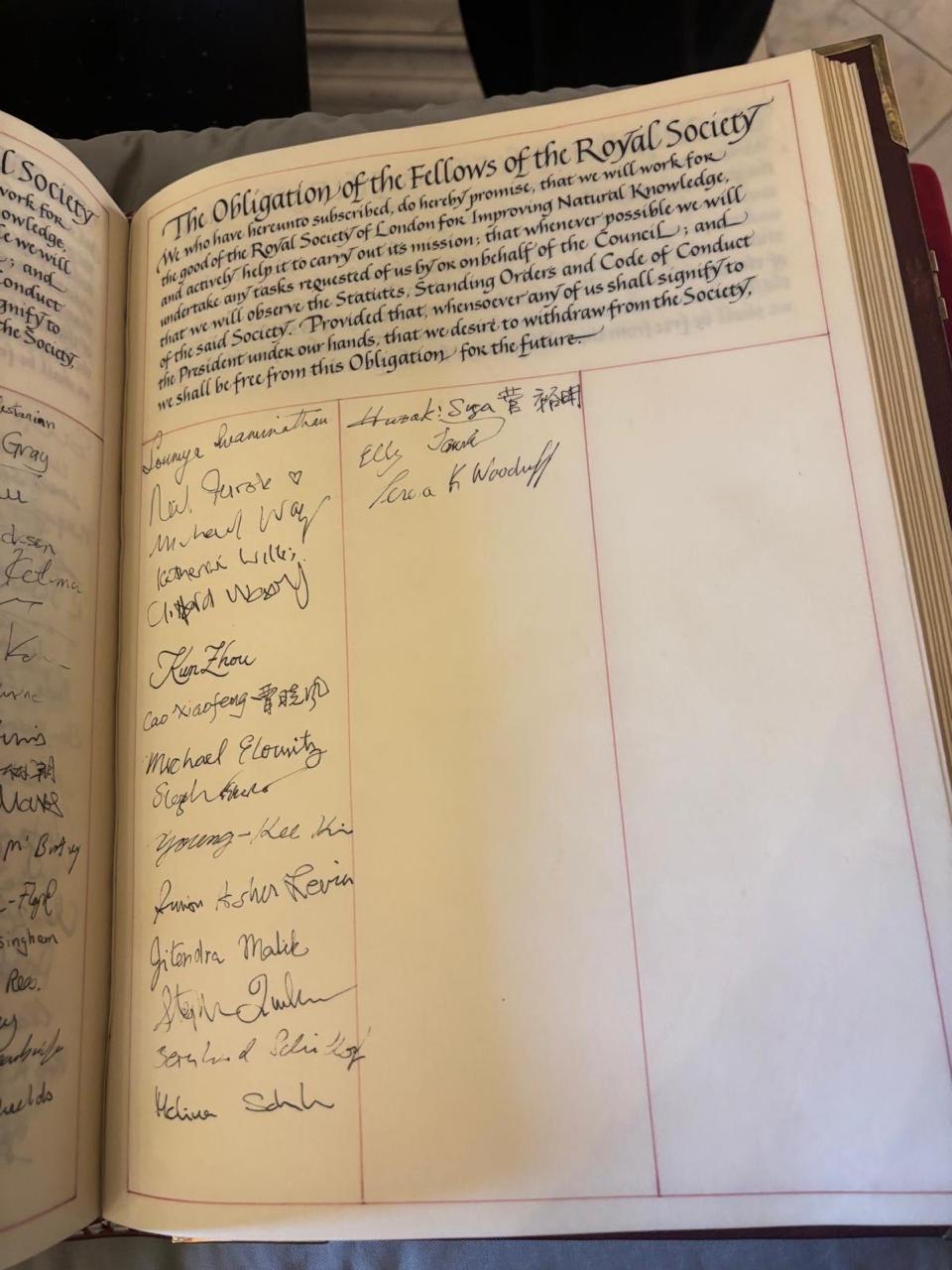
In May 2026, the Royal Society formally inducted Dr. Soumya Swaminathan as a Fellow.
The certificate she signed carries a staggering historical weight. She is only the second Indian woman in history to receive this honor, following vaccinologist Gagandeep Kang in 2019. But for Swaminathan, the ink on that parchment links back to an even more intimate history. In 1973, her late father, the legendary agricultural scientist M.S. Swaminathan—the man who engineered the Green Revolution and saved India from catastrophic famine—signed that very same book.
They are now the first father-daughter duo from India to stand together in that timeless registry. It is a stunning arc of legacy, a generational relay race where the father figured out how to feed a nation, and the daughter figured out how to keep its people alive.
Yet, if you expect her to rest on the laurels of a historic London fellowship, you misunderstand the nature of the woman.
Pomp and circumstance mean very little when there is still work to be done on the ground. Today, back in India as the Chairperson of the M.S. Swaminathan Research Foundation, she is still pushing the boundaries of what health actually means. She is vocal about the intersection of ecology, nutrition, and medicine. She champions the idea of balance, looking at health through a wide lens where human wellness cannot be untangled from the health of the animals we live alongside and the ecosystems we inhabit.
At a recent university address in Bengaluru, she looked out at a sea of young, eager graduates holding fresh degrees. She did not offer them easy platitudes. Instead, she offered a challenge.
She reminded them that scientific excellence, on its own, is an empty trophy. It cannot exist in a vacuum of ivory towers and peer-reviewed journals that no ordinary citizen will ever read. Science, she argued, must be translated with transparency, integrity, and deep compassion. It must matter to the child in the ash-polluted villages near Ennore, to the farmer navigating erratic monsoons, and to the families who have been left behind by rapid development.
The true measure of a scientific breakthrough is not the prestige of the institution that honors it. It is the distance the truth travels to reach the people who need it most.
As the celebrations in London fade into history, the work continues in Chennai, Delhi, and across the globe. The ink in the Royal Society ledger is dry, joining the signatures of Newton and Darwin. But the legacy is still being written in real-time, one breath, one child, and one community at a time.