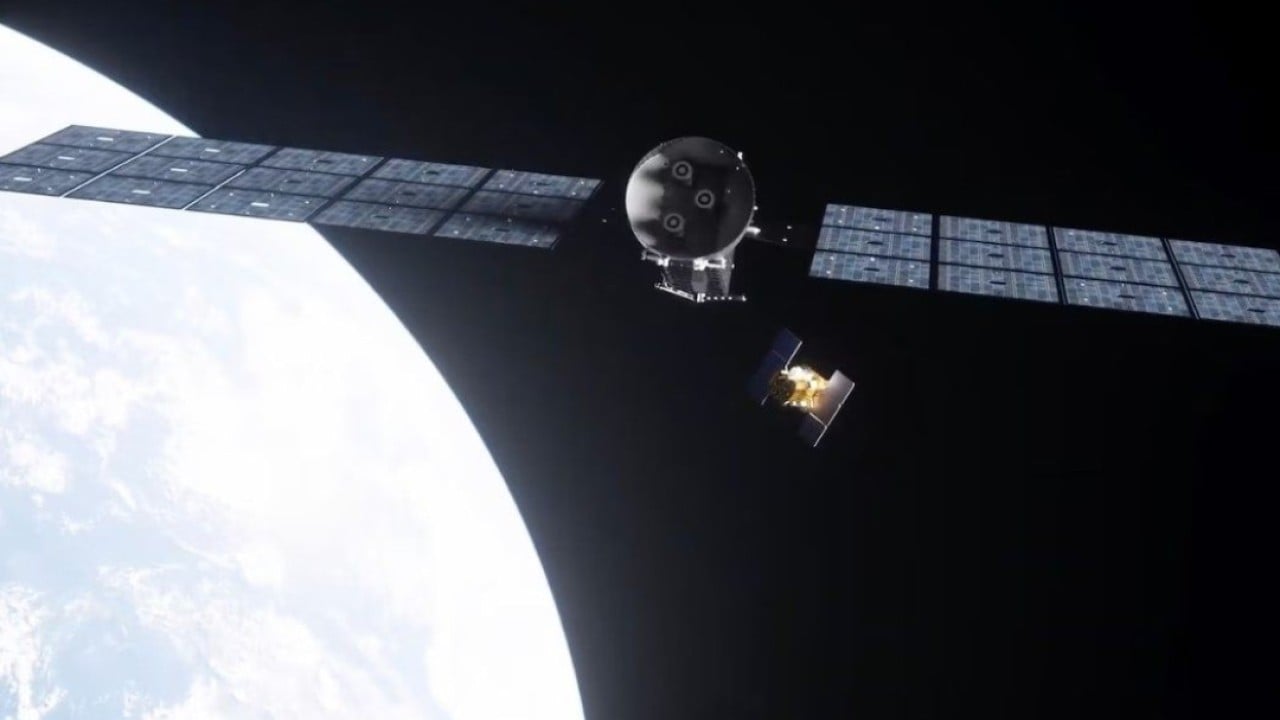
The floor of the control room always feels a little too cold at three in the morning. Screens hum with a dull, blue persistence, casting long shadows across tired faces. For months, engineers in Arizona and Maryland had stared at a slow-moving emergency written in numbers: an altitude dropping week by week, a tiny metallic dot sinking deeper into the atmospheric drag of a waking Earth.
The Neil Gehrels Swift Observatory was falling.
Launched back in 2004, Swift was never meant to sit still. It was built to pivot, to spin, to whirl around in the dark the exact second a dying star screamed across the cosmos. When a gamma-ray burst detonated billions of light-years away, releasing more energy in seconds than our sun will emit in its entire lifetime, Swift caught the ghost light. It gave humanity a front-row seat to the final, violent breaths of the universe.
Yet, space has a way of collecting debts. Intense solar activity—a barrage of high-energy particles swelling Earth's outer atmosphere—began acting like an invisible brake. Swift’s pristine six-hundred-kilometer orbital home shrank down to a precarious three hundred and sixty kilometers, and then lower still. Without intervention, the telescope was scheduled to plunge downward, turning into a streak of fire across the night sky.
Consider what happens next: a desperate gamble.
Instead of waiting for the inevitable death of a billion-dollar asset, space agencies tried something entirely unprecedented. NASA handed a modest thirty-million-dollar contract to Katalyst Space Technologies, an agile startup told to do the impossible. Build a rescue spacecraft from scratch, get it onto a rocket, and send it up to grab a falling observatory by the collar.
They named the rescue craft LINK. On July 3, riding an air-launched Pegasus XL rocket, LINK punched through the troposphere. It carried three robotic arms and a profound sense of stubborn hope. If it worked, humanity would enter a new era where orbital infrastructure could be repaired, refueled, and rescued instead of simply abandoned to space junk yards.
The timeline was merciless. Engineers had less than a year to design, manufacture, and test a machine meant to dock with a tumbling target in a vacuum.
For a few weeks, it looked like magic might actually win. But space is fundamentally indifferent to human deadlines.
Roughly three weeks into the flight, LINK stopped cooperating. A stubborn malfunction seized its attitude control system, sending the rescue probe into an uncontrollable, dizzying spin. Down on Earth, engineers scrambled. They uploaded emergency positioning software, fired thrusters for weeks, and fought tooth and nail to flatten the rotation. They managed to slow the spin, but the damage to its precision orientation was absolute.
The rescue ship needed to be stable to grab its target. Instead, it was caught in its own mechanical vertigo.
The announcement came quietly, stripped of theatricality but heavy with consequence. The rescue mission was officially called off. LINK would never wrap its robotic arms around Swift. The observatory, starved of its higher orbit, will dip deep into the atmosphere and disintegrate before the year is out.
The quiet room did not erupt into panic. There was only the heavy quiet of exhaustion and the realization that stepping into the unknown always carries the risk of a fall.
Yet, the story does not simply end with a funeral in the upper atmosphere. Even now, crippled and spinning, LINK will attempt a ghost-dance rendezvous with Swift. They will fly side by side in the dark, two broken machines sharing an orbit, trading data that will teach future engineers how to survive the next inevitable emergency.
We reached for something fragile in the void, and our fingers came back empty. But the dark remains vast, and the watchers who map it are already building the next pair of hands.