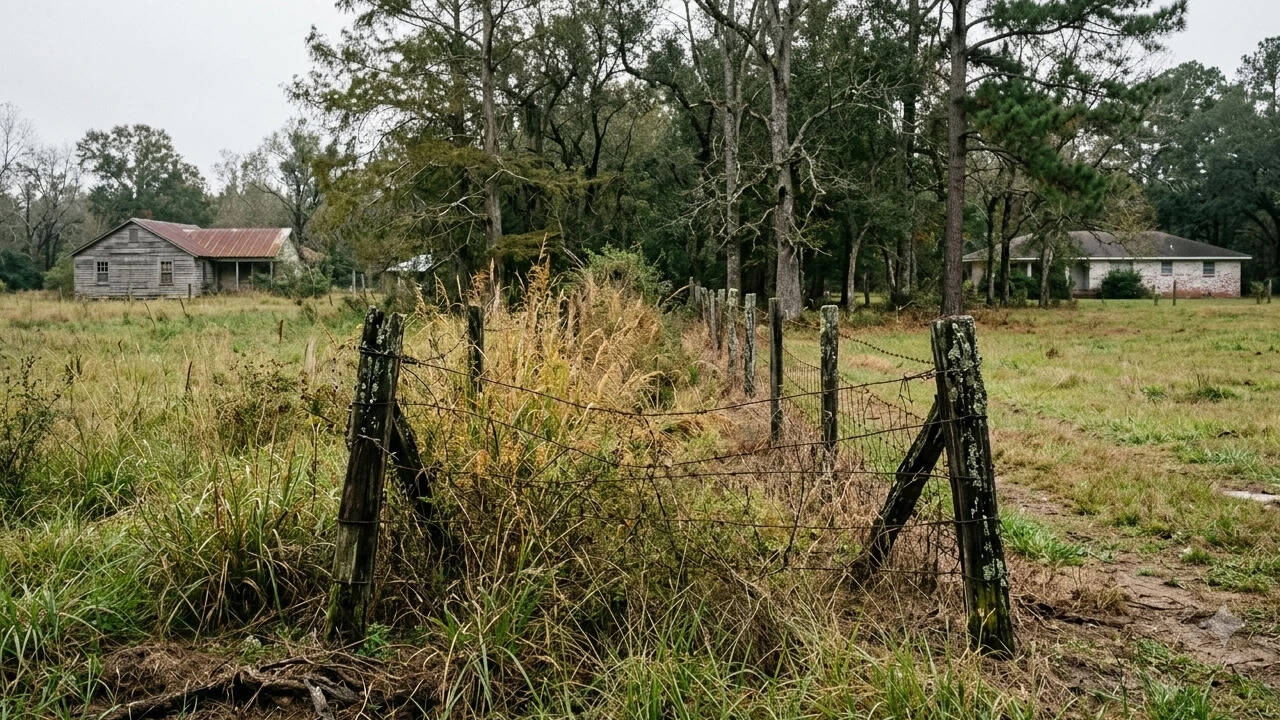
Property lines cause friction. Usually, people argue over an overgrown hedge or a misplaced fence panel. Sometimes, rural feuds escalate into something genuinely bizarre. In Farmerville, Louisiana, a dispute over a narrow seventy-foot strip of timberland escalated past standard neighborhood tension. It turned into a war zone featuring customized warning signs, blinding generator-powered lights, and a dead cow.
When courts finally stepped in, they upheld a fifteen-thousand-dollar damages award and a permanent injunction. But the legal bill only tells half the story. This rural property war exposes how fragile neighborly trust can be once boundaries blur.
How a Friendly Relationship Collapsed
The dispute happened in Union Parish. Jesse and Ruby Colvin squared off against their neighbors, Robert Bradford Jones and Roni Michelle Reppond Jones. The two couples weren't always enemies. They used to be friendly.
Things fractured when questions arose regarding a boundary line near an old, downed fence. The Colvins believed their property extended past that physical marker. The Joneses disagreed. Instead of hiring a surveyor early on and settling the matter over coffee, both sides dug in.
Real estate law doesn't care about past friendships. In Louisiana, boundaries are strictly determined by title deeds, historical possession, and established markers. When informal talks break down, things go south fast.
Escalation Tactics That Crossed the Line
The litigation officially kicked off in September 2023 when the Colvins filed a lawsuit to legally establish the boundary. Yet the real theater played out outside the courtroom.
According to court filings, the campaign of retaliation escalated quickly. The Colvins put up orange construction fencing and erected signs roughly ten feet from the northern boundary facing the Jones property. Two of those fluorescent orange signs featured text reading "No trespassing from neighbours" paired with poop emojis. A third sign announced a fictional "J-one hog farm coming soon".
Then came the lights. The Colvins set up high-powered lighting aimed squarely at the Joneses' yard. To power them, they ran a loud generator. The Joneses later testified that the generator hummed loud enough to make their entire house vibrate.
To top it all off, a dead cow appeared near the disputed property line. The psychological warfare was relentless.
What the Courts Decided
The judicial system eventually brought a reality check to the property line. The trial court reviewed the evidence, examined historical usage, and ruled in favor of the Joneses, determining that the old downed fence line represented the proper boundary.
Unhappy with the outcome, the Colvins took their case to the Louisiana Second Circuit Court of Appeal. They argued that official titles and newer surveys should override the old physical bounds.
The appellate court rejected that argument. Under Louisiana law, if parties or their predecessors possess land within visible bounds for thirty years without interruption, those bounds often hold weight. The court found no clear error in the original ruling.
The judgment wasn't just about dirt. The appeals court fully affirmed the permanent injunction against the harassment and upheld the fifteen-thousand-dollar damages award against the Colvins, alongside appeal costs.
Preventing Your Own Neighborhood Nightmare
You don't want your property dispute ending up in local news reports or legal digests. Most boundary wars start small and snowball because people rely on assumptions rather than official documentation.
If you suspect your neighbor is encroaching on your land, or if you are planning to build a fence, take these steps immediately:
- Order a professional survey: Never rely on old wooden stakes, random trees, or dilapidated fences. Pay a licensed surveyor to pull the legal plat and pin your exact corners.
- Check local civil codes: Property laws vary heavily by state. Rules regarding prescription, adverse possession, or historical boundaries dictate legal ownership far more than what you think belongs to you.
- Communicate in writing: Keep a paper trail. If a conversation turns hostile, stop talking face-to-face and move your communications to certified mail or text.
- Involve mediators early: Lawyers are expensive. Judges are unpredictable. If mediation can resolve a dispute before signs and generators enter the picture, take that route.
Boundaries define property, but they shouldn't dictate your peace of mind. Once petty retaliation begins, everybody loses, regardless of who wins in court.