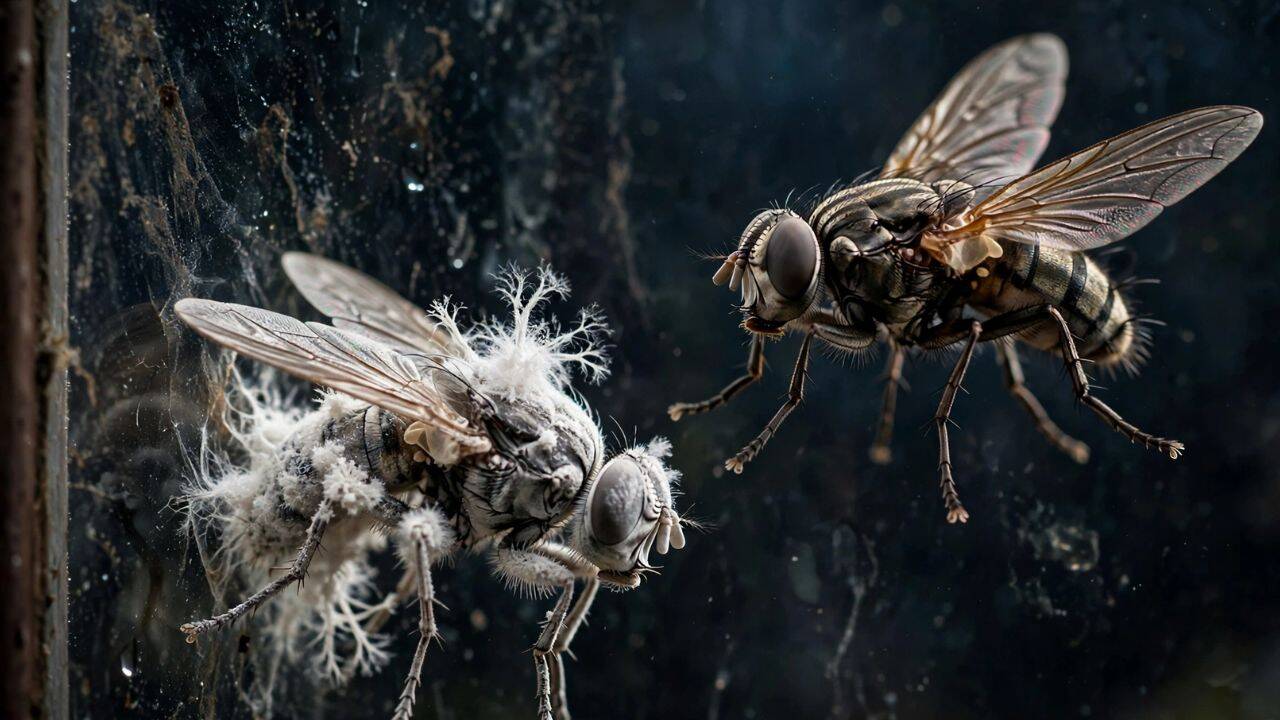
You smell it before you see it.
On a humid August morning, the forest floor does not smell like earth and pine needles. It smells like rot. It smells like a kitchen left too long in the sun, sweet and thick and sickeningly heavy. If you crouch low enough, pushing past the ferns to where the moss stays damp until noon, you enter a different scale of existence. An ancient scale. If you enjoyed this piece, you should look at: this related article.
I learned this the hard way years ago, tracking insect pathology through a dense woodlot while my fingers stained green with crushed chlorophyll. I had expected science to look clean. I had expected sterile petri dishes and quiet laboratories. Instead, I found a crime scene.
A housefly, or rather what used to be one, clung to the underside of a decaying oak leaf. Its wings were thrown back in a jagged, violent crucifix. Its legs were locked. And its abdomen was bloated, swollen tight like a drumskin, stuffed entirely with the white, powdery dust of an alien kingdom. For another look on this development, refer to the recent coverage from Mayo Clinic.
It was dead. But it was far from finished.
The Puppet Master of the Undergrowth
For centuries, naturalists watched this happen and missed the punchline. They saw Entomophthora muscae—a parasitic fungus whose name literally translates to "insect destroyer"—and they assumed it was just a simple predator. They thought it infected a fly, ate it from the inside out, and left a hollow shell behind.
They were wrong. The reality is much darker, and infinitely more strategic.
Consider what happens next in this microscopic war. The fungus does not simply kill its host. It hijacks the nervous system with terrifying precision. It drives the infected female fly upward, compelling her to climb to the highest point she can reach before her muscles seize. She drags herself up a grass stem or a tree leaf, driven by an impulse that is entirely foreign to her.
Then comes the final command.
The fungus forces the dying insect to glue her mouthparts permanently to the surface. She locks her legs in a rigor mortis death-grip. And just as her life flickers out, the fungus commands her wings to lift, parting them wide.
Why? Because physics demands it.
To spread its spores, the fungus needs altitude and clearance. By forcing the dead female to open her wings, the corpse acts as an elevated launchpad. The pressure builds inside that swollen abdomen until the body ruptures along its segments, firing microscopic spores outward in a ballistic arc.
It is a sniper rifle built out of biology.
The Deception That Fools the Living
Here is where the story shifts from ordinary parasite to psychological warfare.
Dead flies do not usually attract attention. A corpse is a warning sign. Every living creature with a pulse avoids the carcass of its own kind. Evolution hardcodes that aversion into our bones, and into the tiny, compound eyes of a healthy male housefly.
Except, the fungus factored that in.
Recent research into the pathology of Entomophthora muscae reveals a weaponized form of necrophilia that sounds like fiction. As the female fly rots on her elevated perch, the fungus pushes chemical attractants—volatile organic compounds—out through her decaying cuticle.
To a passing male fly, that corpse does not smell like death. It smells like an invitation.
It smells like sex.
I remember watching this happen under a macro lens, the sheer disbelief settling in my chest. A healthy, vibrant male landed squarely on the corpse of a female that had been dead for days. He didn't flee. He didn't hesitate. He attempted to mate with the shell.
In that single, tragic microsecond of biological confusion, the trap snapped shut.
The explosive discharge of fungal spores coated his body. Within days, his own internal organs would be consumed. He would soon feel the strange, irresistible urge to climb. He would lift his own wings, lock his legs, and wait for the next unsuspecting fool to fly by.
It is a closed loop of absolute efficiency.
The Broader Lesson of the Forest Floor
We like to think of ourselves as separate from these biological dramas. We build cities of glass and steel, condition our air, and sanitize our countertops, believing we have outsmarted the primal rules of the wild.
Yet, looking at that tiny, hijacked fly on the underside of a leaf, a strange empathy creeps in.
We are all driven by forces we only partially understand. We inherit impulses, chemical cascades, and behavioral scripts written millions of years before we drew our first breath. We think we are steering the ship, choosing our destinations, and making rational choices.
Then a little humidity hits the soil. A subtle shift in the air occurs. And we find ourselves climbing, reaching for a high place we never intended to scale, leaving our wings wide open to the wind.
The forest floor remembers what we try so hard to forget. Survival is not just about strength or speed. Sometimes, it is about patience, deception, and the terrifying realization that even in death, you can still pull the strings.