Color is not passive. It enters the eye and makes a demand on the blood.
Long before the algorithms taught us how to curate our visual diets, long before every screen in our pockets became a miniature window into neon-drenched escapism, there was a man who looked at the dull, gray concrete of mid-century America and decided it lacked sufficient electricity.
His name was Peter Max.
To understand what Max did, you have to remember what the world looked like before he got his brushes on it. The early 1960s possessed a certain heavy sobriety. Suits were charcoal. Living rooms were beige. The future was envisioned in gleaming, terrifying shades of nuclear aluminum and suburban conformity. It was a world that took itself very, very seriously.
Then came the explosion.
Cosmic runners, floating mandalas, Statue of Liberty profiles fractured into rainbows, and sweet-faced girls with flowers woven into their hair. Max did not merely paint posters; he manufactured a visual vocabulary for a generation that refused to inherit its parents' monochrome anxieties. He took the ancient iconography of peace and combined it with the sleek, high-contrast velocity of advertising and commercial art. He understood something fundamental that academic purists missed: art does not belong behind velvet ropes. Art belongs on the back of a denim jacket, on the wall of a college dorm room, on a postage stamp, on the side of a Boeing 727.
At his height, Max was everywhere. You could not turn on the television, walk down a city street, or flip through a magazine without colliding with his saturated universe. He was the visual architect of flower power, translating the amorphous, drifting philosophy of the counterculture into clean lines, pop-art sensibilities, and an optimism so bright it bordered on the psychedelic.
News arrived quietly that Max has died at the age of eighty-eight.
Eighty-eight years. Think of the distance between his early days sketching cosmic voyagers in a chaotic New York studio and the quiet twilight of his later years, when memory began to fade like an old poster left too long in a sunny window. The contrast is sharp, almost painful. The man who taught an entire culture how to look at the future with unbridled wonder spent his final chapters grappling with the cruelest thief of all: dementia.
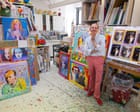
It is a strange and humbling truth about human genius. The mind that can orchestrate a universe of infinite magenta, turquoise, and cadmium yellow can eventually be silenced by the slow erosion of time. In his later years, long after the height of the 1960s cultural earthquake had subsided into history textbooks and vintage shops, Max lived surrounded by the echoes of his own vibrant past. His studio remained a sanctuary of color, even as the fog gathered around his own thoughts.
We often make the mistake of measuring artists solely by their longevity or the pristine maintenance of their faculties. But true cultural impact is not about endurance. It is about a moment of ignition. Max caught a match and threw it into a dry field, and for a glorious, technicolor decade, everyone wanted to stand in the fire.
Consider the posters. Millions of them. Printed on inexpensive paper, tacked to dorm-room walls with little dabs of blue toothpaste adhesive or pushpins. They cost a dollar or two. They were not investment pieces bought by cautious billionaires at Sotheby's. They were democratic art. A kid sitting in a drafty bedroom in Ohio could look at a Peter Max poster and feel, for a fleeting second, that the universe was vast, friendly, and vibrating with secret magic.
That was his real medium. Not acrylic on canvas. Not serigraphs. He sold a feeling.
He gave form to hope at a historical moment when hope felt desperately scarce. The Vietnam War was tearing families and campuses apart. Assassinations had stripped the nation of its political innocence. The future felt genuinely perilous. Into that fracture stepped Peter Max, offering an alternative vision of reality. Not a dark, cynical escape, but a joyful, psychedelic reclamation of joy. He insisted that peace was not just a political slogan, but an aesthetic imperative.
Critics at the time sometimes dismissed him as commercial, too eager to license his work, too comfortable with mass production. They missed the point entirely. Andy Warhol understood what Max was doing because Warhol was doing something parallel; both men recognized that the boundary between fine art and commercial culture was a ghost story invented by snobs. Max wanted his art to breathe the same air as the people. He wanted to be on cereal boxes, wristwatches, and bus shelters. He wanted the world to wear his colors.
And for a while, it did.
As the decades turned, fashion shifted toward minimalism, irony, and grunge. The neon faded into the background. The flower children grew up, took jobs in finance, bought station wagons, and filed their memories of the sixties away in attics. Yet Peter Max never really stopped painting. He kept showing up at his studio, surrounded by assistants, music, and mountains of pigment, attacking canvases with the same restless, frantic energy that defined his youth.
Now the brush has stopped.
The studio is quiet now. The colors remain, splashed across private collections, museum walls, and the fading bedroom posters of aging Boomers who still remember what it felt like to believe that love, art, and a little bit of cosmic optimism could change the trajectory of the earth.
When you walk past a vintage shop today and catch a glimpse of that unmistakable, flowing script signature in the corner of a sun-bleached print, take a moment to look closer. Do not just see the retro aesthetic. See the audacity of it. See a man who looked at a fractured, frightened world and decided, with absolute conviction, that the best response was to paint the sky until it smiled.