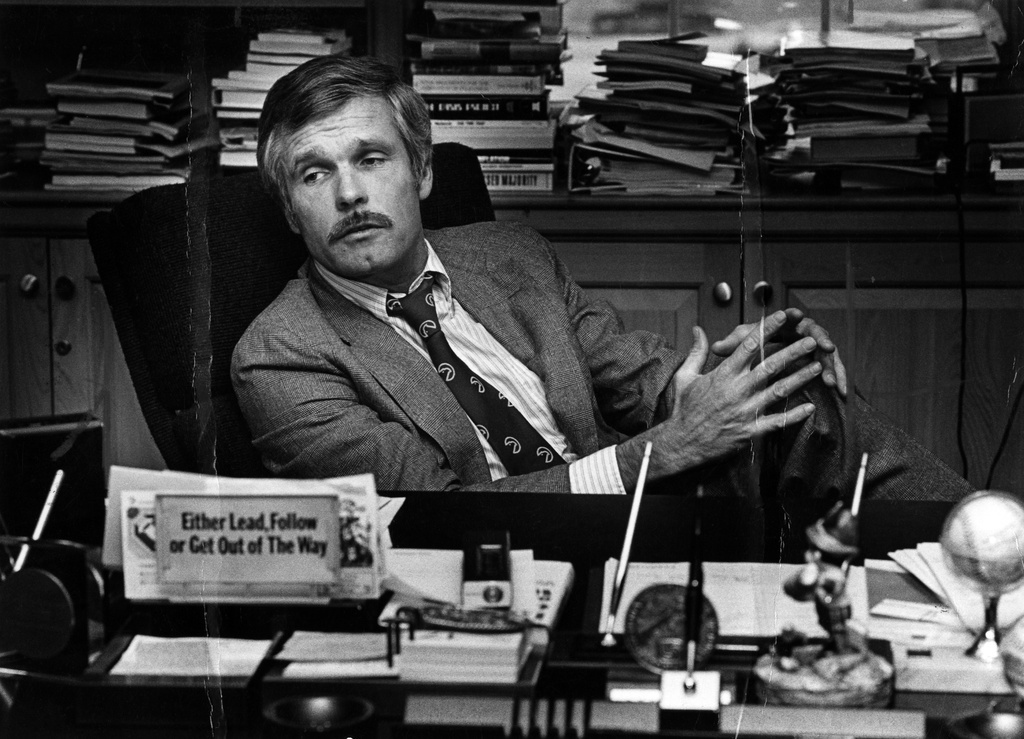
The lights in the control room didn't flicker when Ted Turner drew his last breath at eighty-seven. They stayed steady, humming with the relentless, twenty-four-hour electronic pulse that he—and he alone—forced into existence. There is a profound irony in the fact that the man who abolished the "sign-off" finally had to sign off himself.
He was a man of loud colors and louder convictions, a billionaire who lived like a storm was perpetually brewing just behind his eyes. To look at the facts of his life is to see a spreadsheet of impossible victories: the America’s Cup, the Atlanta Braves, the creation of the first 24-hour news cycle. But the facts are the skin. To understand why his passing marks the end of an era, you have to look at the bone.
The Inheritance of Dust
In 1963, Ted Turner was a young man standing in the wreckage of a life he hadn't quite built yet. His father, Ed Turner, had been a titan of the billboard industry, a man who literally sold the view. But the weight of the business, or perhaps the weight of the world, became too much. Ed took his own life, leaving twenty-four-year-old Ted with a grieving family and a company teetering on the edge of bankruptcy.
Most people would have liquidated. They would have taken the pennies on the dollar and found a quiet life in a safe cubicle. Not Ted. He didn't just want to save the billboard company; he wanted to dominate the sky. He had a fundamental, almost primal understanding that attention was the world’s most precious currency. If you could control what people saw when they looked up, you controlled their reality.
He began buying up radio stations. Then, he bought a failing UHF television station in Atlanta, WTCG. It was a joke in the industry. UHF was the grainy, flickering wasteland of the dial. But Ted saw something others missed. He saw that the world was becoming smaller, and that the wires being strung across the American landscape—the early cable lines—could act as a slingshot.
The Midnight Gamble
Imagine you are a television executive in 1980. You have three networks. You have a captive audience. At midnight, you play the national anthem, show a test pattern of a Native American chief, and go to sleep. The world, for all intents and purposes, stops turning at 12:01 AM.
Ted Turner thought that was a lie. He knew the world didn't stop. He knew that somewhere, a war was starting, a market was crashing, or a child was being born. He decided that the news shouldn't have an expiration date.
When he announced CNN, the "experts" laughed until they were breathless. They called it the "Chicken Noodle Network." They said there wasn't enough news in the world to fill twenty-four hours. They were wrong, of course. Ted knew that news isn't just what happens; it’s the feeling of being there while it happens.
He bet his entire fortune on a satellite and a dream. He was a gambler who didn't believe in the house edge. On June 1, 1980, when the first broadcast went live, he stood in front of the cameras with the manic energy of a preacher who had just seen the face of God. He promised that CNN would stay on the air until the end of the world. He even had a band record "Nearer My God to Thee" to be played as the final broadcast if the apocalypse ever arrived.
He wasn't joking.
The Mouth of the South and the Heart of a Romantic
To know Ted was to be exhausted by him. He was "The Mouth of the South," a man who spoke before he thought and often regretted it later, though he’d never admit it. He challenged Rupert Murdoch to a televised boxing match. He donated a billion dollars to the United Nations when it was unfashionable to do so. He bought millions of acres of land to save the American bison because he couldn't stand the idea of a world without them.
But beneath the bravado was a man deeply attuned to the fragility of things. His environmentalism wasn't a hobby; it was an obsession. He viewed the Earth as a business he had been hired to manage, and he was horrified by the mismanagement of his predecessors. He spoke of nuclear war and climate collapse with a terrifying clarity.
Consider a hypothetical child sitting in a living room in 1991. The room is dark, save for the blue glow of the television. On the screen, green-tinted footage shows tracer fire over Baghdad. This was the Gulf War, and for the first time in human history, the entire planet was watching the same tragedy at the exact same moment.
Ted Turner didn't just report the news; he created a global consciousness. He made it impossible to look away. He forced the suburban dad in Ohio to confront the reality of a soldier in the desert. He broke the walls of the "local" and replaced them with a "global" that was often scary, always loud, and deeply human.
The Cold Sting of Progress
The tragedy of the pioneer is that they eventually get surpassed by the very frontier they opened.
In 2000, Turner oversaw the merger of Turner Broadcasting with Time Warner, which then merged with AOL. It was, in his own words, the biggest mistake of his life. He lost his power. He lost his "baby." He watched as the lean, hungry news organization he built became a cog in a corporate machine.
He spent his final years on his massive ranches, battling Lewy body dementia. The man who lived for communication, who lived for the roar of the crowd and the buzz of the newsroom, found himself in a world that was slowly growing quiet. The storm in his eyes didn't go out; the windows just got cloudier.
His death isn't just the passing of a businessman. It is the end of the "Big Idea" era. Today, our media is fragmented. We live in echo chambers of our own making, curated by algorithms that want to keep us comfortable. Ted Turner never wanted you to be comfortable. He wanted you to be informed, outraged, and engaged. He wanted you to look at the bison, look at the news, and look at the stars.
He didn't just build a network. He built a window.
The "end of the world" band tape still sits in a vault somewhere in Atlanta. It wasn't played today. The world kept turning, just as he knew it would, fueled by the relentless 24-hour cycle he set in motion. The screen didn't go to black. It just moved on to the next story.
Somewhere, on a vast plain in Montana, a bison shakes the dust from its coat and continues to graze, unaware that its greatest champion is gone. The sky is big, blue, and empty, waiting for the next man crazy enough to try and own it.