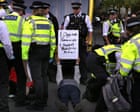
Three hundred and twenty-five arrests in a single afternoon outside the US embassy in London sounds like a scene from a major street riot. It wasn't. It was a Saturday demonstration backing a banned protest group, and almost everyone cuffed by police was accused of expressing support for a proscribed organisation under Britain's Terrorism Act.
That single day in late October 2026 captured everything crazy about modern UK protest policing. When the Metropolitan Police put the final tally at 325 arrests—with 320 specifically tied to suspected support for Palestine Action—it pushed a much bigger legal logjam into full view ahead of the UK Supreme Court's hearing on the ban.
What Happened Outside the US Embassy in London
On Saturday, October 31, 2026, demonstrators gathered outside the US embassy in London in defiance of the government's ban on Palestine Action. Police had warned beforehand that a robust operation was coming. By the time officers wrapped up and released updated figures on Sunday, 325 people had been detained.
Unlike protests that spiral into property destruction or clashes with officers, this action centered on deliberate civil disobedience—holding signs, chanting, and visibly declaring solidarity with a group outlawed under counter-terrorism laws. One protester even climbed a tree outside the embassy waving a placard while crowds below chanted. Meanwhile, solidarity activity also drew scrutiny north of the border, where Police Scotland stated inquiries were underway regarding banners and T-shirts seen around a gathering outside the US consulate in Edinburgh.
Honestly, when you look at who's getting hauled into custody at these demonstrations, the picture looks very different from what people picture when they hear the word "terrorism." Pensioners, former lawyers, teachers, and long-time campaigners have repeatedly risked arrest by holding placards challenging the ban. Watching officers lead elderly demonstrators away for holding a piece of cardboard makes the gap between counter-terrorism statutes and everyday street dissent hard to ignore.
Why Palestine Action Was Banned Under Terrorism Laws
To understand why a street rally turns into a terrorism-act arrest spree, you have to look back to July 2025, when the UK government proscribed Palestine Action. That move made membership in the group—or expressing support for it—a criminal offense under the Terrorism Act.
Palestine Action came to prominence after October 2023 through direct-action campaigns aimed at defense contractors and companies accused of supplying weapons or military equipment to Israel, including repeated actions targeting arms manufacturer Elbit Systems in Britain. Supporters argue those actions are non-violent sabotage or protest targeting supply chains. Ministers and counter-terrorism officials have taken a much harsher view, arguing that direct disruption and damage against defense sites cross a line that warrants proscription.
Here's where things get messy legally. Outlawing a direct-action protest group under anti-terror legislation doesn't just target people breaking into factories. It turns public expressions of solidarity—wearing a shirt, carrying a sign, speaking in support—into a potential crime. Critics from civil liberties circles and legal commentators have warned for months that stretching terrorism powers to cover protest slogans dilutes the meaning of genuine counter-terrorism law while criminalizing dissent.
The Court Rollercoaster Ahead of the Supreme Court
If the politics are heated, the courtroom timeline has been pure whiplash. Before the October 31 London arrests even happened, the legality of the ban had already bounced through major appellate twists:
- July 2025: The ban on Palestine Action took effect, turning support for the group into a Terrorism Act offense.
- February 2026: Three High Court judges ruled that then-Home Secretary Yvette Cooper's decision to ban the group was unlawful following a legal challenge brought by co-founder Huda Ammori.
- Court of Appeal reversal: That High Court ruling was later overturned on appeal, putting the proscription back on firm legal footing pending further review.
- Early November 2026: The UK Supreme Court heard arguments over the ban—right on the heels of the 325 embassy arrests—before reserving judgment for a later date.
Home Secretary Shabana Mahmood defended the ban ahead of the hearing, even after acknowledging in a podcast interview that some arrests had looked "very uncomfortable". That tension sums up the government's tightrope walk: insisting the law exists to protect public safety and national security while watching optics play out that alienate moderate voters and legal observers alike.
Meanwhile, the justice system is choking on volume. Reports around the Supreme Court hearing pointed to roughly 4,200 arrests overall tied to the ban and around 2,500 people charged under the Terrorism Act, with trials stalled until the Supreme Court settles whether the ban itself holds up. Even if you strongly back tough policing, freezing thousands of prosecutions while top judges weigh the underlying legality is a recipe for administrative gridlock.
What Most People Miss About Mass Protest Arrests
When headlines say police detain 325 people at pro-Palestine Action protest at US embassy in London, a lot of readers assume 325 people were violently rampaging or immediately convicted. Neither assumption tells you what's actually happening on the ground.
First, an arrest is the start of a legal process, not a verdict. People detained on suspicion of expressing support for a proscribed organization face bail conditions, investigation, potential charges, and lengthy delays—especially when court dockets are backed up behind a pending Supreme Court ruling.
Second, mass arrests can become a strategic loop rather than a deterrent. For campaign groups like Defend Our Juries, repeated high-volume arrests—especially involving older citizens or professionals who stress they aren't trying to hide—turn every rally into a public spectacle about free speech and state power. Police are left executing orders under existing law, while campaigners use the sheer number of arrests to argue the law is unworkable.
There's also a real debate over proportionality that gets lost in shouting matches. You don't have to agree with Palestine Action's tactics against defense factories to ask whether holding up a placard should carry the same statutory label as terrorism. On the flip side, ministers argue that once a group is legally proscribed, police cannot selectively ignore open breaches of the law without undermining the rule of law itself.
Practical Next Steps If You're Following or Joining Protests
If you're tracking this story—or thinking about attending any demonstration in the UK—don't rely on social media rumors or secondhand clips. Take a few practical steps to stay informed and protected:
- Read primary court and police updates. Check official statements from the Metropolitan Police, UK Supreme Court summaries, and reputable outlets like The Guardian and AP News rather than viral posts that exaggerate numbers or skip legal context.
- Know the exact legal boundaries before you go. If a group is proscribed under the Terrorism Act, slogans, clothing, and banners linked to it carry serious legal exposure. Understand what constitutes an offense before stepping onto the street.
- Line up legal support in advance. Anyone taking part in high-risk civil disobedience should know protest legal observer contacts and independent solicitors ahead of time, rather than figuring it out inside a custody suite.
- Watch the Supreme Court judgment, not just arrest counts. Big arrest numbers make dramatic headlines, but the Supreme Court's ruling on the ban's validity is what will decide whether thousands of pending cases move forward or collapse.


