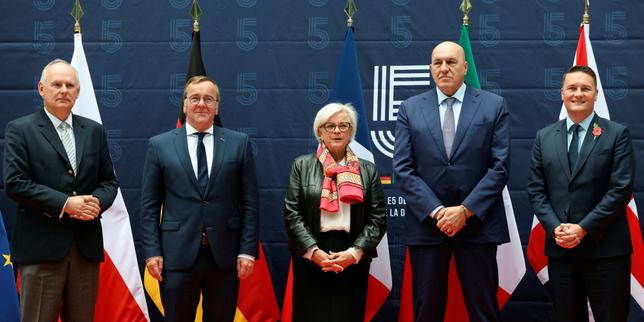
European defense ministers calling for increased domestic military investment are not issuing a routine budget request; they are acknowledging the structural collapse of the post-Cold War security dividend. For decades, European defense architecture operated on an implicit arbitrage: continental states underinvested in hard military capabilities, redirecting capital toward domestic social infrastructure while relying on the United States to underwrite high-end deterrence, strategic airlift, and intelligence, surveillance, and reconnaissance (ISR). That equilibrium is now broken. The joint declaration by five European defense ministers—representing the continent's primary military and industrial powers—signals a formal transition from aspirational diplomatic rhetoric to an industrial mobilization problem.
To understand the operational reality behind this diplomatic appeal, one must strip away the political consensus and examine the underlying mechanics of force generation, industrial capacity, and alliance economics. The ministers' core thesis—that the Euro-Atlantic space remains secure only if European states invest heavily in their own capabilities and resources—is a direct response to three converging pressures: high-intensity attrition warfare on Europe's eastern flank, the strategic pivot of American military bandwidth toward the Indo-Pacific, and the severe fragmentation of the European Defense Technological and Industrial Base (EDTIB). Meanwhile, you can read similar developments here: Jennifer Shuford’s Four-Month CDC Exit Is Not a Political Scandal It Is the Inevitable Collision of State and Federal Public Health.
The Free-Rider Equilibrium and the Deterrence Deficit
In alliance economics, collective defense behaves as a classic public good, governed by the logic of Mancur Olson’s theory of collective action. Because deterrence provided by a dominant ally is non-excludable, smaller or medium-sized allies face a rational incentive to minimize their own contributions while capturing the security benefit. Throughout the 1990s and 2000s, this dynamic manifested as structural disarmament across Europe. Force structures were optimized for low-intensity expeditionary crisis management rather than peer-to-peer territorial defense. Inventories of main battle tanks, heavy artillery tubes, and short-to-medium-range air defense systems were liquidated, while ammunition stockpiles were drawn down to levels sufficient for only days of high-intensity combat.
The ministers' demand to invest in "our own capabilities" is an admission that the resulting deterrence deficit can no longer be masked by institutional guarantees alone. Deterrence by denial—convincing an adversary that an offensive will fail to achieve its operational objectives—requires physical mass, deep magazine capacity, and logistical resilience. A treaty obligation without deployed, combat-ready brigades and industrial surge capacity is a diplomatic vulnerability. To understand the complete picture, we recommend the excellent report by The Washington Post.
This creates an acute strategic bottleneck for the Euro-Atlantic alliance. The United States military is structured around a force-sizing construct that struggles to simultaneously deter a peer competitor in the Western Pacific and sustain a major land war in Europe. When Washington diverts carrier strike groups, air defense interceptors, and strategic airlift to the Indo-Pacific or the Middle East, the European theater experiences an immediate capability vacuum. The European ministers are effectively stating that Europe must become the primary conventional security provider for its own continent, transforming the United States from a first-responder force into a strategic backstop.
Deconstructing "Capabilities and Resources" into Operational Variables
Diplomatic communiqués frequently obscure the distinction between financial inputs and military outputs. Spending two percent of Gross Domestic Product (GDP) on defense is an accounting metric, not a combat capability. A state can hit a spending target through bloated personnel pensions and inefficient procurement while fielding zero deployable divisions. When defense practitioners speak of building sovereign capabilities and resources, they are referring to four distinct operational layers that currently suffer from severe bottlenecks across Europe.
1. Strategic Enablers and Force Multipliers
European militaries possess competent tactical formations, yet they remain functionally dependent on Washington to operate at scale. These missing elements—known as strategic enablers—include:
- Heavy strategic airlift and air-to-air refueling fleets capable of moving mechanized brigades across the continent within days rather than months.
- Space-based intelligence, surveillance, and reconnaissance (ISR) assets for persistent target acquisition.
- Suppression and Destruction of Enemy Air Defenses (SEAD/DEAD) packages, which require specialized electronic warfare aircraft and anti-radiation munitions.
- Integrated theater-wide command and control (C2) networks that allow multi-national corps to share targeting data in real time.
Without independent European ownership of these enablers, European forces cannot execute complex, multi-domain operations independently. Investing in "our own capabilities" means allocating capital specifically to close these high-end technological gaps rather than merely buying more legacy platforms.
2. Deep Magazine Capacity and Attrition Readiness
Modern conventional warfare is an industrial consumption contest. Daily expenditure rates of 155mm artillery shells, surface-to-air missile interceptors, and loitering munitions in high-intensity conflict dwarf peacetime manufacturing assumptions. For thirty years, European defense firms operated on a boutique production model: low volume, high unit cost, and just-in-time supply chains with zero excess tooling. Shifting to an attrition-ready posture requires funding multi-year procurement contracts that allow manufacturers to capitalize new production lines, secure sub-tier supply chains for nitrocellulose and energetic materials, and maintain warm industrial bases.
3. Military Mobility and Logistical Infrastructure
Capabilities are useless if they cannot reach the theater of operations. European transport infrastructure—bridges, rail gauges, port facilities, and customs frameworks—was engineered for commercial efficiency, not the rapid transit of 70-ton main battle tanks from Atlantic ports to the Suwalki Gap. Upgrading dual-use infrastructure and standardizing cross-border military transit protocols represents a massive, unglamorous resource requirement that rarely features in defense ministry press releases but dictates operational timelines.
4. Defense Research, Development, and Technological Sovereignty
Relying entirely on off-the-shelf foreign acquisitions solves immediate inventory shortages at the expense of long-term industrial autonomy. When European states purchase foreign weapons systems, they often surrender control over source codes, maintenance cycles, and export permissions—constraints governed by mechanisms like the U.S. International Traffic in Arms Regulations (ITAR). True resource sovereignty requires sustained expenditure on domestic research and development (R&D) to ensure European industry owns the intellectual property for next-generation air combat, long-range precision fires, and autonomous drone swarms.
The Fragmentation Penalty in European Defense Economics
The primary obstacle preventing Europe from converting its collective economic weight into commensurate military power is not a lack of aggregate capital, but structural fragmentation. The combined GDP of European NATO members rivals that of the United States, yet their collective military output is a fraction of Washington's. This inefficiency is driven by national industrial protectionism.
Instead of pooling demand to achieve economies of scale, European governments routinely split procurement budgets across competing domestic champions. Europe operates multiple distinct types of main battle tanks, infantry fighting vehicles, fighter aircraft, and frigate classes, whereas the United States relies on a tiny fraction of that platform diversity. This fragmentation imposes a severe economic penalty across the entire lifecycle of military hardware:
- Duplicated R&D Overhead: Billions of euros are wasted reinventing identical baseline technologies across parallel national programs, starving frontier innovation of capital.
- Sub-Optimal Production Runs: Small national order books prevent manufacturers from amortizing fixed tooling costs, driving up unit prices and extending delivery schedules.
- Logistical Nightmare in the Field: When a multinational NATO battle group deploys, differing ammunition calibers, spare parts inventories, and maintenance protocols complicate sustainment under fire.
The joint appeal by the five defense ministers is an implicit attempt to enforce demand aggregation. By aligning their strategic messaging, these states are attempting to create a political framework that justifies joint procurement, shared industrial workshare agreements, and harmonized technical standards.
The Execution Friction: Where the Strategy Breaks Down
While the strategic logic of European defense self-reliance is sound, executing this transition faces severe structural headwinds. An objective assessment must account for four primary points of friction that threaten to stall the ministers' agenda.
The Industrial Workshare Trap
Joint European defense projects frequently collapse or suffer massive cost overruns due to the principle of juste retour—the political demand that a nation’s industrial return must strictly match its financial contribution. Rather than awarding contracts to the most efficient prime contractor and sub-tier suppliers, governments carve up engineering and assembly work across national borders to appease domestic labor unions. This politicization of the supply chain guarantees delays and inflates unit costs, undermining the very efficiency joint procurement is meant to achieve.
Fiscal Compression and Competing Domestic Mandates
European economies face aging demographics, rising healthcare and pension liabilities, high public debt-to-GDP ratios, and the capital demands of the energy transition. Sustaining defense budgets above two or three percent of GDP over a decade requires politically painful fiscal trade-offs: raising taxes, cutting social transfers, or expanding sovereign debt. Unlike a one-time stimulus package, defense capabilities require permanent recurring funding for operations, maintenance, and personnel salaries. When immediate geopolitical panic subsides, domestic political pressure invariably reverts to raiding defense capital accounts to fund social programs.
Labor and Raw Material Bottlenecks
Money cannot instantly buy industrial output when physical supply chains are constrained. European defense manufacturers face acute shortages of specialized aerospace engineers, machinists, and welders. Concurrently, global supply chains for critical minerals, semiconductors, and chemical precursors for explosives are heavily concentrated outside Europe, exposing European rearmament to external chokepoints and price shocks.
The Transatlantic Industrial Tension
A push for European industrial preference inevitably creates friction with Washington. U.S. defense contractors rely heavily on European Foreign Military Sales (FMS) to sustain their own production lines and lower unit costs for the Pentagon. Conversely, European leaders argue they cannot build an autonomous industrial base if European taxpayers' money is overwhelmingly routed to American factories. Balancing the urgent need for immediate off-the-shelf readiness (which often favors U.S. systems available now) against the long-term goal of European industrial sovereignty (which requires waiting for domestic systems to mature) remains an unresolved strategic dilemma.
Operationalizing the Mandate: The Strategic Play
For European defense ministries to move beyond declarative statements and actually secure the Euro-Atlantic space through indigenous capacity, they must abandon incrementalism and implement three structural reforms in procurement and force planning.
First, European governments must shift from bespoke national specifications to strict commercial-style off-the-shelf joint procurement. Defense ministries must freeze national customization requests—the primary driver of cost overruns and schedule slippage—and commit to multi-year, pooled block-buys of existing proven European platforms, particularly in air defense, artillery systems, and armored vehicles. Predictable, decade-long order books are the only mechanism that will convince private capital and defense prime contractors to build new factories without demanding excessive risk premiums.
Second, European states must establish a dedicated, ring-fenced funding mechanism specifically for strategic enablers, managed at the multinational level. Rather than expecting twenty-plus individual nations to buy fragmented slices of space-based ISR, heavy airlift, and electronic warfare capabilities, the major European powers must pool capital into common-funded fleets modeled on NATO’s existing Airborne Early Warning and Control (AWACS) program. This eliminates duplication and immediately closes the operational gaps that keep Europe dependent on American force multipliers.
Third, defense ministries must overhaul their regulatory and financial frameworks to reclassify defense manufacturing as critical strategic infrastructure. This requires mandating that European public and institutional lending banks remove environmental, social, and governance (ESG) exclusions that currently starve sub-tier defense suppliers of working capital and credit lines. Without cheap, accessible debt financing for the thousands of small and medium-sized enterprises that produce castings, optics, and electronics, the prime contractors will remain bottlenecked regardless of how much top-line budget governments approve. Security in the Euro-Atlantic space will ultimately be determined not by the volume of ministerial communiqués, but by the throughput speed of European factory floors.


