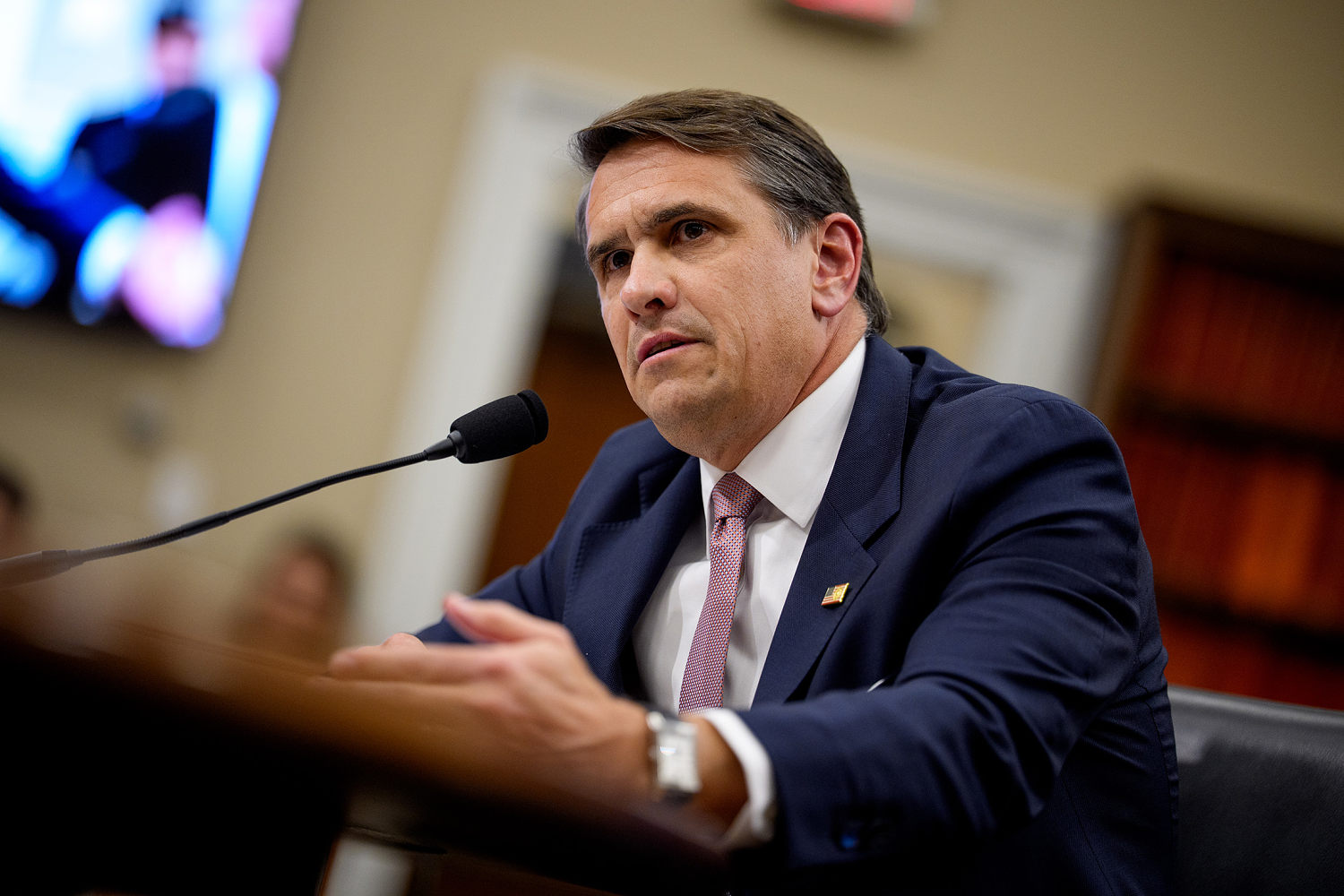
President Donald Trump’s decision to formally nominate Acting Attorney General Todd Blanche to the permanent role of Attorney General signals a structural shift in the administration's execution of federal law enforcement strategy. Far from a routine personnel rotation, the elevation of the president’s former lead defense counsel constitutes a deliberate realignment of the Department of Justice (DOJ) around two operational parameters: absolute executive alignment and rapid, institutional counter-offensives. By replacing the conventional distance between the White House and the DOJ with a direct pipeline of personal trust, the administration is optimizing the department for speed and compliance in its policy execution.
Understanding the strategic implications of this nomination requires an examination of the structural mechanics of the modern DOJ, the executive friction points that precipitated the removal of former Attorney General Pam Bondi, and the specific legislative barriers Blanche must navigate to secure Senate confirmation.
The Transition Matrix: From Bondi to Blanche
The structural friction within the second Trump administration’s Justice Department can be modeled as a mismatch between executive objectives and bureaucratic friction. The abrupt dismissal of Pam Bondi in April 2026 occurred after her efforts to initiate prosecutions against perceived political adversaries stalled within the department’s internal review mechanisms. This created an operational bottleneck for a White House prioritizing immediate, tangible action against legacy institutional actors.
Blanche's rapid ascent from Deputy Attorney General to Acting Attorney General, and finally to the permanent nominee, reflects an intentional strategy to eliminate this bottleneck. While Bondi approached the office through the lens of a political ally and former state attorney general, Blanche operates with the specific tactical familiarity of a federal criminal defense attorney who spent years deconstructing federal indictments from the outside. This operational divergence yields two distinct models of departmental leadership:
- The Political Compliance Model (Bondi): Relies on external rhetoric and top-down directives to force institutional pivots, which frequently collide with civil service regulations, procedural guardrails, and career-attorney resistance.
- The Litigator Alignment Model (Blanche): Leverages granular familiarity with federal criminal procedure, the United States Attorneys' Manual, and internal administrative levers to accelerate investigations from within, bypassing traditional bureaucratic friction points.
Blanche utilized his tenure as acting chief to establish his utility to the executive branch, initiating rapid investigations into prior administration officials and orchestrating high-profile policy shifts designed to signal complete loyalty to the administration’s core agenda.
The Three Pillars of Departmental Realignment
To evaluate how Blanche intends to govern the permanent department, his recent actions can be categorized into three distinct operational pillars. Each pillar addresses a specific executive objective while introducing corresponding institutional stressors.
1. Systematic Retribution and Counter-Investigations
Blanche has reoriented the department’s investigative priorities toward past law enforcement and intelligence officials. The primary mechanism for this effort was his appointment of Joseph diGenova, an 81-year-old former Reagan-era prosecutor, to lead a specialized, Florida-based grand jury probe. This investigation targets allegations of a decade-long conspiracy by intelligence officials to undermine the president.
By outsourcing this high-stakes probe to an outside veteran rather than relying on career public integrity prosecutors in Washington, Blanche established a parallel investigative track designed to minimize internal institutional leaks and maximize compliance with executive intent.
2. The Financialization of Ideological Redress
The most controversial mechanism introduced during Blanche’s acting tenure was the creation of a $1.776 billion "Anti-Weaponization Fund". Structured as part of a civil lawsuit settlement between the president and the Internal Revenue Service, the fund was designed to financially compensate individuals who claimed they were targets of political persecution by prior administrations.
From an analytical standpoint, this fund represented an attempt to use departmental settlement authority to establish an extraordinary administrative remedy outside the standard congressional appropriations process.
3. Institutional Transparency as a Political Lever
Blanche oversaw the selective redaction and public distribution of highly sensitive government files, most notably the investigative dossiers related to Jeffrey Epstein. This shift establishes a precedent where the department’s disclosure mechanisms are deployed strategically to fulfill campaign transparency promises, shifting the DOJ's traditional posture of strict confidentiality regarding closed investigative files.
The Cost Function of Aggressive Loyalism
While Blanche’s aggressive maneuvers successfully secured the president's formal nomination, they have generated severe blowback, exposing the mathematical and political limitations of running the DOJ as an extension of a personal defense firm. This friction culminated in a significant retreat just days before his nomination announcement.
The "Anti-Weaponization Fund" triggered a bipartisan backlash in the Senate. The operational flaw lay in its broad eligibility parameters. During congressional testimony, Blanche declined to rule out the possibility that individuals convicted of violent offenses during the January 6, 2021, Capitol riot could apply for payouts. This stance alienated key Senate Republicans, whose votes are mathematically required for his permanent confirmation.
The resulting political bottleneck threatened the passage of a critical budget reconciliation bill containing the administration’s immigration enforcement funding. Faced with a choice between preserving the fund or stalling the administration's broader legislative agenda, Blanche executed a sharp reversal. Following a federal court ruling that temporarily blocked the program, he informed lawmakers that the department would completely halt the fund.
This tactical retreat demonstrates a core vulnerability in Blanche's strategic position: his efforts to maximize loyalty to the executive branch directly degrade the political capital required to clear the legislative hurdles of the Senate.
The Confirmation Calculus: Mapping Senate Variables
Securing a permanent appointment requires Blanche to convert his acting authority into a successful Senate confirmation vote. While he cleared his Deputy Attorney General confirmation in March 2025 with a tight 52–46 party-line vote, the calculus for the top position has grown significantly more complex.
[Senate Judiciary Committee Review] ──> [Bipartisan Deficit Evaluation] ──> [Floor Confirmation Vote]
               │                                      │
               ▼                                      ▼
    Epstein Dossier Redactions             Anti-Weaponization Fallout
The upcoming Senate Judiciary Committee hearings will focus heavily on two specific areas of vulnerability:
- The Bipartisan Deficit: The fallout from the $1.776 billion settlement fund has created friction with moderate Senate Republicans who view the initiative as an unconstitutional evasion of the power of the purse. Because the Republican majority is narrow, the defection of even a few senators breaks the confirmation model.
- The Personal Lawyer Paradox: Opposition Democrats will focus their strategy on Blanche's professional history. They will argue that an attorney who successfully managed a president's personal criminal defense cannot structurally transition to an independent officer of the constitution. His previous testimony—where he insisted the president would never ask him to perform illegal acts—will be weaponized to present him as an agent of executive overreach rather than a defender of statutory law.
The administration is betting that the elimination of the anti-weaponization fund will pacify legislative holdouts. However, Blanche will still face intense scrutiny regarding his involvement in dismissing high-profile corruption cases, such as the ongoing federal matter involving New York City Mayor Eric Adams.
Strategic Recommendation
The White House must recognize that Blanche’s primary value asset—his willingness to deploy the DOJ's instruments aggressively on behalf of the executive—is also his greatest confirmation liability. To guarantee his confirmation without permanently damaging the department's operational efficacy, the administration must execute a deliberate two-step pivot.
First, Blanche must undergo an immediate rhetorical re-centering ahead of his Senate hearings. He must temporarily shelve highly politicized initiatives and frame his upcoming tenure through the lens of institutional stabilization and standard prosecutorial metrics, highlighting his eight-year background as a federal prosecutor in the Southern District of New York. By emphasizing his past management of the violent crimes unit and his work on complex white-collar investigations, he can offer moderate senators the institutional cover they need to vote in his favor.
Second, once confirmed, the operational focus must shift away from novel, legally precarious financial mechanisms like the anti-weaponization fund, which invite judicial intervention and legislative gridlock. Instead, the department should channel its objectives through established statutory frameworks. Executive priorities can be achieved legally and efficiently by reallocating traditional civil rights resources, altering internal prosecutorial guidelines, and utilizing traditional independent counsel appointments. This approach secures the executive branch's core objectives while protecting the department from costly defeats in federal court.