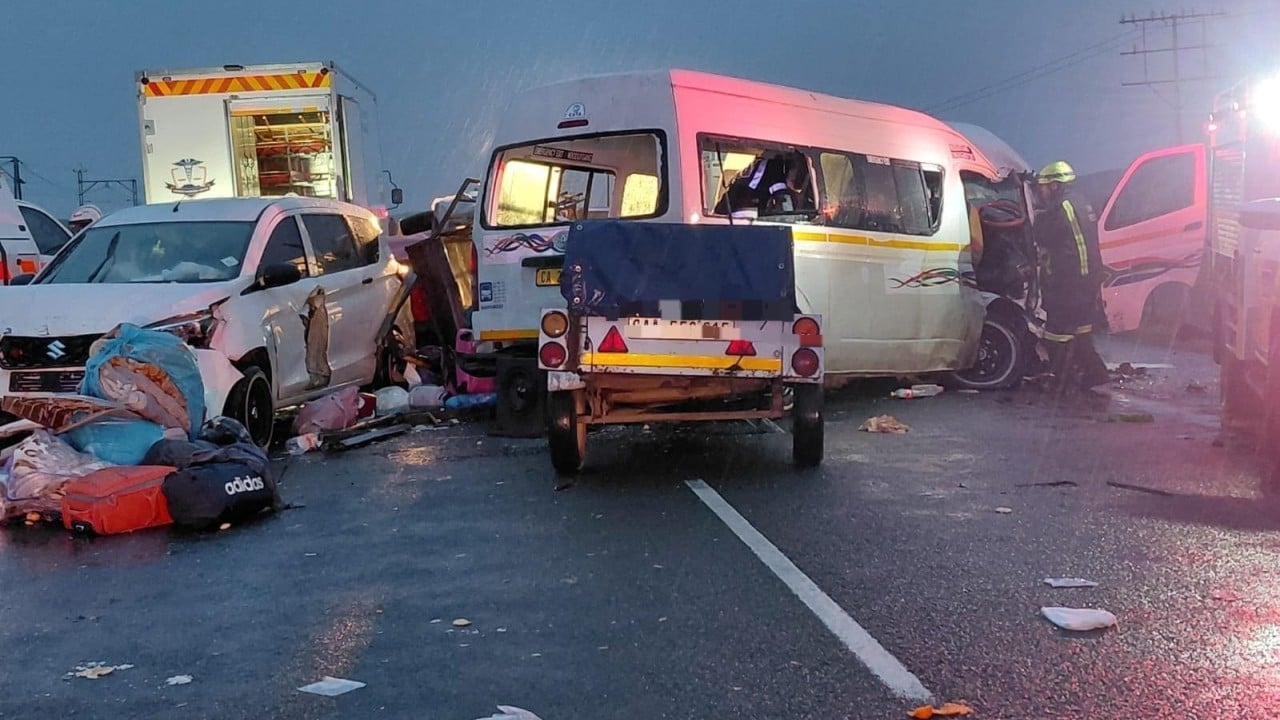
Mass casualty traffic incidents rarely represent isolated anomalies. When twenty-one individuals lose their lives in a multi-vehicle highway collision on arterial transit corridors such as the Western Cape section of the N1, the event functions as a visible intersection of underlying economic, structural, and regulatory pressures. Analyzing such a tragedy requires stripping away superficial narratives of driver error to examine the systemic vulnerabilities embedded within public transport models, infrastructure design, and enforcement architectures.
The Economic Architecture of Informal Transit
Public transit networks in developing economic zones frequently rely on decentralized, privately operated micro-transport vehicles rather than state-subsidized mass transit systems. Minibus taxis dominate commuter transit across South Africa, moving millions of workers daily. However, the financial model governing these operations creates perverse incentives regarding safety and speed.
Operators face high capital acquisition costs, fluctuating fuel prices, and steep maintenance expenses against compressed profit margins. Revenue generation depends entirely on passenger volume and trip frequency. Every hour spent stationary for routine maintenance or safety inspections represents a direct loss of income. Consequently, vehicle maintenance schedules are often stretched to mechanical breaking points. Tires run past tread limits, braking systems degrade, and suspension components endure severe cyclical fatigue.
Driver compensation structures mirror these pressures. Drivers rarely receive a fixed wage; instead, they operate under a daily quota system where earnings above a specified threshold translate into personal income. This structure links driver remuneration directly to velocity and trip turnaround times. Extended shifts, fatigue, and aggressive driving maneuvers become rational behavioral responses to an irrational economic environment. When high-speed long-distance routes intersect with these operational pressures, the probability of catastrophic failure increases exponentially.
Corridor Physics and Kinetic Energy Disparities
The physical dynamics of multi-vehicle collisions on high-speed national corridors involve extreme energy exchanges. The September incident on the N1 highway between Prince Albert and Leeu-Gamka involved high-capacity minibus transport units colliding with utility vehicles under night-driving conditions.
Kinetic energy scales quadratically with velocity ($KE = \frac{1}{2}mv^2$). When mass-market transport vehicles, optimized for passenger density rather than structural crashworthiness, operate at national speed limits, the margin for error narrows to zero. Unlike heavy commercial rail or regulated intercity bus liners, standard light commercial passenger transport configurations lack advanced energy-absorbing crumple zones, reinforced side-impact beams, and certified passenger restraint systems.
Nighttime operations introduce additional physical variables. Visual acquisition distances drop significantly under low-illumination highway conditions, reducing reaction times below the physiological threshold required for evasive maneuvering. When a head-on or angle collision occurs between vehicles traveling at combined velocities exceeding one hundred and twenty kilometers per hour, the resulting deceleration forces exceed human physiological survivability limits. The presence of multiple vehicles multiplies the collision vectors, transforming a primary impact into a sequence of secondary crushing events.
The Regulatory Enforcement Deficit
Legislative frameworks governing road safety exist across municipal and national jurisdictions, yet enforcement mechanisms suffer from structural bottlenecks. Traffic management authorities operate under severe resource constraints relative to the vast geographic spread of national road networks.
Inspection stations and random vehicle checkpoints target visible compliance metrics, such as licensing documentation and basic lighting functionality, but often fail to diagnose internal mechanical fatigue, structural chassis compromise, or driver fatigue levels. The informal nature of large segments of the transport industry complicates oversight. Fleet operators can bypass formalized registry systems, and drivers frequently operate without standardized certification or compliance histories.
Corruption within licensing and testing bureaus further degrades the integrity of the regulatory shield. When commercial transport permits and driver competency certificates can be acquired outside merit-based evaluation protocols, unqualified operators enter high-risk transit corridors. The enforcement vacuum allows substandard vehicles to remain operational until catastrophic failure forces a reactive state response.
Structural Interventions and Systemic Overhaul
Preventing future mass-casualty incidents requires moving past reactive punitive measures such as criminal investigations and temporary road closures. True risk reduction demands a fundamental redesign of transport economics and infrastructure safety protocols.
First, the capital structure of public transport must be transformed. Shifting from fragmented owner-operator models to consolidated, capitalized corporate transit networks allows for centralized maintenance fleets, standardized safety equipment, and salaried drivers. A salaried operating model eliminates the economic incentive for reckless speed and excessive daily driving hours.
Second, infrastructure enhancements must address the physical realities mixed-traffic corridors present. National highways shared by heavy freight trucks, high-speed passenger vehicles, and light commercial transport require physical median barriers to eliminate the possibility of head-on collisions. Dedicated public transport lanes, improved lighting at high-risk rural junctions, and intelligent transport systems monitoring vehicle speeds in real-time can mitigate human error.
Third, regulatory oversight must transition from random physical spot-checks to continuous digital telemetry monitoring. Mandating telematics systems across all commercial passenger transport vehicles enables real-time tracking of speed, braking intensity, and operating hours, triggering automated penalties for safety violations before collisions occur.
The loss of twenty-one lives on a single stretch of highway signals an urgent need to reallocate capital and political will toward systemic transportation reform. Until the structural economics of public transport align with passenger safety, catastrophic collisions will remain an inevitable outcome of a broken transit network.