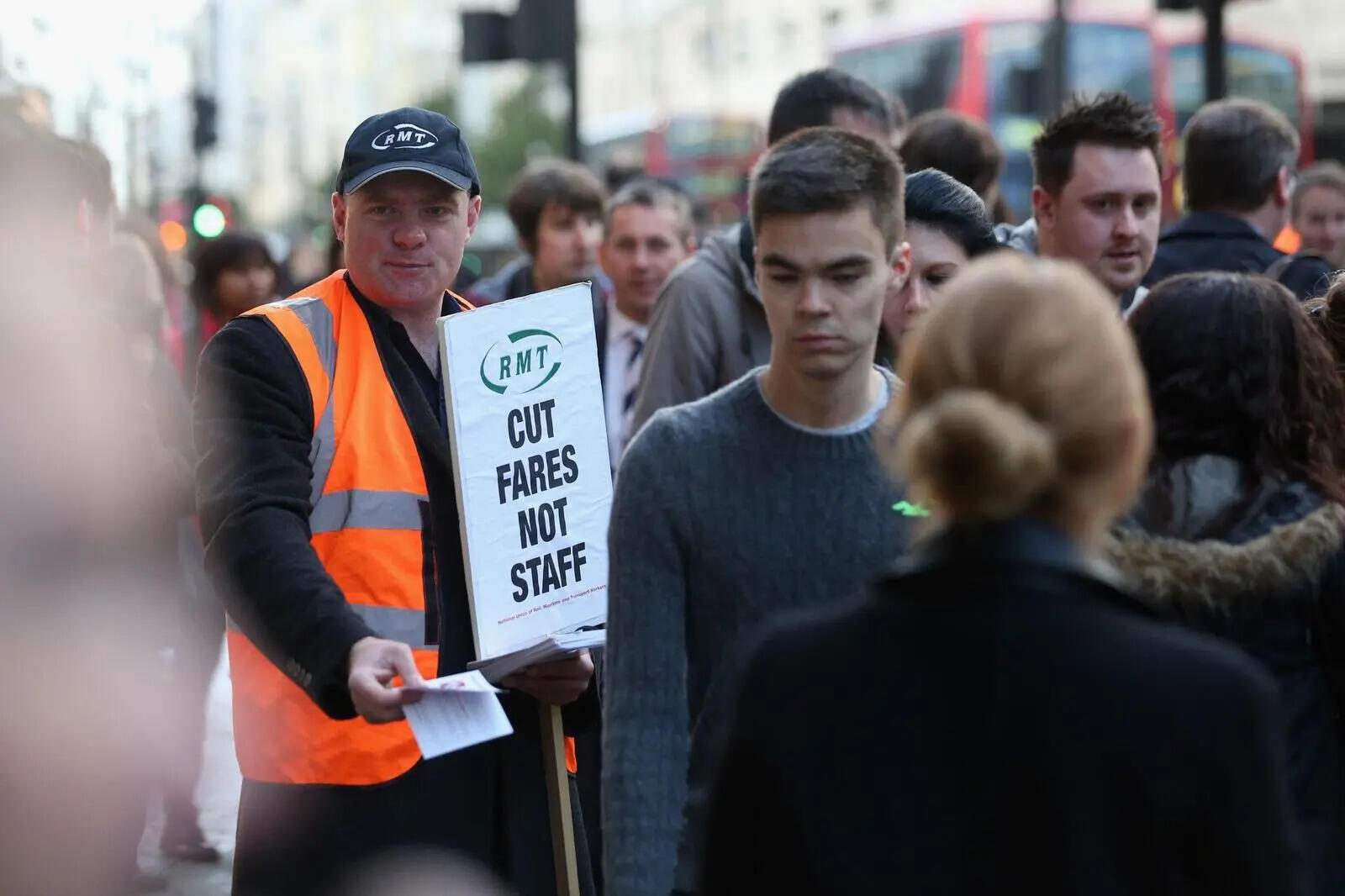
The announcement of impending industrial action on the London Underground highlights a recurring vulnerability in metropolitan infrastructure: the disproportionate leverage wielded by centralized transit labor forces over localized economies. When negotiations between Transport for London (TfL) and trade unions reach a deadlock, the resulting disruption is typically framed by public media as a mere logistical inconvenience. This view obscures the predictable, systemic economic cost function that governs such events.
To evaluate the true impact of a London Underground strike, one must move past the rhetoric of "last-ditch talks" and instead analyze the structural bottlenecks, labor economics, and network dependencies that dictate the outcomes of these disputes.
The Tri-Primal Architecture of Transit Disputes
Every mass transit labor dispute operates within a rigid tripartite framework. The breakdown of any single pillar within this architecture guarantees operational failure.
                  [ The Dispute Architecture ]
                               |
        +----------------------+----------------------+
        |                      |                      |
[ Structural Wage      [ Operational Autonomy  [ Fiscal Solvency
  Compression ]          vs. Automation ]        Constraints ]
1. Structural Wage Compression and Inflation Indexation
The primary driver of industrial action is the divergence between nominal wage growth and the localized cost of living. In highly dense urban centers like London, macroeconomic inflation acts as a real-term pay cut for fixed-salary employees. Unions demand indexation—pegging wage increases to the Retail Prices Index (RPI) or Consumer Prices Index (CPI)—to preserve purchasing power. Conversely, management views indexation as a dangerous structural liability that permanently inflates the baseline operating cost for subsequent fiscal years.
2. Operational Autonomy vs. Technological Automation
Beyond monetary compensation, the underlying friction frequently stems from working conditions, specifically shift patterns, roster flexibilities, and the introduction of automated systems. As infrastructure modernizes, management attempts to optimize labor deployment through algorithmic scheduling and reduced headcount at physical stations. Labor unions view these optimizations as an erosion of job security and a dilution of collective bargaining power. The dispute is therefore a battle for sovereignty over the operational rulebook.
3. Fiscal Solvency Constraints
TfL operates under a structural deficit exacerbated by shifting post-pandemic passenger behaviors, such as the permanent adoption of hybrid working models. Unlike fully nationalized transit systems or purely private operators, TfL relies on a delicate mix of passenger fare revenue, commercial advertising, and central government grants. Because the government frequently conditions financial settlements on cost-reduction mandates, TfL management possesses remarkably narrow fiscal guardrails. They cannot simply buy peace with generous wage packages without triggering a structural deficit or raising fares, the latter of which risks a political backlash and demand destruction.
The Network Effect and Commuter Cascades
The economic damage of a Tube strike is not confined to the shuttered platforms of the Central or Jubilee lines. It propagates through the wider transport network via a series of predictable cascading failures.
The London Underground serves as the high-capacity spine of the capital's transit ecosystem. When this spine is severed, demand does not vanish; it shifts to secondary and tertiary networks that lack the capacity to absorb the volume.
- The Surface Fleet Bottleneck: London’s bus network operates on surface streets subject to fixed spatial constraints. When millions of underground passengers divert to buses, boarding times multiply, dwell times at stops lengthen, and the overall commercial speed of the fleet plummets.
- The Modal Shift to Private Hire: Commuters with higher price sensitivity shift toward private hire vehicles and ride-hailing applications. This sudden surge triggers algorithmic surge pricing, extracting discretionary capital directly from consumers. More critically, it floods the road network with low-occupancy vehicles, causing widespread traffic congestion that paralyzes commercial logistics and surface freight.
- Active Travel Saturation: While walking and cycling absorb a fraction of short-haul journeys, infrastructure constraints—such as the density of cycle lanes and the availability of bike-share schemes—cap the maximum absorption capacity of active travel modes.
The result is a geometric increase in journey times across all modalities. A commuter whose journey normally takes 45 minutes via the Victoria line faces a multi-modal commute exceeding two hours. This represents a direct extraction of productive time from the economic ecosystem.
Quantifying the Cost Function of Urban Stagnation
To calculate the macroeconomic friction of a 24-hour Tube strike, economists utilize a multi-variable cost function. The total economic loss ($L$) is the sum of direct revenue losses, productivity degradation, and secondary transactional dampening.
$$L = R_{lost} + P_{drop} + T_{shrunk}$$
Direct Fare Revenue Attrition ($R_{lost}$)
During a strike, TfL suffers an immediate, irrecoverable drop in daily farebox receipts. While some travelers hold annual or monthly Travelcards—meaning their capital is already captured—pay-as-you-go (contactless and Oyster) revenues drop toward zero on suspended lines. This cash flow interruption worsens TfL's working capital position and reduces the internal funds available for capital expenditure projects, such as line extensions and rolling stock renewals.
Productivity Degradation ($P_{drop}$)
The most severe financial damage occurs within the service-oriented knowledge economy of central London. The loss can be categorized into two distinct buckets:
- Absenteeism: Workers who cannot access alternative transport or work remotely miss their shifts entirely. This is highly disruptive for hospitality, retail, and healthcare sectors where physical presence is non-negotiable.
- Presenteeism and Fatigue: Workers who endure grueling multi-hour commutes arrive at their workplaces with significantly reduced cognitive and physical capacity. The output per hour drops sharply, creating an invisible drag on corporate productivity.
Secondary Transactional Dampening ($T_{shrunk}$)
The hospitality, leisure, and retail sectors bear the brunt of secondary dampening. High-street footfall in central retail districts drops precipitously during a strike. Consumers defer non-essential shopping trips, cancel restaurant reservations, and avoid West End entertainment venues. While a portion of this economic activity is deferred rather than lost entirely, a significant percentage of impulse retail spend and time-sensitive hospitality revenue is permanently destroyed.
The Strategic Asymmetry of Industrial Action
The persistence of transit strikes stems from a fundamental asymmetry in leverage between union leadership and transit management.
| Variable | Union Position | Management (TfL) Position |
|---|---|---|
| Leverage Source | Total monopoly over operational labor supply. Systems cannot run without safety-critical staff. | Control over capital allocation, long-term employment contracts, and regulatory frameworks. |
| Pain Tolerance | High in the short term. Strike funds cushion individual wage losses for workers during brief walkouts. | Low to moderate. Public and political pressure mounts rapidly as gridlock paralyzes the capital. |
| Primary Objective | Maximization of long-term real wages, preservation of headcount, and retention of strict work rules. | Cost containment, modernization of working practices, and maintenance of structural fiscal balance. |
This asymmetry explains why last-minute talks frequently break down. For union leadership, authorizing a strike is a rational exercise of monopoly power designed to test management’s breaking point under political pressure. For management, capitulating to structural cost increases threatens long-term insolvency, making resistance a fiscal necessity.
Systemic Failures in Current Mitigation Strategies
The current playbook for managing industrial action relies on two primary mitigation levers: encouraging remote work and increasing surface transit frequency. Both approaches suffer from structural limitations that prevent them from fully offsetting the disruption.
The Remote Work Delusion
The widespread adoption of hybrid working has led some commentators to argue that Tube strikes no longer pose a systemic threat to the economy. This perspective ignores the rigid class and sectoral divisions within the urban workforce.
While knowledge workers in finance, law, and tech can seamlessly pivot to working from home, the foundational economy of London—encompassing facilities management, security, hospitality, healthcare, and retail—cannot be executed via a laptop. A strike effectively locks out the frontline workforce, forcing businesses to operate at reduced capacity or shut down entirely. Remote work does not solve the strike; it merely insulates a privileged subset of the population while shifting the economic burden onto lower-wage hourly workers.
Surface Transit Saturation
Attempting to mitigate an underground rail shutdown by deploying additional buses is a mathematical impossibility. A single standard London Underground train can transport up to 1,000 passengers. To replace the capacity of a single line operating at 30 trains per hour requires the deployment of hundreds of buses.
Adding this volume of heavy vehicles to a surface road network already choked by displaced motorists triggers a systemic traffic gridlock. The additional buses become trapped in the very congestion they help create, rendering their theoretical capacity useless.
The Path to Structural Resolution
Resolving the systemic vulnerability of metropolitan transit networks to industrial action requires moving away from short-term financial fixes and addressing root-cause structural challenges.
[ Structural Resolution Framework ]
         |
         +---> 1. Accelerated Grade-4 Automation (Driverless Trains)
         |
         +---> 2. Multilateral Multi-Year Fiscal Settlements
         |
         +---> 3. Regulatory Reform & Minimum Service Levels (MSLs)
1. Accelerated Grade-4 Automation
The ultimate insulation against transit labor disruption is the transition to unattended train operation (Grade of Automation 4, or GoA4), as seen on systems like the Paris Métro Line 14, the Singapore MRT, and London's own Docklands Light Railway (DLR).
By removing the reliance on a human operator in the cab, the system eliminates the primary choke point exploited during industrial disputes. However, this strategy requires immense capital expenditure to upgrade signaling systems, install platform edge doors, and retro-engineer century-old tunnels. It also faces fierce resistance from unions during the multi-year implementation phase.
2. Multilateral Multi-Year Fiscal Settlements
The chronic instability of TfL’s funding structure prevents long-term strategic planning. Capital funding agreements with the central government should be structured on rolling five-to-ten-year horizons rather than short-term emergency injections. This stability would allow management to forecast labor costs accurately, commit to long-term capital investments, and offer predictable, non-inflationary wage growth pathways that remove the volatility from annual negotiations.
3. Regulatory Reform and Minimum Service Levels
Implementing enforceable Minimum Service Levels (MSLs) during industrial action provides a regulatory mechanism to limit economic damage. Under this framework, a defined percentage of normal transit capacity must be maintained even during an official strike, preserving core economic mobility. The challenge lies in the operational execution: identifying safety-critical staff who must legally cross picket lines, and managing the legal friction that inevitably follows the enforcement of such mandates.
The upcoming cycle of industrial action should not be viewed as an isolated contract dispute, but rather as a predictable symptom of an unhedged infrastructure dependency. Until the structural imbalances between fiscal reality, labor leverage, and technological automation are resolved, London’s economy remains hostage to the operational vulnerabilities of its transport spine.


