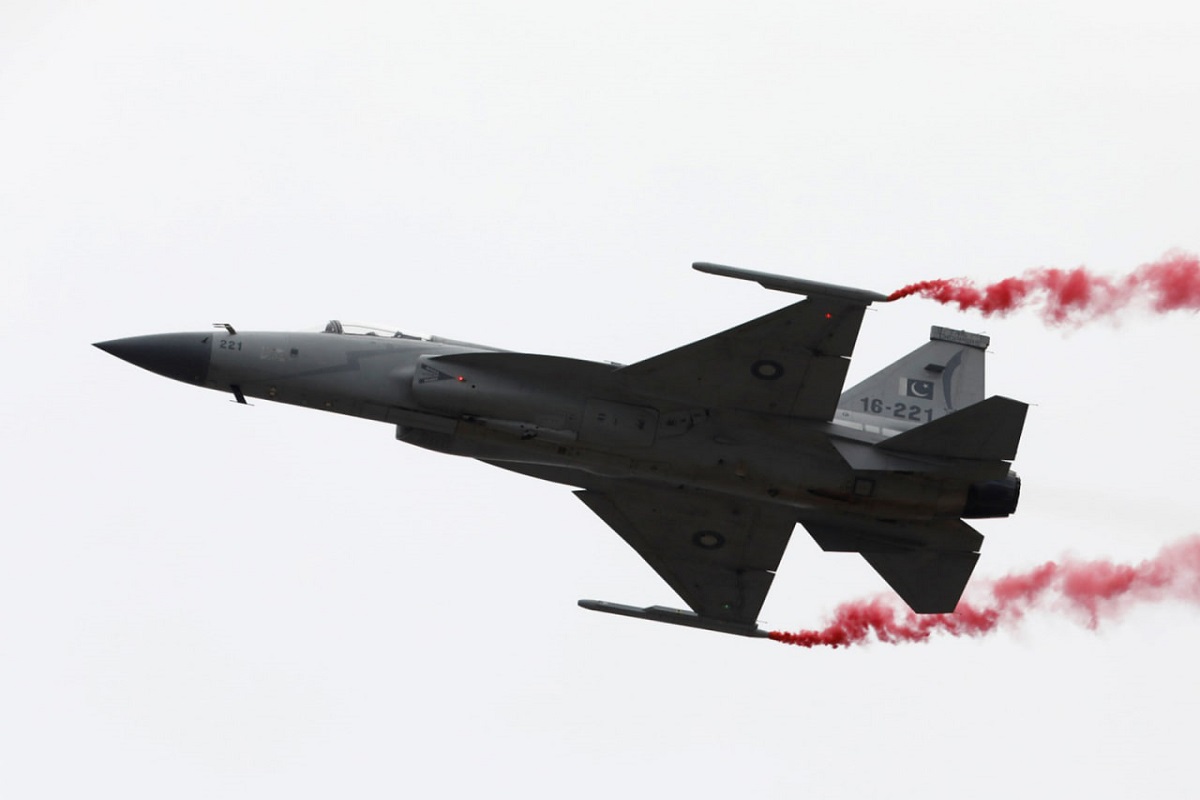
The deployment of Pakistani JF-17 Block III and F-16 C/D multirole fighters to the Middle East—specifically to Saudi Arabia for the "Spears of Victory" and "S-77" maneuvers—is not a precursor to an imminent global conflict, but a calculated calibration of the Islamic Military Counter-Terrorism Coalition (IMCTC) defense architecture. While sensationalist reports suggest an "abrupt" entry into a Middle Eastern war, the movement reflects a long-standing bilateral defense pact designed to standardize aerial combat protocols across the Sunni-majority security apparatus. To understand the strategic weight of this movement, one must analyze the intersection of airframe interoperability, regional power projection, and the specific technical upgrades inherent in Pakistan's latest hardware.
The Triad of Pakistan’s Expeditionary Air Strategy
The sudden visibility of Pakistani assets in the Arabian Peninsula serves three distinct operational objectives that go beyond simple drill participation. Also making waves recently: Why the Nabatieh attack on Lebanese State Security changes everything.
- Interoperability and Data-Link Integration: Modern aerial warfare relies on the Link-16 standard and similar high-speed data exchange systems. By flying alongside Saudi F-15SAs and Royal Air Force Typhoons, Pakistan’s Air Force (PAF) validates the JF-17 Block III’s ability to operate within a Western-centric sensor grid. This reduces "friction of command" during joint operations.
- Signal Intelligence and Electronic Warfare (EW) Profiling: Training in the Middle East allows the PAF to test its KLJ-7A Active Electronically Scanned Array (AESA) radars against diverse electronic signatures. This is a technical necessity; the electromagnetic environment in the Gulf is significantly more saturated than the Indo-Pakistani border, providing a high-stress testing ground for Pakistan’s indigenous and Chinese-derived EW suites.
- Strategic Depth and Logistics Validation: Moving multiple squadrons over 2,000 kilometers requires a sophisticated logistics tail. This deployment functions as a live-fire test of Pakistan’s aerial refueling capabilities and its ability to sustain high sortie rates far from its primary maintenance hubs in Kamra and Sargodha.
The JF-17 Block III as a Force Multiplier
The core of the recent speculation involves the JF-17 Block III. This specific iteration represents a departure from earlier low-cost interceptors. Its integration into Middle Eastern exercises signals to regional actors that Pakistan now possesses a "fourth-generation plus" capability that is independent of US-imposed end-user monitoring agreements that restrict its F-16 fleet.
The Block III features the following upgrades that alter the regional balance: Further details into this topic are explored by BBC News.
- AESA Radar Integration: Unlike traditional pulse-doppler systems, AESA allows for simultaneous tracking of multiple targets with a lower probability of intercept.
- PL-15 Missile Compatibility: This long-range air-to-air missile (LRAAM) provides a "look-down, shoot-down" capability that exceeds the range of many existing regional threats, effectively creating a "no-go" zone for hostile reconnaissance assets.
- Integrated IRST (Infrared Search and Track): This allows for the detection of "stealthy" or low-RCS (Radar Cross Section) targets without emitting radar signals, a critical requirement in a theater where F-35s and advanced drones are active.
Deconstructing the War Rumors vs. Geopolitical Reality
The claim that Pakistan is entering a "Great War" (Mahayuddh) ignores the structural constraints of its domestic economy and the specific nature of its defense contracts with Saudi Arabia. Pakistan operates under a "Defense of the Holy Cities" mandate, which historically translates to a defensive posture rather than an offensive one.
The movement of fighter jets is a response to two specific regional pressures:
1. The Iranian-Israeli Friction Point
As tensions between Iran and Israel fluctuate, Saudi Arabia and its allies are hardening their airspace. Pakistan's presence provides a "secondary tier" of air defense. This isn't about attacking a third party; it is about establishing a "Saturation Defense" model. By adding more airframes to the regional pool, the coalition increases the cost of any potential airspace violation by non-state actors or regional rivals.
2. The Vacuum of US Pivot
As the United States reallocates resources toward the Pacific, Middle Eastern powers are diversifying their security partners. Pakistan, possessing an experienced pilot corps and a growing indigenous defense industry, is the most logical "surrogate" for providing high-end tactical training and surge capacity without the political baggage of direct Western intervention.
The Cost Function of Deployment
Deploying a fighter wing is an expensive endeavor. For an economy under IMF scrutiny, Pakistan's decision to send these assets indicates that the exercise is likely subsidized by the host nation (Saudi Arabia) or is part of a "service-for-capital" exchange. The PAF provides the "human capital"—highly trained combat pilots—while the host provides the infrastructure and fuel. This creates a symbiotic relationship where Pakistan gains high-tier operational experience and regional influence while the Gulf states gain a battle-hardened aerial partner.
The "S-77" exercise specifically focuses on "Complex Air Operations" (COMAO). In these scenarios, dozens of aircraft from different nations must coordinate a single mission. The failure of logic in many news reports is the assumption that these jets are there for a specific "enemy." In reality, they are there to solve the "Problem of Heterogeneous Fleets." How does a Chinese-designed radar (JF-17) talk to an American-designed air defense system (Patriot) without causing friendly fire? Solving this mathematical and technical riddle is the primary goal of the current deployment.
Strategic Forecast
The presence of Pakistani fighters in the Middle East will likely become a permanent or semi-permanent fixture of the regional security architecture. We should expect the following developments in the 24-month horizon:
- Establishment of a Permanent Training Hub: Pakistan may establish a permanent training presence in Saudi Arabia, mirroring the "Talwar" exercises but with a focus on drone integration and electronic warfare.
- Increased Hardware Sales: Success of the JF-17 Block III in these exercises will serve as a live demonstration for other Middle Eastern and African nations looking for high-capability aircraft without Western political strings.
- Trilateral Security Dialogues: Watch for increased coordination between Pakistan, Saudi Arabia, and Turkey. These three nations are increasingly aligning their defense industries to create a self-sustaining "Global South" security bloc that is less dependent on Washington or Moscow.
The operational reality is that Pakistan is not preparing for a "Great War" in the Middle East; it is positioning itself as the indispensable technical and tactical backbone of the region's emerging independent defense framework. The movement of jets is not a sign of chaos, but a signal of a new, more integrated order of regional deterrence.