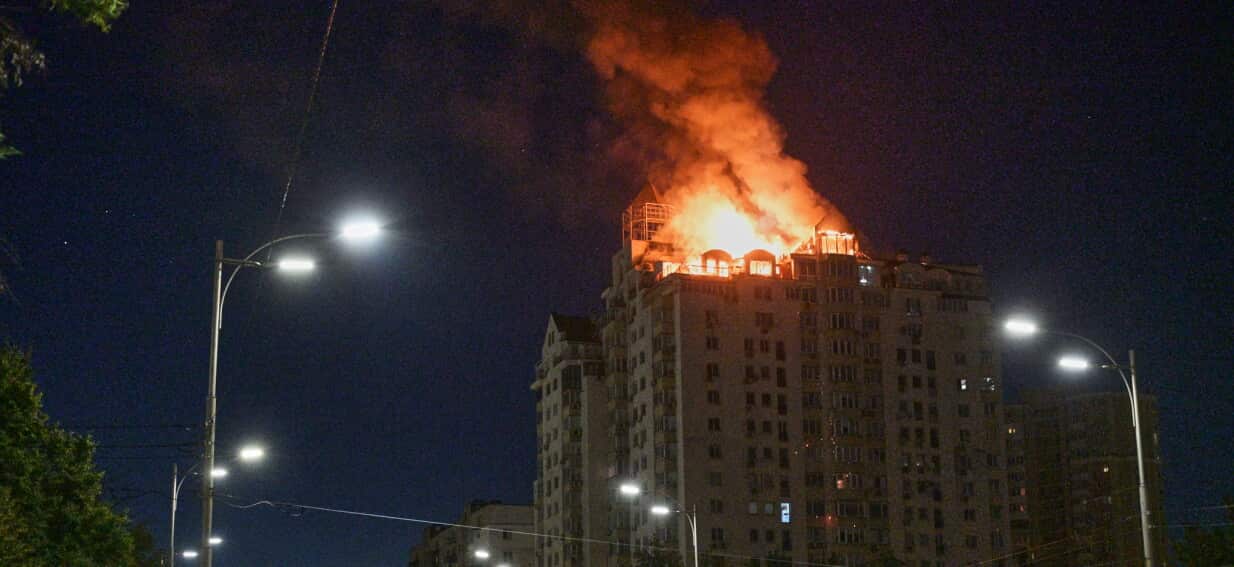
The overnight bombardment of Kyiv on July 2, 2026, marks a critical shift in the operational scale of aerial warfare. Utilizing a combined inventory of 74 missiles and 496 strike drones, Russian forces executed their largest coordinated assault on the Ukrainian capital since the invasion began. The operational objective was not merely structural destruction, but the deliberate saturation and depletion of Kyiv's Western-supplied air defense architecture. The attack resulted in at least 13 confirmed civilian fatalities, over 85 injuries, and verified damage across more than 30 distinct urban locations.
Analyzing this engagement requires stripping away political rhetoric to examine the tactical calculus of saturation strikes, the economic and systemic limits of air defense interception, and the strategic bottlenecks defining the current phase of the conflict.
The Saturation Calculus: Mass vs. Interception Capacity
The core mechanism of the assault relied on asymmetric mass to overwhelm localized defense systems. Air defense networks operate under fixed resource constraints: tracking bandwidth, engagement channels, and ready-to-fire interceptor stockpiles. By launching 570 total aerial vectors within an 11-hour window, the strike architecture forced a severe mathematical strain on Kyiv’s defensive umbrella.
The Decoy and Strike Mix
The attack structure deployed a highly deliberate operational sequence designed to maximize penetration vectors:
- Low-Cost Mass Vectors: The deployment of 496 strike drones served primarily as kinetic clutter. These systems force air defense operators into a continuous resource-allocation dilemma: expend high-cost interceptors or risk letting low-altitude ordnance penetrate the inner defense ring.
- High-Velocity Penetration Vectors: Simultaneously, 74 missiles—including advanced ballistic variants—were timed to exploit gaps created when tracking systems were saturated by the low-speed drone swarms.
Ukrainian Air Force telemetry confirms that while the majority of incoming threats were neutralized, 25 ballistic missiles and 12 drones breached the defense perimeter, striking 33 distinct locations. This 80 percent aggregate interception rate, though technically high, reveals a critical vulnerability when total vector volume scales to these historic proportions. The remaining 20 percent of unmitigated ordnance possesses sufficient kinetic and explosive energy to inflict catastrophic structural failures across an urban landscape.
The Attrition Asymmetry: Financial and Production Bottlenecks
The financial and industrial inputs required to sustain and defend against this scale of aerial bombardment reveal a stark structural imbalance between the two combatants. Air defense is fundamentally an un-scalable economic model when facing mass-produced adversarial assets.
The cost function of a single Patriot Advanced Capability-3 (PAC-3) interceptor ranges between $3 million and $4 million. In contrast, the low-cost strike drones deployed by Moscow are estimated to cost between $20,000 and $50,000 per unit. When a defensive system uses a multi-million-dollar missile to neutralize a low-cost drone, the economic attrition favors the attacker. Even when using cheaper, short-range systems or mobile anti-aircraft gun assets to handle drones, the sheer volume of 496 incoming units guarantees that premium interceptors must eventually be fired to prevent catastrophic infrastructure failures.
The secondary bottleneck is industrial throughput. The global production capacity for advanced surface-to-air missiles is strictly limited by specialized aerospace supply chains and highly precise electronic components. Ukraine cannot rely solely on the transfer of finished stockpiles from allied nations, as these partners face their own statutory minimum inventory requirements.
This reality underpins Ukrainian President Volodymyr Zelenskyy's immediate post-attack pivot to requesting manufacturing licenses from the United States to build Patriot missiles domestically. Shifting from a consumption-based dependency model to a localized production model is the only viable method to alter the long-term attrition curve. However, establishing advanced aerospace manufacturing infrastructure within a country under active bombardment presents massive physical and logistical hurdles.
Urban Vulnerability Metrics: The Physical Impact Log
The geographic distribution of the damage underscores the deliberate dispersion of the strike vectors. The Kyiv City Military Administration and the State Emergency Service (DSNS) recorded significant damage across 30 distinct sites, heavily concentrated within 20 residential apartment structures and civilian utility centers across multiple municipal districts:
- Darnytskyi District: A direct hit caused a progressive structural collapse across six stories of a nine-story residential building, highlighting the severe kinetic energy transfer of unmitigated ballistic impacts on Soviet-era reinforced concrete.
- Shevchenkivskyi District: Multiple impacts damaged a hotel, two five-story residential buildings, and an ambulance substation, the latter injuring critical first-responder personnel and degrading localized medical triage capabilities.
- Holosiivskyi and Desnianskyi Districts: High-rise residential structures sustained major roof fires and partial collapses, trapping civilian populations under rubble and forcing the deployment of nearly 500 emergency personnel.
The Kremlin's official narrative claimed the operation was a high-precision strike targeting military and energy infrastructure in retaliation for Ukrainian long-range drone attacks on Russian fuel networks, such as the strike on the Kstovo oil refinery in Nizhny Novgorod. However, the physical distribution of hits across central and residential municipal zones indicates that either the targeting data was deliberately calibrated for urban terror, or the accuracy of Russian high-precision systems degrades significantly under the influence of active electronic warfare and defensive countermeasures.
Defensive Modernization or Systemic Depletion
The long-term stability of Kyiv’s airspace depends on resolving a foundational paradox: defensive forces must achieve a near-perfect interception rate every single time, whereas an attacking force requires only a minor penetration percentage to achieve strategic disruption.
To prevent systemic depletion, the defensive architecture must evolve along three distinct operational lines. First, Western partners must accelerate the deployment of directed-energy weapons and advanced kinetic gun systems to handle low-tier drone vectors at a near-zero cost-per-shot. Second, international sanctions frameworks must be tightened to cut off the flow of dual-use Western microelectronics that continue to find their way into Russian missile guidance systems via third-party transshipment hubs. Finally, allied nations must streamline the transfer of technology required for localized missile production, accepting the calculated risk of sharing proprietary military designs to secure a sustainable production base.
Without these structural adjustments to the industrial baseline, the mathematical reality of saturation attacks will continue to strain the structural resilience of Ukraine's capital.