The collective sigh of relief echoing around Old Trafford isn’t satisfaction. It is exhaustion.
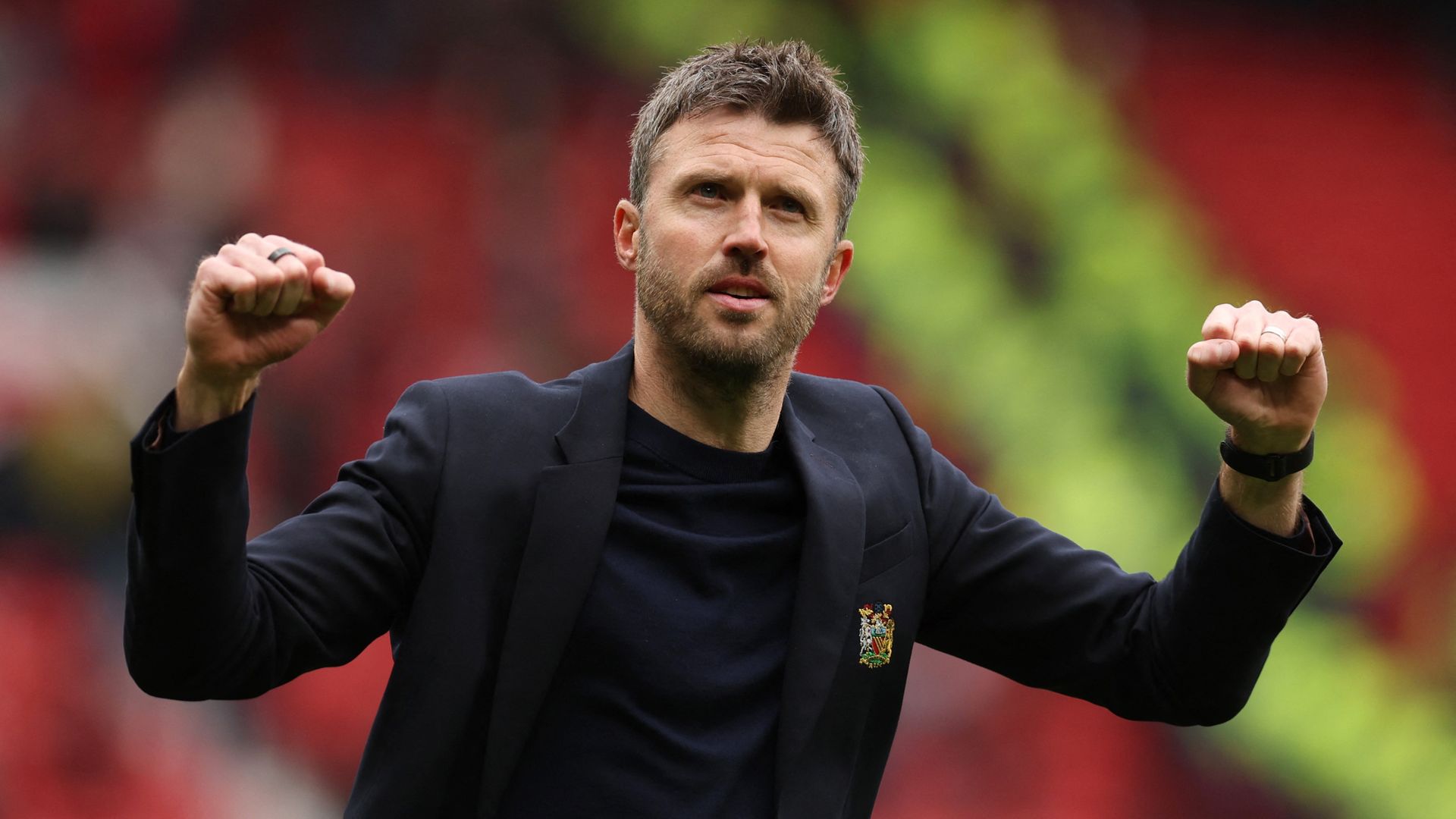
Manchester United appointing Michael Carrick on a permanent deal is being painted by the mainstream football media as a sensible, stabilizing, and romantic return to the club's core DNA. They will tell you he knows the club. They will point to his tactical flexibility at Middlesbrough. They will highlight his calm demeanor as the exact antithesis to the chaotic managerial cycles that defined the post-Ferguson era.
They are lying to you. Or worse, they are lying to themselves.
Appointing Carrick isn't a bold new dawn. It is an admission of intellectual bankruptcy. It is the definitive proof that INEOS, despite all the corporate restructuring and high-performance talk, has succumbed to the same institutional disease that crippled every previous regime: the desperate search for a localized messiah.
The Myth of the Structural Cushion
The prevailing narrative suggests that the manager matters less now. Under the new sporting hierarchy, the manager is merely a head coach. He plugs into a elite recruitment machine, a data-driven scouting apparatus, and a corporate framework designed to withstand any single individual's failure.
This is a fundamental misunderstanding of elite football mechanics.
A high-performance sporting structure does not diminish the importance of the head coach; it amplifies it. In a modern football club, the head coach is the operational executioner of a multi-million-pound asset portfolio. If the man at the top of the training pitch lacks elite tactical iteration, the entire structure becomes a Ferrari driven by someone who just passed their test.
I have spent years analyzing the internal mechanics of top-tier European clubs during major transitions. When a board convinces themselves that the system will save the manager, the system invariably collapses.
Look at Monchi’s second spell at Sevilla, or the structural overhaul at Arsenal before Mikel Arteta actually found his tactical identity. A sporting director can hand a coach a world-class ingredient list. If the coach only knows how to make toast, you still get toast.
The Championship Illusion
The data being used to justify Carrick's tactical acumen is flawed because it ignores the context of the English Championship.
Yes, his Middlesbrough sides played brave, possession-heavy, expansive football. They built from the back with a fluid 4-2-3-1 that rotated into a 3-2-4-1 in possession, overloading the half-spaces and utilizing a high structural line.
But the Championship is a league defined by physical attrition and tactical variance, not elite-level pressing traps.
In the Championship, you can dominate matches through superior squad value and basic positional rotation. In the Premier League, you are facing tactical monsters. You are matching wits with Pep Guardiola’s rest-defense structures, Unai Emery’s hyper-coordinated offside traps, and Andoni Iraola’s relentless mid-block presses.
There is zero evidence in Carrick’s managerial data to suggest he can engineer a tactical press break against an elite Champions League-level system.
When people ask, "Can a Championship coach make the jump directly to a top-six club?" the honest answer is almost always no, unless they are an anomalous tactical revolutionary. Carrick is a highly competent coach. He is not a revolutionary.
The Toxic Currency of Club DNA
We need to kill the phrase "Club DNA" permanently. It is a marketing term masquerading as sporting philosophy.
Every time Manchester United looks backward to move forward, they lose five years. The romanticism surrounding Carrick stems entirely from his playing days under Sir Alex Ferguson. He represents a bridge to an era that is not just gone, but completely irrelevant to modern tactical trends.
Real Madrid do not hire managers because they understand "The Real Madrid Way." They hire managers who win football matches, whether it’s the pragmatic cynicism of Carlo Ancelotti or the systemic rigidity of Jose Mourinho. Bayern Munich do not pick coaches based on internal culture; they pick them based on systemic compatibility with their academy and squad trajectory.
By prioritizing a safe, culturally compliant insider, United have chosen PR over performance. They chose a manager who won't rock the boat, who won't challenge the newly appointed board executives, and who will say all the right things in the media about "the standards of this great club."
The Tactical Black Hole: What Carrick Actually Does
Let's look at the actual tape, rather than the sentimentality.
Carrick’s tactical blueprint relies heavily on an asymmetrical build-up. At Middlesbrough, he frequently instructed his left-back to tuck inside to form a back three, allowing the right-back to bomb forward into the attacking line. This worked beautifully when isolated against lower-tier opposition.
Against Premier League structures, this asymmetry is an invitation to be destroyed on the counter-attack.
Modern elite transition defense requires absolute structural balance. If you leave a vacancy in the wide defensive channels against teams like Liverpool or Arsenal, their wingers will isolate your center-backs within three seconds of a turnover.
Furthermore, Carrick’s defensive mid-block has historically lacked aggression. His teams prefer to drop and contain rather than press aggressively to win the ball high up the pitch.
In the modern Premier League, a passive mid-block is suicide. If you do not disrupt the opposition’s build-up phase in the middle third, elite midfielders will pick you apart. United currently possess a squad built for high-intensity, transitional football. Forcing them into a patient, low-tempo positional system is a square peg in a round hole.
The Hidden Cost of the Safe Choice
The biggest risk of the contrarian approach I am advocating—hiring an uncompromising, external tactical fundamentalist like a Roberto De Zerbi or a Ruben Amorim before his recent moves—is that it alienates the dressing room. It requires a brutal, painful squad overhaul. It causes short-term friction.
But the downside of the safe choice is worse. The downside of Carrick is stagnation.
It is the slow, quiet realization eighteen months from now that the team is perfectly pleasant, completely watchable, and entirely incapable of challenging for a title. It is a guaranteed ticket to fifth place.
United fans are asking: "Is Carrick ready for the pressure?"
That is the wrong question. The pressure is irrelevant to a man who has won Champions Leagues as a player. The real question is: "Does Carrick possess a distinct, elite tactical edge that can exploit the marginal inefficiencies of the best teams in the world?"
The answer is no. He possesses a great reputation, an elegant playing history, and a sensible coaching pedigree. None of those things stop an elite press.
Stop celebrating stability. Stability in the face of superior opposition is just a slow death.
Manchester United didn’t hire a head coach to take them to the apex of European football. They hired a shield to protect the board from criticism if the rebuild takes too long.
The club has traded ambition for comfort. Expect the results to reflect exactly that.