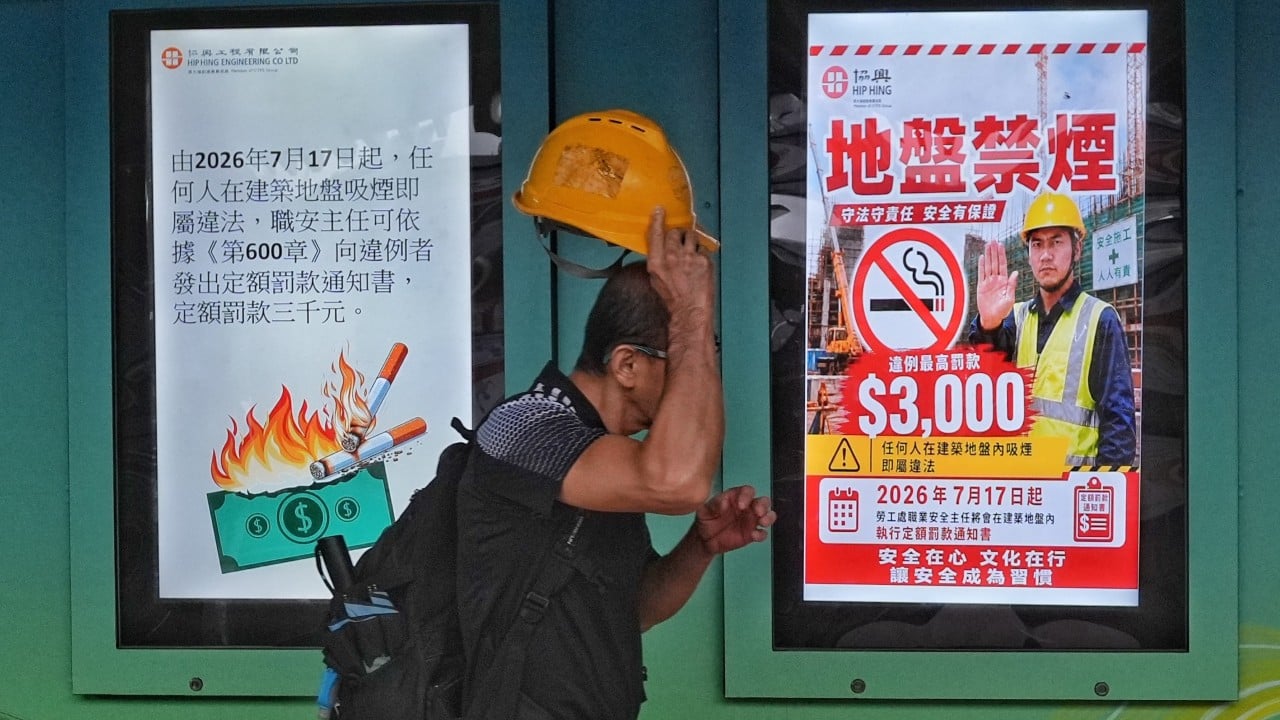
The introduction of a blanket smoking ban across Hong Kong construction sites represents a massive regulatory intervention in the city's labor dynamics. Triggered by the catastrophic Wang Fuk Court fire in Tai Po, the policy shifts liability directly onto the supply chain. The legislation establishes a dual-liability framework: individual workers face immediate $3,000 fixed penalties, while principal contractors and subcontractors risk fines up to $400,000 for systemic compliance failures.
This regulatory shift alters the economics of construction site management. To understand its true impact, we must move beyond simple compliance and analyze the operational trade-offs, labor friction, and structural behavioral changes driving the industry's response.
The Economics of Compliance: The Dual-Liability Cost Function
The legislation splits the financial burden of non-compliance between individual workers and corporate entities. This division creates a distinct cost function for both parties, influencing how they manage risk.
The Corporate Risk Equation
For contractors, the potential $400,000 fine is not the only financial risk. Systemic violations can lead to more severe outcomes:
- Direct Penalties: Fines up to $400,000 for failing to take "reasonable steps" to maintain a smoke-free site.
- Catastrophic Liability: Under extreme fire risk conditions, prosecutors can seek up to $3 million in corporate fines and six-month prison terms for executives.
- Friction Costs: The administrative expense of setting up storage facilities, conducting mandatory bag searches, and managing security checkpoints.
- Reputational Capital: Major public and private developers are increasingly vetting subcontractors based on safety records, meaning a single smoking violation can jeopardize future bidding eligibility.
The Worker Decision Model
For a construction worker earning a daily wage, a $3,000 fine represents a severe financial hit, often wiping out several days of income. Workers must balance this risk against the psychological and physical demands of nicotine withdrawal:
$$Utility = U(\text{Nicotine Relief}) - P(\text{Detection}) \times C(\text{Fine} + \text{Job Loss})$$
Where:
- $P(\text{Detection})$ is the probability of being caught by site managers or Labour Department inspectors.
- $C$ is the total cost, combining the $3,000 fine with the risk of being blacklisted under company-specific demerit systems.
As $P(\text{Detection})$ rises through smart surveillance and mandatory bag checks, the risk calculation shifts, forcing workers to either quit or leave the job site to smoke.
The Operational Bottleneck: Entrance Control and Demerit Systems
Implementing the industry's "eight-pillar management system" introduces a clear physical bottleneck at the site entrance.
[Worker Arrival] ➔ [Security Bag Check] ➔ [Lighter/Cigarette Storage] ➔ [Site Entry]
                                                                        │
                                   [Demerit System Enforcement] ◄───────┘
The process of checking bags and storing lighters at designated entry checkpoints creates a morning logjam, especially on high-density projects. To offset these delays, contractors are deploying structured deterrents inside the perimeter.
The Demerit Point System
To maintain compliance without relying solely on government inspectors, major contractors are implementing strict private enforcement policies. A prominent example is the 15-point demerit system:
- First Offense: Immediate deduction of 15 points, resulting in an instant site ban.
- Rehabilitation Path: Banned workers must complete specialized safety and cessation courses to earn back access.
- Second Offense: Permanent blacklisting across all projects managed by the contractor.
This tiered approach shifts the enforcement burden onto the workforce. By making the immediate cost of a violation a career threat rather than just a fine, contractors have successfully aligned worker self-interest with site safety regulations.
The Friction of Site Boundaries and Lost Productivity
While early reports highlight strong worker cooperation, the ban introduces real-world productivity challenges. The policy permits smoking outside the official boundaries of the construction site. This exemption creates a geographical loophole with distinct operational consequences.
The Transit Time Penalty
On a large-scale high-rise development, a worker located on the 40th floor cannot easily step outside the site boundary for a quick break. The time required to use hoist elevators, walk past security checkpoints, smoke, and return to the work area can easily exceed 25 minutes.
If a worker takes three such breaks per shift, the contractor loses over an hour of active labor per day. Across a workforce of 500, this idle transit time quickly erodes project margins.
The Congestion Effect
Because workers must exit the site boundary to smoke, public sidewalks directly adjacent to construction gates are becoming informal smoking areas. This shift concentrates secondhand smoke and waste at the site perimeter, potentially triggering complaints from neighbors and increased scrutiny from municipal authorities.
Structural Substitution: The Transition to Smoking Cessation
The difficulty of leaving high-rise worksites is driving a shift in behavior. Rather than navigating the logistics of off-site breaks, many workers are choosing to cut back or quit entirely. This transition is supported by a mix of corporate incentives and public health programs.
Contractors are actively funding on-site cessation clinics, providing nicotine replacement therapies, and running educational seminars during safety briefings. For the individual worker, these programs lower the cost of quitting, transforming a strict regulatory hurdle into an opportunity to improve their long-term health.
The Strategic Path Forward for Contractors
To navigate this new regulatory landscape without sacrificing productivity, principal contractors should adopt a structured operational strategy:
- Automate Entrance Logistics: Avoid manual bag-check delays by using smart lockers at site entrances. Workers can secure their personal items using RFID-enabled wristbands, keeping entry lines moving quickly.
- Use Smart Inspection Tools: Deploy thermal imaging and intelligent CCTV networks in high-risk zones, such as fuel depots and electrical installations, to monitor compliance without relying on constant manual patrols.
- Offer Micro-Incentives for Cessation: Offset potential labor friction by tying compliance and cessation milestones to safety bonuses, shifting the focus from punishment to positive reinforcement.