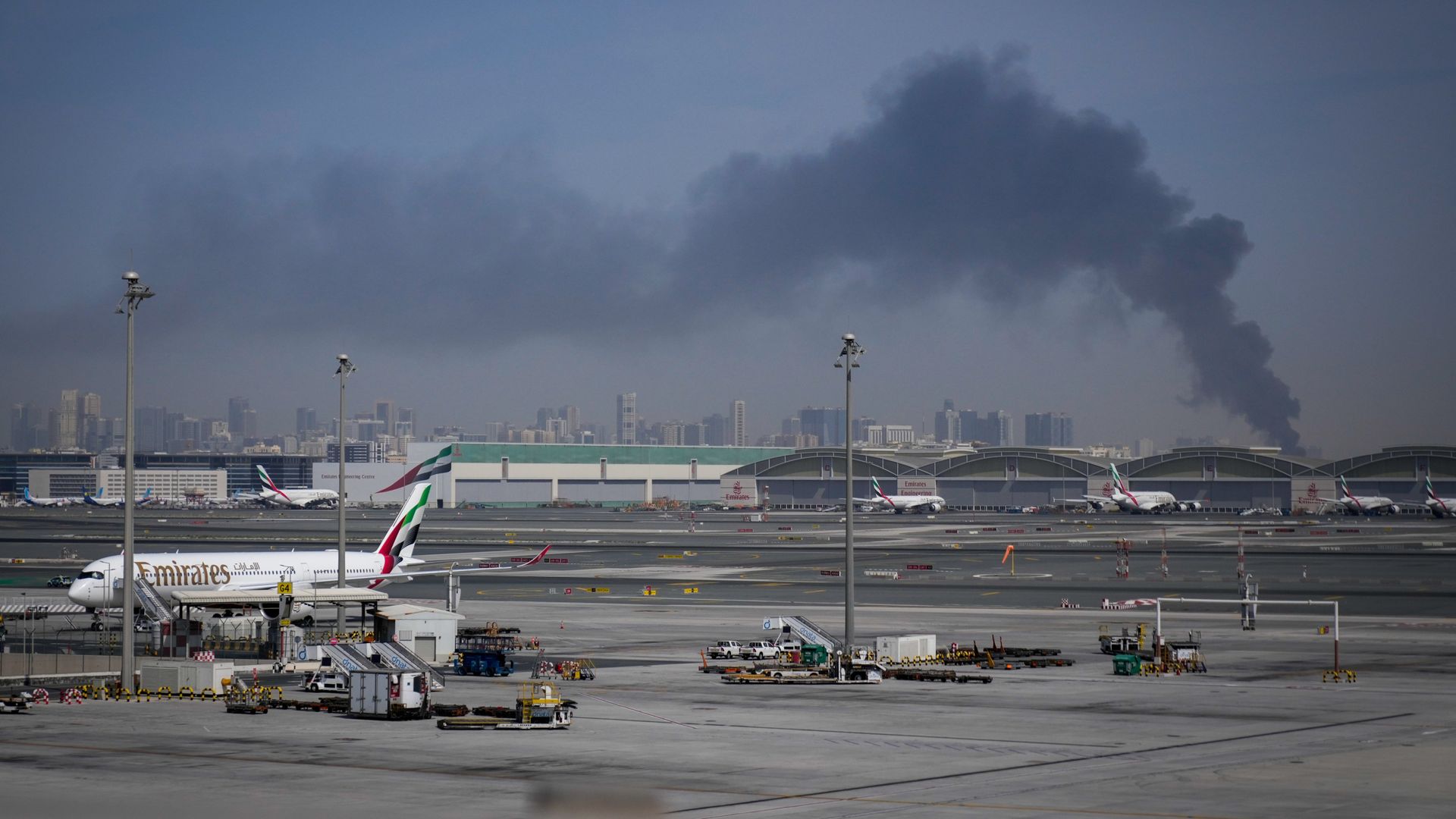
Thousands of travelers are currently stuck in airport terminals across the globe because of a sudden, massive disruption in Middle Eastern airspace. If you’ve looked at a flight tracker in the last few hours, you’ve seen the "black hole" over Iran and its neighbors. This isn't just a minor delay or a weather issue. It’s a systemic collapse of one of the world's most critical transit corridors following the recent military escalations.
Airlines didn't wait for official decrees to start pivoting. They saw the missiles and moved. When Iran launched its strike, the immediate reaction from aviation authorities in Jordan, Iraq, and Lebanon was to slam the door shut. They closed their skies to all civilian traffic. This effectively severed the main artery connecting Europe to Southeast Asia and the Indian subcontinent. It's a logistical nightmare that's only getting started.
The Chaos at Global Hubs
The impact wasn't limited to the region. Major international hubs like Dubai, Doha, and Abu Dhabi—the "Big Three" transit points—saw their schedules shredded. These airports rely on precision timing to move people from one side of the world to the other. When you close the sky over Iran, you don't just delay a flight from Tehran to Istanbul. You break the connection for a family flying from London to Sydney.
I’ve seen this play out before, but the scale today is different. Carriers like Lufthansa, Emirates, and Qatar Airways had to make split-second decisions. Some planes turned around mid-flight. Others were diverted to airports in Egypt or Turkey that were already over capacity. If you're sitting in a terminal in Frankfurt or Singapore right now, you're feeling the ripples of a conflict happening thousands of miles away.
The sheer volume of stranded passengers is staggering. We aren't talking about a few hundred people. We're talking about tens of thousands. Hotels near major airports are booked solid. Airline app servers are crashing. The human cost of these "airspace closures" is a sea of people sleeping on yoga mats in Terminal 3, waiting for news that might not come for days.
Why Re-Routing Isn't Simple
You might think pilots can just "fly around it." They can't. Not easily, anyway. Modern aviation is built on fuel efficiency and predefined paths. Avoiding Iranian or Iraqi airspace means taking the "long way" around, usually over Saudi Arabia or further north through Azerbaijan and Turkmenistan.
This adds hours to a flight. Hours mean more fuel. More fuel means more weight. More weight means fewer passengers or less cargo. It's a math problem that ends in canceled flights. Many long-haul jets simply don't have the fuel reserves to take a four-hour detour on an already twelve-hour journey.
Safety is the only thing that matters here. Nobody wants a repeat of MH17 or PS752. Airlines are being hyper-cautious because the risk of a "misidentification" in a crowded, active combat zone is too high. If the military is firing interceptors, civilian jets need to be nowhere near that zip code.
The Economic Aftershocks for Travelers
Expect ticket prices to jump. It’s basic economics. When airlines have to burn 20% more fuel to get you to Bangkok, they aren't going to eat that cost. They'll pass it to you. We're already seeing surcharges creep into booking engines.
Beyond the ticket price, there's the issue of compensation. Most airlines will claim "force majeure" or "extraordinary circumstances." This is their "get out of jail free" card. It means they aren't legally required to pay you for the delay under many jurisdictions, like the EU's EC 261/2004, because the situation is outside their control. You might get a meal voucher if you're lucky, but don't count on a cash payout for the lost time.
Navigating the Mess
If you're supposed to fly through the Middle East in the next 72 hours, don't just show up at the airport. That's the biggest mistake people make. You'll just end up part of the crowd.
- Check the tail number. Use a flight tracking app to see where your actual plane is. If your flight is from New York to Dubai, but the plane is currently stuck in Cairo, you aren't leaving on time.
- Use social media for rebooking. Don't stand in a 400-person line at the service desk. DM the airline on X (formerly Twitter) or use their chat function. Often, the digital teams have more power to move you than the stressed-out gate agent.
- Verify your travel insurance. Most basic policies have "civil unrest" or "airspace closure" clauses. Read the fine print now. If your policy doesn't cover this, you're on the hook for your own hotel and food.
- Look for "Fifth Freedom" flights. Sometimes you can bypass the hubs by looking for direct flights that use different paths, though these are rare and currently very expensive.
The situation is fluid. Airspace opens and closes based on the latest intelligence. One hour the path over Jordan is clear, the next it's a no-go zone. This uncertainty is what's killing the schedule. Even if the missiles stop flying today, it'll take a week for the aircraft and crews to be back in the right places.
Don't assume your flight is "fine" just because you haven't received an email. Airlines are overwhelmed and their notification systems are lagging. Take control of your own itinerary. If you can postpone your trip by a week, do it. The stress of being stranded in a transit lounge without your luggage isn't worth the risk. Pack an extra change of clothes and all your essential meds in your carry-on. You might be spending a lot more time in a terminal than you planned.