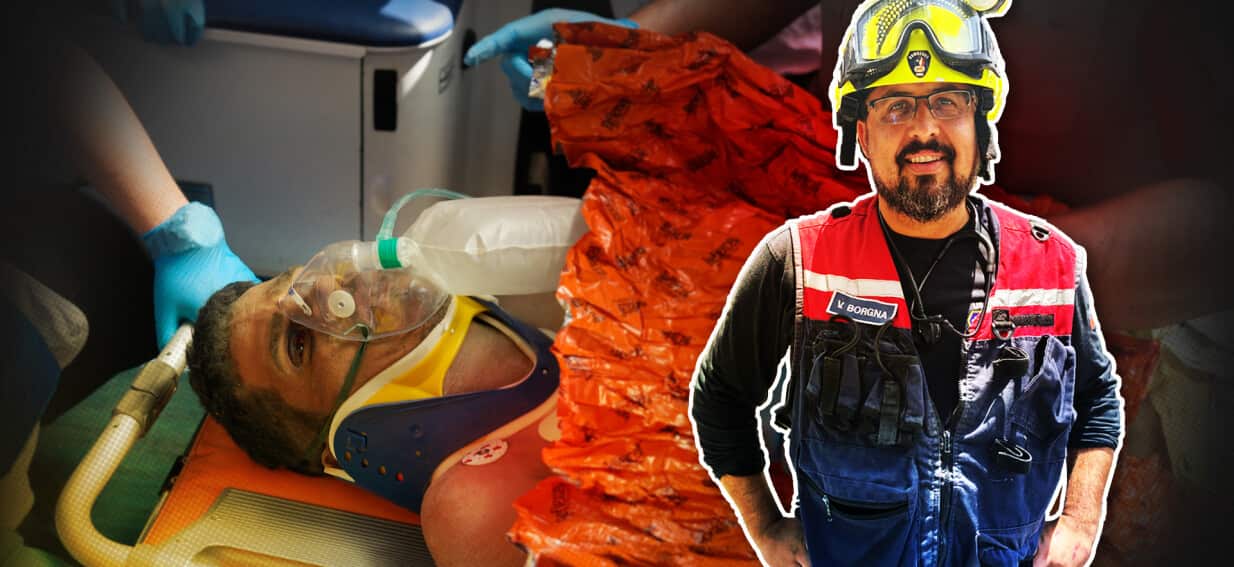
The media loves a resurrection story. When news broke of a man in Venezuela pulled alive from the rubble eight days after a devastating earthquake, the global press pool ran its predictable, boilerplate script. They called it a miracle. They praised the late-stage rescue efforts. They spun a heartwarming yarn about human resilience and hope against all odds.
It is a beautiful narrative. It is also an incredibly dangerous delusion. You might also find this similar coverage useful: The Diplomatic Echo Chamber Over Maritime Tragedies Unmasking the Bureaucratic Spectacle.
Every time the media sensationalizes an extreme anomaly—like an eight-day survival under concrete—they actively distort the public's understanding of disaster medicine. They validate inefficient search-and-rescue timelines. They encourage families to demand that rescue crews dig with teaspoons long after a site has transitioned from a rescue mission to a recovery operation.
The harsh reality of disaster triage does not care about your feel-good headlines. In structural collapse engineering and trauma medicine, survival is dictated by cold, uncompromising physics and biology, not miracles. Celebrating the one-in-a-million outlier obscures the systemic failures that caused the collapse in the first place and misallocates scarce resources when every second counts. As discussed in recent articles by NPR, the results are worth noting.
The Rule of Threes Is Broken
Open any standard survival manual and you will find the classic "Rule of Threes." You can survive three minutes without air, three days without water, and three weeks without food.
In a structural collapse, this framework is worse than useless. It is lethal.
The "three days without water" rule assumes you are sitting in a shaded room at room temperature. It does not account for the crushing pressure of a reinforced concrete slab creating a localized hyper-thermic environment. When a building pancakes, the compressed air, dust, and friction create an immediate microclimate. If a victim is trapped in a void space with ambient temperatures exceeding 35 degrees Celsius, severe dehydration and acute kidney injury do not wait 72 hours. They set in within 24.
Furthermore, the media entirely ignores the silent killer of the rubble: Crush Syndrome.
First documented thoroughly by Eric Bywaters during the London Blitz in 1941, crush syndrome occurs when major muscle groups are subjected to prolonged pressure. When a limb is pinned under a beam, muscle tissue begins to die, releasing massive amounts of myoglobin, potassium, and phosphorus into the local circulation.
As long as the victim remains trapped, the damage is localized. The moment a well-meaning but untrained rescue team lifts that beam without administering intravenous fluids first, those toxins flood the bloodstream. The result is sudden cardiac arrest or acute renal failure.
When you read about a man rescued after eight days, you are looking at a freak statistical anomaly where the debris formed a perfect protective vault, the individual possessed specific genetic tolerances to dehydration, and no major mass was compressing his limbs. You are looking at a lottery winner. Building a disaster response framework around a lottery winner is a recipe for mass casualties.
The Mirage of the Golden Window
Urban Search and Rescue (USAR) teams globally operate on what is known as the "Golden Window"—typically the first 48 to 72 hours post-collapse. During this timeframe, the probability of extracting living victims is at its peak. After 72 hours, the survival curve does not just dip; it plummets off a cliff.
Look at the data from historical seismic events compiled by the International Search and Rescue Advisory Group (INSARAG). In the 2010 Haiti earthquake, over 130 people were pulled alive from the rubble by international teams. The vast majority of those extractions occurred within the first four days. The outliers extracted on day seven or eight made the evening news, but they represented less than 0.5% of the total rescued population.
Yet, because of stories like the Venezuela rescue, politicians and the public demand that heavy machinery be held back for weeks. They fear that a bulldozer will crush a hypothetical survivor.
Here is the trade-off nobody wants to admit: by delaying the deployment of heavy earth-moving equipment to search for the 0.5% chance of an outlier survivor, you drastically slow down the clearance of critical infrastructure. You block the roads. You delay the delivery of clean water, field hospitals, and medical supplies to the 99.5% of survivors who are out in the open but dying of exposure, sepsis, or cholera.
I have seen disaster responses grind to a halt because a local commander, terrified of bad press, refused to clear a collapsed apartment block on day six. Meanwhile, two blocks away, children were dying of dehydration in makeshift tents because the supply trucks could not pass the blocked intersection.
We are sacrificing the living on the altar of the extraordinarily unlikely.
The Economics of Hope
Let's talk about the logistics. International USAR teams are incredibly expensive to mobilize. They fly in specialized canine units, seismic listening devices, and fiber-optic cameras.
By the time an international team touches down in a developing nation after a major earthquake, 24 to 36 hours have already elapsed. Customs delays, airport congestion, and broken transport links routinely eat up another 12 hours. By the time their high-tech listening gear is deployed on a pile of rubble, the Golden Window is practically closed.
The data shows that the overwhelming majority of live saves—upwards of 90%—are performed by local bystanders, neighbors, and first responders within the first twelve hours using their bare hands, shovels, and crowbars.
Instead of funding this reality, global aid priorities are skewed by the media's obsession with late-stage "miracle" rescues. Millions of dollars are funneled into elite search teams that arrive on day four, while the local communities receive zero training in basic triage, structural cribbing, or bleeding control.
If you want to save lives in a seismic zone like Venezuela, Turkey, or Nepal, you do not invest in more fiber-optic cameras for foreign teams to use on day eight. You invest in localized, community-level resilience. You teach the guy who owns the hardware store down the street how to safely leverage a concrete slab off his neighbor's chest within twenty minutes of the shaking stopping.
Stop Demanding Miracles, Demand Building Codes
The focus on the survival of a trapped individual shifts the blame from human negligence to natural inevitability.
Earthquakes don't kill people; collapsing buildings kill people.
When we marvel at a man surviving eight days under concrete, we are treating the collapse as an act of God that can only be countered by divine intervention. We ignore the corruption, the bypassed zoning laws, the unwashed aggregate used in the concrete mix, and the lack of rebar that caused the building to turn into a tomb in the first place.
The media coverage of the Venezuela rescue spent pages detailing the emotional reunion of the family, but barely a paragraph on why a modern structure collapsed like a house of cards during a moderate tremor.
If we want to stop writing these stories, we have to stop romanticizing the rescue. We need to look at the rubble not as a stage for human drama, but as a crime scene. Every survival story is fundamentally a failure of prevention.
The next time you see a headline about a survivor pulled from the wreckage after a week, do not celebrate. Demand an audit of the municipal engineering department. Ask why the local hospital lacked the dialysis machines required to treat the inevitable crush syndrome cases. Look at the logistics chain that failed to clear the roads.
The miracle narrative is an anesthetic for a complacent society. It allows us to feel good about a catastrophe while changing absolutely nothing about how we prepare for the next one. We are clapping for a man who beat casino odds, while the house continues to stack the deck against everyone else.