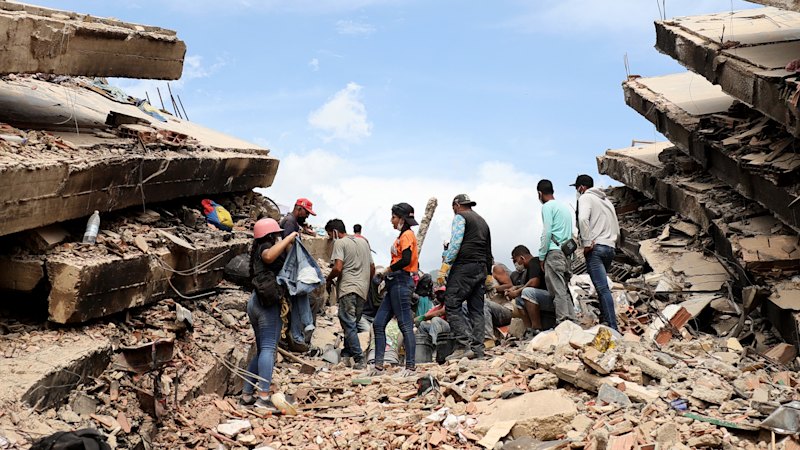
They survived. Against every metric known to disaster medicine, a father and his ten-year-old son were pulled alive from the wreckage of a collapsed concrete apartment block in Cumaná, four days after a major earthquake struck northeastern Venezuela. For ninety-six hours, they endured total darkness, crushing pressure, and suffocating dust without a drop of water. Their extraction is undeniably a miracle of human endurance. Yet, behind the triumphant photographs of volunteer rescuers carrying the dehydration-stricken pair lies a much darker, structural failure that nearly cost them their lives.
The rescue should have taken four hours, not four days.
While state-run television networks quickened their cameras to capture the emotional reunion, international disaster response experts saw a different story. They saw a textbook example of how economic ruin, decayed infrastructure, and a hollowed-out emergency management system turn a manageable natural disaster into a prolonged near-catastrophe. The survival of this father and son was not a victory of the system. It was a victory despite it.
The Anatomy of Ninety Six Hours in the Dark
When the earth shifts, concrete does not bend. It shears, creates voids, and traps air. In this instance, a heavy structural beam wedged against a fallen retaining wall, creating a triangular pocket roughly three feet high. This accidental shelter saved the pair from instant death.
Medical reality, however, begins ticking immediately. The human body can go weeks without food, but water is a non-negotiable currency. In a humid, tropical climate like Venezuela’s coast, the timeline shrinks drastically.
Under normal conditions, a human loses roughly one liter of water daily through respiration and sweat. Trapped beneath tons of debris, surrounded by ambient heat radiated by curing concrete, that rate accelerates. By hour seventy-two, the kidneys begin to conserve fluid aggressively, concentrating urine and signaling the onset of acute renal failure. Hallucinations begin. The tongue swells.
The father, a forty-two-year-old mechanic, used his knowledge of structural weight to keep his son calm. He rationed their breathing, forcing the boy to lie perfectly still to minimize metabolic heat production. It was a masterclass in primal survival. But while theyHusbanded their strength below ground, a chaotic scene played out above them.
The Hollowed Out Rescue Apparatus
Heavy rescue operations require a specific triad of assets: acoustic listening devices to locate heartbeats, hydraulic cutters to breach reinforced concrete, and trained canine units. Venezuela’s official civil defense agency possessed almost none of these at the site during the critical first forty-eight hours.
Decades of economic isolation and underfunding have left regional fire departments and rescue squads utterly stripped. Heavy vehicles sit on blocks for lack of tires or specialized transmission fluid. The acoustic sensors that should have pinpointed the father’s rhythmic hammering against a pipe on day one were absent. Instead, rescuers resorted to the ancient, flawed method of yelling into the void and putting their ears to the dirt.
Disaster Response Asset Availability (Cumaná Regional Sector)
+------------------------+-------------------+--------------------+
| Equipment Type         | Required Standard | Operational Status |
+------------------------+-------------------+--------------------+
| Acoustic Sensors       | 4 Units           | 0 Units            |
| Hydraulic Spreaders    | 6 Units           | 1 Unit (Leaking)   |
| K9 Search Teams        | 2 Teams           | 0 Teams            |
| Shoring Timber/Steel   | Ample Supply      | Sourced from Slums |
+------------------------+-------------------+--------------------+
Volunteers and neighbors formed the backbone of the initial effort. They dug with their bare hands, buckets, and civilian-grade crowbars. While their heroism is unquestionable, digging blindly into a collapse zone frequently causes secondary shifts in the debris. One wrong move can collapse the remaining voids, crushing survivors instantly. The fact that the structural pocket held is a testament to luck, not tactical precision.
Why the Aid Stalls at the Border
A common defense mounted by municipal authorities is the unexpected severity of the tremor. Earthquakes are unpredictable. That is an undeniable truth. However, the international community has spent thirty years perfecting a rapid-deployment mechanism for precisely these scenarios. Neighboring nations offered specialized urban search and rescue teams within six hours of the initial shockwave.
Those offers sat in bureaucratic limbo.
Geopolitical friction and a deep-seated institutional paranoia meant that visas and airspace clearances for foreign rescue experts became subjects of intense political negotiation rather than immediate humanitarian action. While diplomats argued over customs protocols for specialized rescue gear, a ten-year-old boy was drinking his own sweat to stay alive.
This is the hidden cost of isolationism. When a nation treats international cooperation as a threat to sovereignty, its citizens pay the price in bone and blood. By the time a stripped-down team from a friendly regional ally was permitted on the ground, three days had already elapsed.
The Concrete Scourge of Unregulated Building
The structural collapse itself was entirely preventable. Cumaná is not new to seismic activity; it sits directly atop a major fault system that has destroyed the city multiple times over the past four centuries. Modern engineering knows how to build for this.
The building that collapsed, however, was a product of the informal construction boom that defines much of modern Latin America.
To save costs, local contractors frequently alter concrete mixes, adding too much water or using unwashed beach sand contaminated with salt. The salt corrodes the internal steel rebar over time, turning the structural pillars into brittle chalk. The building did not collapse because the earthquake was unsurmountable. It collapsed because the concrete was rotten from the inside out, uninspected by corrupted or non-existent municipal oversight bodies.
Structural Failure Mechanism
1. Salty Sand Mix -> 2. Rebar Corrosion -> 3. Brittle Core -> 4. Seismic Shear -> 5. Total Pancake Collapse
Tens of thousands of families across Venezuela sleep inside similar death traps every night. A survival story like this should not just inspire relief; it should provoke profound anger regarding the total absence of building code enforcement.
The Long Road to Recovery
The physical extraction of the father and son is merely the prologue to a brutal medical journey. They are currently in an intensive care unit, battling the cascading effects of crush syndrome.
When muscles are compressed for extended periods, the cells die and release massive quantities of myoglobin, potassium, and phosphorus into the bloodstream. Once the pressure is released during rescue, these toxins flood the circulatory system simultaneously. The sudden deluge frequently overwhelms the kidneys, leading to acute renal failure even after the patient is safely out of the rubble.
They require continuous hemodialysis, metabolic monitoring, and advanced psychological intervention for severe post-traumatic stress. In a medical system plagued by frequent power outages and chronic shortages of basic antibiotics, their survival is still a day-to-day gamble. The doctors working on them are fighting with tied hands, reusing equipment and relying on families to purchase basic medical supplies from black-market pharmacies.
We celebrate the rescue because the alternative is too grim to contemplate. But true journalistic integrity demands that we look past the tearful embraces on the hospital steps. We must look at the empty tool sheds of the rescuers, the corrupted foundations of the apartment complexes, and the political pride that locks out life-saving aid. The survival of this father and son is a beautiful anomaly. If the structural decay of the nation's emergency infrastructure continues on its current trajectory, the next family trapped beneath the concrete will not be so lucky.
:max_bytes(150000):strip_icc()/parts-of-a-swamp-cooler-2718628-a477e6f0787b4f8bb62ddf2def31d495.png)