The coffee in the basement of the European Council building always tastes like damp cardboard. It is 3:00 AM. A mid-level trade negotiator named Thomas stares at a spreadsheet on his laptop, his eyes bloodshot from a thirty-six-hour marathon session. The rows of data track rare earth element imports from China and state-subsidized aluminum flows from Russia. To the public, this is dry bureaucracy. To Thomas, it is a slow-motion heart attack. Every decimal point represents a piece of leverage his continent has surrendered over three decades of geopolitical complacency.
He looks out the window at the quiet Brussels streets. The streetlights are powered by a grid vulnerable to foreign cyberattacks. The cars parked below rely on lithium-ion batteries processed almost entirely in a single country thousands of miles away.
For generations, the West operated on a comfortable assumption: economic interdependence would inevitably export democratic values. We bought the gas, we outsourced the manufacturing, and we assumed the prosperity we generated abroad would buy us security at home.
We were wrong.
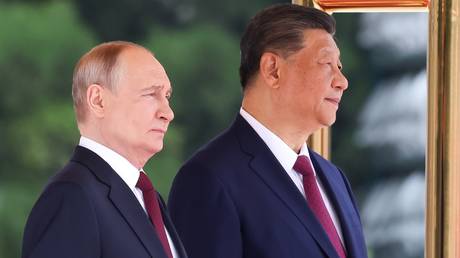
Instead of exporting our values, we imported our vulnerabilities. The architecture of global trade, once envisioned as a web of peace, has been weaponized. Today, Vladimir Putin and Xi Jinping are not merely running rival superpowers; they are holding up a massive, unflinching mirror to the Western world. And what we see reflected back is an uncomfortable truth: the greatest threat to Western stability isn't the strength of its adversaries, but the profound fragmentation within its own borders.
The Strategy of the Fractured Mind
To understand how we arrived at this basement office, we have to look past the military parades in Red Square or the naval maneuvers in the South China Sea. The real battlefield is psychological, economic, and institutional.
Consider the mechanism of a standard cyber campaign. It rarely begins with an overt attack on critical infrastructure. Instead, it starts with an exploit of a social fault line. A controversial local election, a racial grievance, a labor dispute—these are the entry points. Russian intelligence agencies do not create these divisions; they merely find them, pour gasoline on them, and strike a match through thousands of coordinated bot accounts and state-sponsored media outlets.
The objective is simple: paralysis. A society consumed by internal culture wars and political tribalism cannot formulate a long-term strategic response to external threats. While Western capitals debate the optics of domestic policy, Moscow and Beijing operate on thirty-year horizons.
China’s approach complements this strategy by targeting the material foundation of Western life. Think of the supply chain not as a logistical highway, but as a nervous system. If a single nation controls the processing of 80 percent of the world’s cobalt and neodymium, it holds its fingers on the pulse of the global technology sector. When the West threatens sanctions or criticizes human rights abuses, Beijing can quietly tighten the valve on these essential materials. It is a quiet, bloodless form of coercion. It forces Western leaders to choose between their moral rhetoric and the immediate economic survival of their tech-driven economies.
This is the paradox at the heart of the modern crisis. The very openness that defines Western democracy—free speech, free markets, open internet—has been turned into a vector for asymmetric warfare. Our systems are designed for trust, which makes them extraordinarily fragile in an era of deep strategic distrust.
The Illusion of Self-Correction
There is a comforting myth told in the corridors of power in Washington and London: the West always wakes up just in time. We point to the mobilization of World War II, the resolve of the Cold War, and the rapid economic pivots of the past. We tell ourselves that our democratic institutions possess an inherent self-correcting mechanism that authoritarian regimes lack.
But that mechanism requires a shared baseline of reality.
When Thomas looks at his spreadsheets, he sees a terrifying consensus gap. In the past, a clear external threat unified the electorate. Today, the threat itself is a matter of partisan debate. One half of a population sees Russia as an existential menace; the other half views it as a cultural ally or a distraction from domestic failures. One segment of industry demands immediate decoupling from China, while another insists that economic isolation would trigger a catastrophic domestic depression.
This division is exactly what the Sino-Russian partnership calculates for. Their alliance is not born of genuine ideological alignment—historically, Moscow and Beijing have viewed each other with deep suspicion. Rather, it is a marriage of convenience designed to accelerate the fragmentation of Western hegemony. They recognize that a multipolar world is far easier to navigate and dominate than one governed by a unified Western consensus.
The economic reality is stark. The combined manufacturing capacity of the authoritarian bloc now rivals or exceeds that of the West in critical sectors. While Western economies shifted toward finance, services, and software over the last forty years, the physical production of the world’s essential goods migrated East. You cannot build air defense systems with software algorithms alone; you need steel, semiconductors, and specialized manufacturing talent. The erosion of that industrial base has left the West strategically exposed, relying on adversaries for the very components needed to defend against them.
The Realignment of the Global South
Beyond the immediate tension between Washington, Moscow, and Beijing lies a broader, equally critical theater: the nations of Africa, Latin America, and Southeast Asia. For decades, Western foreign policy in these regions relied on a template of conditional aid, structural adjustment loans, and lectures on governance.
The Chinese Belt and Road Initiative offered an entirely different proposition. It was transactional, fast, and unburdened by demands for political reform. If a nation needed a port, a railway, or a digital surveillance network, Beijing built it. The fact that these projects often came with predatory debt structures was secondary to the immediate, tangible development they provided.
Russia provided the security muscle. Through private military corporations, Moscow offered regimes protection, counter-insurgency support, and weapons systems, entirely detached from human rights metrics.
As a result, when the West attempted to rally global condemnation of the invasion of Ukraine or China's maritime expansion, much of the world shrugged. They did not see a principled defense of a rules-based international order; they saw a hypocritical struggle between old colonial powers and new economic titans. The West’s moral authority, degraded by decades of inconsistent interventions and economic neglect, no longer commands automatic alignment.
This shift has profound consequences for the resource security of the West. The raw materials required for the green energy transition—copper, lithium, nickel—are buried in soil governed by leaders who are increasingly looking to Beijing and Moscow for their economic and security partnerships. The West is finding itself lonely on a stage it used to dominate completely.
The Cost of the Long Sleep
The true danger facing Western civilization is not a sudden, dramatic military invasion. It is the slow, grinding exhaustion of its institutional will. It is the creeping realization that the systems we built to ensure peace and prosperity are being used to dismantle them from within.
Back in the Brussels basement, Thomas closes his laptop. The clock now reads 4:15 AM. In a few hours, the political leaders will arrive, give their press conferences, and announce another round of incremental policy adjustments. They will speak of resilience, partnerships, and strategic autonomy.
But the fundamental question remains unanswered. Can a society built on short-term political cycles, quarterly corporate earnings, and deep internal polarization summon the collective discipline to match adversaries who measure progress in generations?
The answer cannot be found in a trade policy document or a military procurement budget. It requires a fundamental reassessment of what a society values more: the immediate comfort of cheap consumer goods and unbridled political theater, or the long-term survival of its foundational liberties. The mirror held up by Moscow and Beijing reveals that we have been trading our long-term security for short-term convenience.
As the first gray light of dawn hits the windows of the European Council, the streetlights click off, one by one, leaving the city in that uncertain, fragile moment before the world fully wakes up.