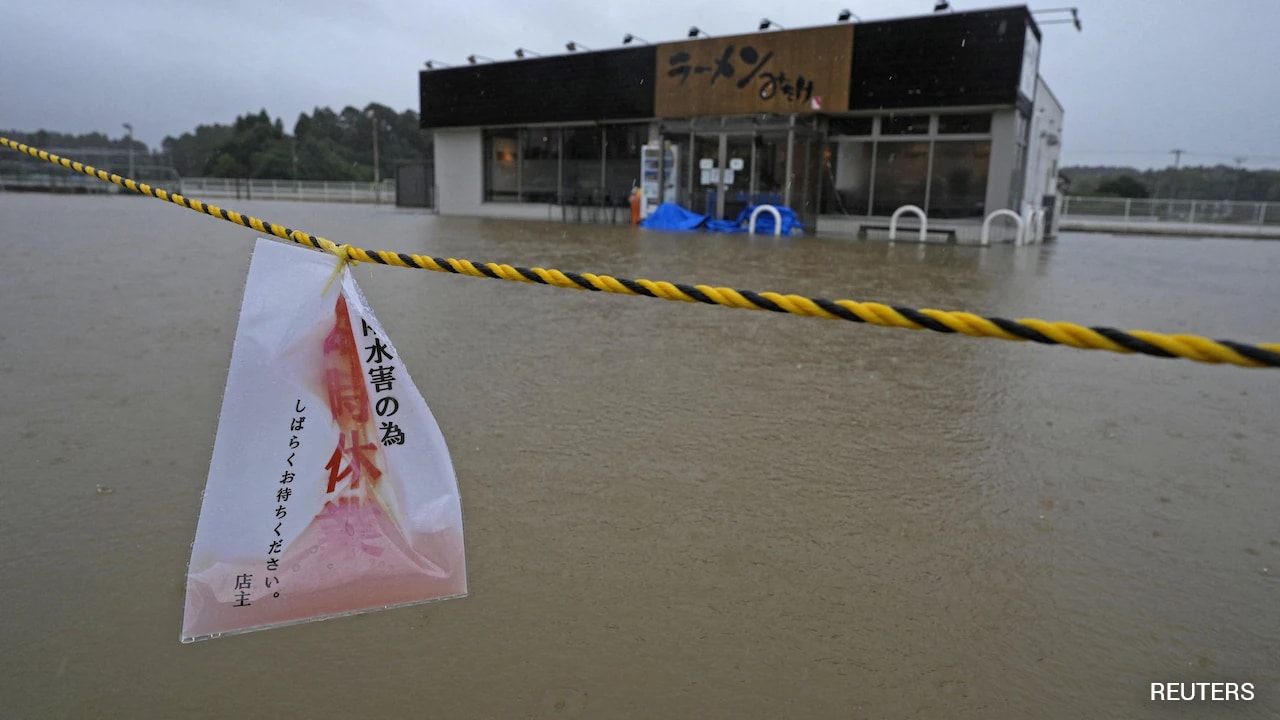
When Typhoon Dujuan slammed into eastern Japan in late September 2026, it did not arrive as an unprecedented meteorological shock. It was Japan's twenty-fifth named tropical cyclone of the year, tracking along a well-worn path of Pacific storms that meteorologists have charted for decades. Yet, despite the familiarity of the threat, the storm laid bare a chilling reality about modern disaster vulnerability. More than 1.6 million residents across Tokyo, Chiba, Kanagawa, and the surrounding Kanto region faced emergency warnings as torrential rain and gale-force gusts battered the eastern seaboard. By the time the skies cleared, at least six people were dead, several others remained missing, and entire neighborhoods were buried under tons of liquefied soil. This was not merely an act of nature. It was a severe stress test of a heavily engineered society confronting an era where historical baseline rainfall metrics no longer apply.
The Geography of Risk and the Limits of Advisory Systems
To understand why Typhoon Dujuan proved lethal despite days of advance notice, one must examine the peculiar geography of Japan’s population centers. Much of the nation's urban expansion is squeezed into narrow coastal plains hemmed in by steep, densely forested mountainsides. When extreme precipitation hits these slopes, the soil transforms almost instantly from a stable foundation into a fluid battering ram.
The Japan Meteorological Agency issued its highest-level landslide warnings—Level 5 alerts—for vulnerable pockets like Oshima in the Izu Islands and specific districts in Kanagawa and Chiba. Yet these alerts carried a critical structural flaw built into Japanese disaster law: they were advisory, not mandatory. Municipalities can urge, plead, and broadcast evacuation advisories across every screen and speaker, but the ultimate decision to flee rests with the individual citizen.
This creates a dangerous cognitive friction. For a working professional living in an apartment building in Yokosuka or Kamogawa, leaving home means abandoning property, navigating paralyzed transit networks, and seeking refuge in crowded school gymnasiums without any guarantee of safety or comfort. When previous storms have passed without catastrophic impact on a specific street, residents develop a psychological immunity to warnings. They gamble on probability, staying put until the sound of cracking timber and roaring mud leaves zero window for escape.
Furthermore, Japan's acute demographic aging exacerbates this vulnerability. In many semi-rural and suburban fringe communities nestled against mountain foothills, the population skews heavily elderly. For an octogenarian living alone, the physical act of packing emergency bags, wading through rising floodwaters, and reaching a designated municipal shelter miles away is an insurmountable barrier. Advisory notices assume mobility and independent decision-making capacity that simply do not exist for significant segments of the population most exposed to slope failures.
The Engineering Paradox of Concrete Sabo Dams
Japan is arguably the global master of disaster engineering. Drive through any mountainous prefecture, and you encounter an astonishing array of concrete infrastructure designed to tame nature. Sabo dams—massive check dams built across mountain streams to trap rolling boulders and debris flows—stand as sentinels above nearly every major settlement near steep terrain. Coastal seawalls protect low-lying ports, and subterranean drainage caverns beneath Tokyo rank among the most sophisticated hydraulic marvels on Earth.
Yet Typhoon Dujuan exposed the limits of structural mitigation when confronted with clustered meteorological phenomena known as linear rain bands. These stationary bands of intense precipitation dump staggering volumes of water over the exact same localized coordinates hour after hour. When rainfall rates exceed one hundred millimeters per hour, concrete infrastructure does not necessarily fail catastrophically; rather, it is simply bypassed.
Water accumulates in secondary gullies and unreinforced slopes where sabo dams were never constructed because the terrain was deemed low-risk. Saturated topsoil on residential hillsides begins to slough off under its own dead weight, dragging homes off their foundations regardless of how sturdy the seawalls are miles away at the ocean's edge. Traditional engineering doctrine relies on historical frequency distributions that assume extreme events are separated by decades of recovery time. When storms strike back-to-back—as parts of Chiba experienced following severe flooding just weeks prior in August—the soil never regains its baseline cohesion. The ground remains perpetually primed for liquefaction.
The maintenance burden of this vast concrete inventory adds another layer of systemic strain. Many sabo structures, drainage channels, and retaining walls constructed during the postwar economic boom are now decades old, requiring constant inspection and billions of yen in upkeep. When extreme weather events deliver concentrated rainfall loads that exceed design thresholds by thirty or forty percent, even meticulously maintained barriers can be overwhelmed within minutes.
The Urban Disruption Cascade
The immediate impact of a typhoon in a hyper-dense urban agglomeration like Tokyo is measured not just in direct casualties, but in the rapid paralysis of critical infrastructure networks. As Dujuan brushed the eastern coast with gusts reaching upwards of 144 kilometers per hour, transport authorities faced immediate shutdown decisions. Major rail operators, including JR East and private lines, suspended services on key commuter arteries to prevent derailments and structural damage from falling trees.
The disruption cascaded instantly through the regional economy. More than 275 domestic and international flights were grounded at Haneda and Narita airports, stranding thousands of travelers and disrupting global cargo chains. Public spaces, commercial venues, and even major tourist draws like Ueno Zoo and Kamogawa Seaworld shuttered their gates. Power grids buckled under falling branches and wind-blown debris, leaving thousands of households in Chiba and Kanagawa without electricity overnight, halting refrigeration, water pumps, and local manufacturing operations.
For an economy operating on razor-thin logistical margins, these closures represent millions of dollars in lost productivity. More importantly, they highlight the vulnerability of commuting populations caught mid-transit. A commuter trapped on a stationary train or stranded at a station concourse becomes an immediate burden on emergency response systems that are already stretched thin managing structural collapses and water rescues in residential zones. Municipalities must coordinate emergency food and water distribution for stranded populations while simultaneously deploying heavy machinery to clear blocked arterial roads.
The Human Cost in the Valleys and Slopes
Statistics obscure the raw human tragedy embedded in every disaster report. In Yokosuka, a woman in her sixties lost her life when a torrent of mud smashed directly through the ground floor of her home. In Miura, rescue workers faced grueling hours tunneling through collapsed wooden structures and deep silt to locate missing residents, including an elderly couple and a young adult trapped inside an inundated apartment complex.
These victims often live in older residential neighborhoods built decades ago before modern seismic and landslide zoning restrictions were rigorously enforced. While new developments on marginal land are subjected to stringent geotechnical reviews, millions of older homes occupy historical hazard zones—low-lying river valleys, alluvial fans at the mouths of steep ravines, and terraced cuts along coastal hills. Retrofitting millions of legacy properties with deep-pile foundations or steel-reinforced retaining walls is economically impossible for individual homeowners and municipal governments alike. Consequently, every major typhoon acts as a lottery where the poorest or oldest housing stock bears the heaviest toll.
The emotional toll on survivors is equally acute. Watching family heirlooms and lifelong possessions washed away in minutes leaves psychological scars that linger long after the mud is cleared. For communities that experienced severe flooding and wind damage only weeks earlier during the late-summer storm surge, the arrival of Dujuan felt like a cruel persistence of misfortune, undermining the psychological resilience of residents trying to rebuild their lives.
The Psychological Aftermath and the Routine of Recovery
When the floodwaters recede and train lines reopen, public attention shifts almost immediately back to normal commerce. Piles of waterlogged tatami mats, ruined appliances, and mud-stained furniture line suburban curbsides in Chiba and Ibaraki. Residents don rubber boots, pick up shovels, and begin the grueling process of mucking out their living spaces—a ritual repeated across Japan with numbing regularity after every typhoon season.
This cycle generates a quiet exhaustion among local communities. When disasters occur annually or even multiple times a year, disaster fatigue sets in. Municipal officials note that participation rates in voluntary community drills often decline because citizens become desensitized to constant warnings. When every storm is billed as a potential historic emergency, the alarm bells lose their urgency. People calculate the fatigue of evacuating against the perceived risk of staying home, and too often, fatigue wins.
Local governments face their own institutional fatigue. Emergency response budgets are drained by repeated recovery operations, forcing prefectural authorities to divert funds from long-term infrastructure upgrades to immediate disaster relief. This reactive cycle prevents municipalities from implementing proactive adaptation measures that could mitigate future disasters.
Confronting the New Meteorological Normal
The approach of Typhoon Dujuan and its subsequent toll force a hard appraisal of future preparedness. Relying on evacuation advisories that depend entirely on individual compliance is proving inadequate as storm intensity increases. Local governments are beginning to experiment with stricter early-evacuation mandates, pre-positioning rescue assets closer to known hazard zones before landfall rather than reacting after roads wash out.
Yet structural adaptation faces hard financial and physical limits. You cannot pave every mountainside, nor can you relocate millions of residents away from the coastal plains that sustain Japan's urban civilization. The challenge moving forward requires a fundamental shift from trying to block nature to building adaptive resilience—redesigning land-use policies to gradually depopulate the most hazardous ravines, upgrading rural drainage basins, and rewriting building codes to withstand torrential inundation rather than just wind loads.
Until those systemic reforms catch up to a changing climate, every coastal community will remain locked in an uneasy truce with the Pacific, waiting for the next rain band to form off the horizon and test the limits of human engineering once more.