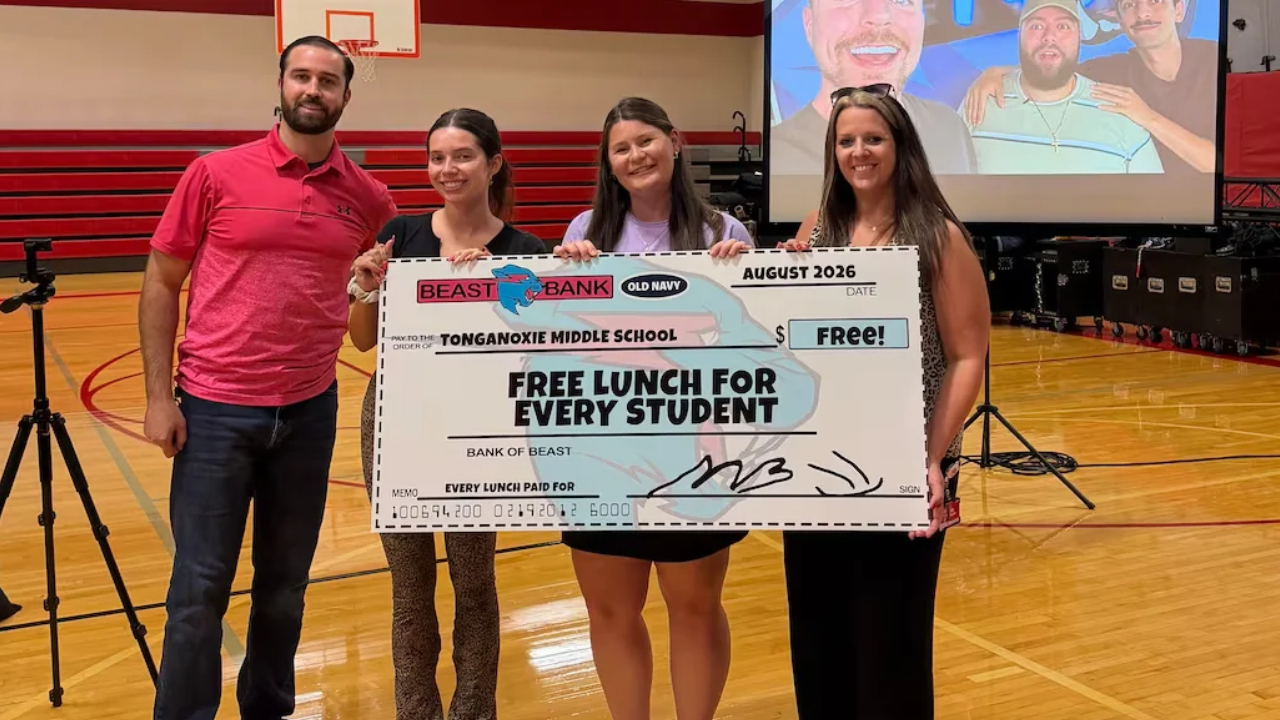
Every time Jimmy Donaldson—known to hundreds of millions as MrBeast—cuts a check to wipe out medical debt, build wells, or erase school lunch balances, the internet throws a digital parade. Local news outlets run tear-jerking segments about a Kansas teacher’s viral campaign sparking a celebrity rescue. Comment sections fill with praise for the king of "stunt philanthropy."
Stop applauding. You are celebrating a band-aid slapped onto a severed artery.
The lazy consensus surrounding MrBeast’s latest school lunch intervention treats an algorithmic business transaction as a systemic solution to child hunger. When a Kansas educator has to beg the internet for spare change so third-graders can eat a hot meal, and a YouTuber steps in to save the day for a video thumbnail, the story isn't that generosity won. The story is that public policy completely collapsed, and we outsourced basic civic duty to the attention economy.
The Economics of Stunt Philanthropy
To understand why these viral rescues are deeply flawed, you have to look at the underlying business model. MrBeast is not running a traditional charity; he is running a high-velocity media empire where goodwill is the primary raw material for content production.
I have spent years analyzing creator-economy unit economics and corporate social responsibility budgets. I have watched brands blow millions on cause-marketing campaigns that generate massive impressions while leaving the root problem entirely untouched. The mechanics here are identical, just executed with far better pacing and retention editing.
Here is how the Beast Philanthropy flywheel actually operates:
- Identify a visceral, undeniable human need. Hunger, blindness, lack of clean water. Things no rational person can argue against.
- Inject capital to solve the immediate symptom. Pay off the ledger. Fund the surgery.
- Film the emotional payoff. Capture the tears, the shock, and the relief in 4K resolution.
- Monetize the resulting attention. Generate tens of millions of views, sell Feastables chocolate bars, secure lucrative brand integrations, and capture AdSense revenue.
- Reinvest a fraction of the proceeds into the next spectacle.
Is this illegal? No. Does it put food in the stomachs of hungry kids in Kansas today? Yes.
The danger lies in how this model warps public perception. By framing systemic poverty as an exciting obstacle course that a benevolent billionaire-in-the-making can clear in a 15-minute video, we sanitize the cruelty of the systems that created the debt in the first place. A school lunch balance should not exist as a concept. "Lunch debt" is a bureaucratic euphemism for denying children food because their parents lack liquidity. When a YouTuber clears that debt, the school district breathes a sigh of relief, the state legislature avoids passing a funding bill, and the public gets a dopamine hit that excuses them from demanding actual tax reform.
The Illusion of Scale Versus Structural Permanence
Critics who point out the flaws in viral charity are usually met with the same tired rebuttal: "What have you done to help kids today?"
This is a classic logical fallacy that confuses individual moral action with systemic design. Let’s look at the math. According to data from the School Nutrition Association, unpaid school meal debt across the United States runs into the hundreds of millions of dollars annually. Even if MrBeast dedicated every single dollar of his personal net worth and every cent of his YouTube revenue to paying off lunch balances, he could not sustain the program nationally for a single academic year.
Compare viral philanthropy to universal free school meal legislation passed in states like California, Maine, and Minnesota.
| Metric | Viral Celebrity Intervention | Universal Free Meal Policy |
|---|---|---|
| Funding Source | Ad revenue, sponsorships, merchandise | Progressive taxation & state budgets |
| Duration | One-time ledger wipe | Permanent, recurring annual allocation |
| Eligibility | Dependent on viral luck & teacher outreach | Every enrolled student, zero stigma |
| Accountability | Algorithmic performance & viewer retention | Voters, school boards, and state audits |
| Administrative Burden | High (crowdfunding, PR coordination) | Near zero (eliminates means-testing) |
When Minnesota passed universal free school meals in 2023, it didn't require a single camera crew, a crying principal, or a viral TikTok from an overworked teacher. It required political will. It eliminated the administrative overhead of tracking debt, removed the social stigma of the "free lunch line," and ensured that every child walked into the cafeteria on equal footing.
Imagine a scenario where a town's water main bursts, flooding basements and ruining homes. Instead of the city council fixing the pipes, a wealthy influencer shows up with ten thousand luxury sponges, films himself mopping up three living rooms, and uploads it to tremendous applause. The residents of those three houses are grateful—rightfully so. Meanwhile, the water is still gushing out of the broken main, flooding the rest of the neighborhood while everyone argues about how generous the guy with the sponges is.
That is where we are with public education funding.
Dismantling the "People Also Ask" Myths
Whenever these stories trend, search engines light up with variations of the exact same questions. Almost all of them are built on a broken premise.
Does MrBeast actually lose money on his charity videos?
No, and anyone telling you otherwise doesn't understand basic accounting. While Beast Philanthropy operates as a separate 501(c)(3) nonprofit organization, the main channel videos and the brand halo they generate are massive profit centers. The goodwill earned from giving away money directly lowers customer acquisition costs for his consumer packaged goods, like Feastables and Lunchly. It is the most efficient marketing engine on the planet. Calling it "losing money" is like saying Apple loses money when it shoots a Super Bowl commercial.
Why shouldn't rich creators fix problems if the government won't?
They can, and in acute emergencies—like hurricane relief or immediate food bank shortages—private speed beats bureaucratic deliberation every time. The problem isn't the check; it's the replacement effect. As sociologist Rob Reich argues in his book Just Giving, big philanthropy is often an exercise of power without democratic accountability. When private wealth steps in to fund public infrastructure, it allows elected officials to slash public budgets while pointing to private charity as the safety net. You end up with a lottery system for basic human rights: if your teacher goes viral, your kids eat. If your teacher isn't media-savvy, your kids get a cold cheese sandwich and a debt notice.
Isn't any help better than no help at all?
In the short term, yes. In the long term, charity that preserves the conditions requiring charity is a trap. Economist Dambisa Moyo extensively documented how poorly structured aid creates dependency and undermines local institutional accountability. Apply that exact same principle to American school districts. If school boards know a GoFundMe or a celebrity donor will bail out their cafeteria deficits every spring, the pressure to lobby state lawmakers for permanent funding evaporates.
The Uncomfortable Truth About The Kansas Teacher
Look closely at the catalyst for this specific story: a Kansas teacher launching a campaign to pay off student meal balances.
Teachers are already buying pencils, notebooks, and tissues out of their own underpaid salaries. Now, we have added "chief fundraising officer" and "social media viral marketer" to their unofficial job descriptions. That teacher didn't start a campaign because she wanted to hang out with a YouTuber. She did it because she watched hungry kids walk through her classroom door every morning and realized the adults in charge of the state budget weren't going to lift a finger.
The media coverage frames this as an inspiring tale of community resilience. In reality, it is an indictment of civic abandonment. We are forcing frontline educators to perform emotional labor on the internet to crowdsource basic nutrition for children in the wealthiest nation in human history.
What Actually Fixes The Problem
To be completely fair to Donaldson, he is playing the exact game our society built for him. He didn't break the American social safety net; he just figured out how to monetize the wreckage while doing more tangible good than 99% of traditional billionaires who hide their money in vanity foundations and art collections.
If you want to actually solve school lunch debt instead of just feeling good about a YouTube video, stop sharing heartwarming viral clips and start demanding structural boringness:
- Eliminate means-testing in local districts. Push your local school board to adopt the Community Eligibility Provision (CEP), a federal option that allows high-poverty schools to serve free breakfast and lunch to all students without collecting household applications.
- Vote on state-level universal meal bills. Support legislation that mandates free meals for all K-12 students, funded through state general funds rather than local property tax scraps.
- Audit your district's debt collection practices. Many districts spend more money hiring third-party collection agencies and mailing warning letters to parents than the actual value of the unpaid lunches. Demand the immediate termination of punitive "lunch shaming" policies.
- Direct your donations to policy advocacy, not just ledger bailouts. Paying off a school's debt clears the slate for one semester. Funding the local coalitions lobbying the statehouse clears the slate forever.
MrBeast did his job: he made a compelling piece of entertainment that fed some kids in Kansas and drove millions of clicks. Now do yours, and stop mistaking a YouTube video for a functioning society.