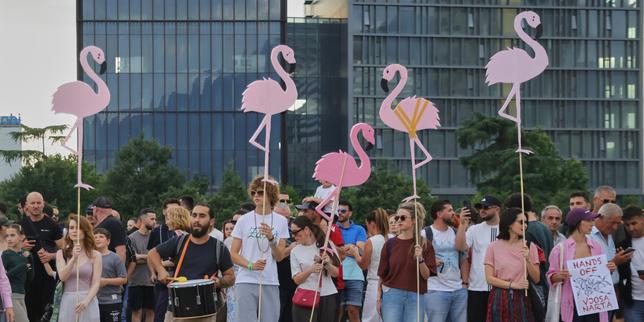
The international press loves a good David versus Goliath story. When Donald Trump’s son-in-law Jared Kushner announced a billion-dollar luxury real estate development on Albania’s pristine Zvërnec peninsula, the narrative practically wrote itself. Western media outlets rushed to cover the "flamingo revolution," painting a picture of local activists and rare birds standing as the last line of defense against the Trump family and Albanian Prime Minister Edi Rama.
It is a beautiful, romantic, and completely naive fantasy.
The lazy consensus among Western journalists is that this development is an unmitigated ecological tragedy pushed by a corrupt regime to appease American oligarchs. They look at the Narta Lagoon, see thousands of pink flamingos, and declare the entire project an act of environmental vandalism.
They are asking the wrong questions. They are looking at Albania through a privileged, post-industrial lens that ignores the brutal realities of Mediterranean economics. The truth about the Vlora project is not an eco-thriller; it is a masterclass in sovereign rebranding and economic survival.
The Flawed Premise of the "Pristine Wilderness"
Let’s dismantle the first myth: the idea that the Narta Lagoon is an untouched paradise that will be destroyed by capitalism.
I have spent fifteen years analyzing Mediterranean coastal development. I have watched Spain destroy its coast with cheap concrete high-rises, and I have seen Greece choke its islands with unmanaged mass tourism. If you actually visit the areas surrounding Vlora and the Narta Lagoon outside of a curated press trip, you do not find an untouched Eden. You find a region that has suffered from decades of structural neglect, illegal waste dumping, and uncontrolled urban sprawl.
The "eco-revolution" narrative assumes that doing nothing preserves nature. It does not. Without massive capital injection, the Narta Lagoon faces a slow death from agricultural runoff and local pollution.
Luxury eco-tourism—when executed by high-end brands like Aman, which Affinity Partners is eyeing for this project—requires pristine environments to justify its price tag. Kushner isn't building a mega-resort for budget cruise ship passengers; he is targeting ultra-high-net-worth individuals who pay $3,000 a night specifically for isolation and untouched views. The economic incentive for the developer is to keep the flamingos exactly where they are.
Why Edi Rama’s Bet on Kushner is Pure Pragmatism
Western critics accuse Prime Minister Edi Rama of selling out Albania's sovereignty for political favor. They claim this project is a geopolitical bribe designed to secure a lifeline with a potential future US administration.
This view grossly underestimates Rama’s strategy. Rama is not a passive actor being bullied by American capital; he is a hyper-pragmatic leader pulling off the ultimate sovereign pivot.
For decades, Albania was the hermit kingdom of Europe, isolated by a paranoid communist dictatorship. When it opened up, it became synonymous in the Western imagination with migration crises and organized crime. Rama’s entire tenure has been a calculated effort to rewrite that script.
Look at the data that the critics ignore:
- Albania welcomed over 10 million tourists in 2023, a massive spike for a nation of 2.8 million.
- Tourism now accounts for over 20% of the country's GDP.
- The current tourism model is heavily reliant on low-cost European sun-seekers who spend very little per capita.
A nation cannot build long-term wealth on €30-a-night hostel stays and cheap beers on the beach. To jump from a developing economy to a high-income nation, Albania needs high-yield tourism. It needs the kind of infrastructure that forces global airlines to route direct flights to the newly built Vlora International Airport. Kushner’s project provides the anchor tenant for the entire southern coast's economic future.
The Double Standard of Western Environmentalism
There is a glaring hypocrisy at the heart of the Western outrage over Zvërnec. Wealthy European and American commentators, sitting in cities built on centuries of industrial pollution and concrete development, are telling Albanians that they must remain an economic museum to preserve the view for migratory birds.
When France builds mega-resorts in the Alps, or when Italy expands luxury marinas in Sardinia, it is called economic development and sustainable tourism management. When Albania attempts to utilize its most valuable asset—its coastline—to lift its population out of relative poverty, it is labeled a tragedy.
Let’s look at the legal mechanics. Critics point out that the Albanian government amended its protected areas laws to allow for these luxury developments. They scream authoritarianism. In reality, this is standard legislative agility. Governments across the globe, from Costa Rica to Montenegro, routinely modify zoning laws to accommodate strategic foreign direct investment (FDI).
If an investment of $1 billion represents roughly 5% of Albania's total GDP, any rational government would rewrite its zoning laws to make it happen. To do otherwise would be fiscal malpractice.
The Real Risk Nobody is Talking About
My contrarian view does not mean the project is without risk. But the risk is not that the flamingos will fly away. The real danger is the classic "resource curse" of luxury real estate: local economic exclusion.
When a sovereign state creates an enclave for the hyper-wealthy, the benefits can easily fail to trickle down if the legal framework is weak.
| Project Element | The Naive Eco-View | The Real Economic Risk |
|---|---|---|
| Land Use | Destroying flamingo habitats. | Skyrocketing land values pricing out locals. |
| Job Creation | Only low-wage service jobs. | Lack of local hospitality training for luxury standards. |
| Infrastructure | Overburdening local grids. | Creating a "two-tier" infrastructure system (luxury vs. local). |
If the Rama government does not mandate that local contractors are used, that local agricultural supply chains are integrated into the resorts, and that a significant portion of tax revenues are directly reinvested into Vlora’s public schools and hospitals, then the project will fail the Albanian people. That is the debate activists should be having. Instead, they are wasting energy fighting an inevitable development using outdated environmental slogans.
Stop Romanticizing Poverty
The "flamingo revolution" is a media construction that satisfies a Western desire for anti-Trump resistance and environmental romanticism. It completely ignores the aspirations of the Albanian youth, who have been leaving the country in droves for decades to find work in London, Munich, and Milan.
You do not stop the brain drain by telling young Albanians to become underpaid park rangers in a state-protected swamp. You stop it by attracting global capital, creating high-paying corporate hospitality roles, and building a modern economy that demands international standards of law, property rights, and infrastructure.
Jared Kushner's investment group is not coming to Vlora out of charity. They smelled an undervalued asset in a country hungry for growth. Edi Rama did not roll out the red carpet out of fear; he did it because he understands that in the brutal market for foreign investment, you capitalize on opportunity when it knocks, or you watch your neighbors leave you behind.
The luxury villas will be built. The airport will bring in the private jets. The flamingos, highly adaptable creatures that have coexisted with human industry from the salt pans of France to the coast of Kenya, will find their balance.
Stop crying over the end of Albania's isolation. It is time to watch it grow up.



:max_bytes(150000):strip_icc()/how-many-types-of-dwarfism-are-there-2860725-v1-8dae2c531b4b47d9ae36ae404d3308a0.png)