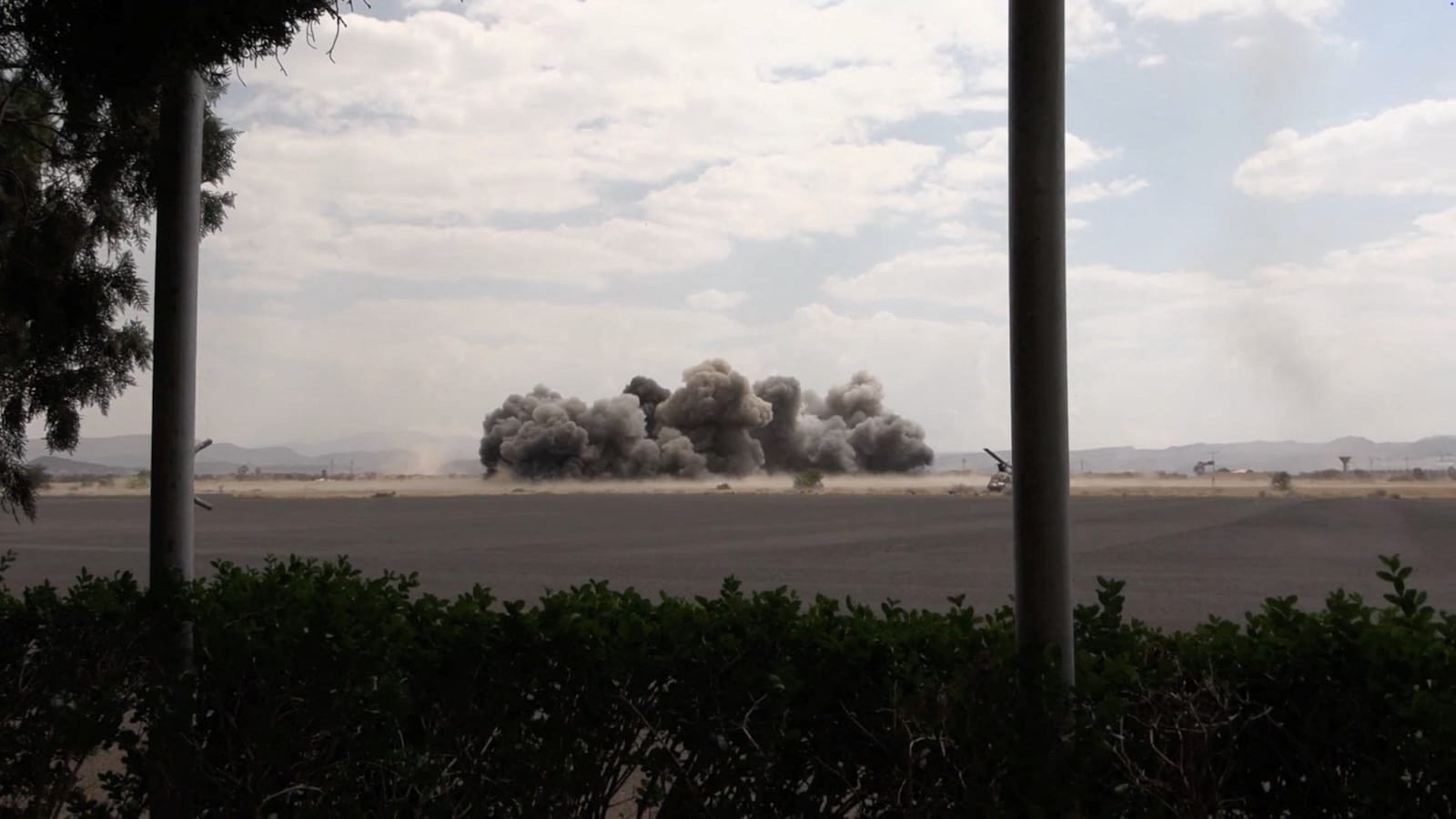
The international press is panicking over a "broken peace" that never actually existed.
Following a strike on Sanaa airport, headlines scream that the Houthis firing missiles into Saudi Arabia has shattered a four-year truce. It is a neat, comforting narrative. It positions geopolitics like a football match where everyone plays by the rules until someone suddenly commits a foul.
It is also completely wrong.
To suggest a four-year truce just ended is to misunderstand the fundamental nature of asymmetric warfare, regional deterrence, and the economics of the Red Sea shipping crisis. The mainstream media is treating a predictable escalation in a continuous, active conflict as a shocking plot twist.
If you are analyzing regional stability based on the premise that Yemen was at peace until five minutes ago, your strategy is already broken.
The Illusion of the Four-Year Ceasefire
Let us correct the timeline immediately. The formal, UN-brokered truce in Yemen officially expired in October 2022. What followed was not "peace." It was a mutually agreed-upon period of exhaustion.
Saudi Arabia wanted an exit strategy from a costly military campaign. The Houthis needed time to consolidate power, restock their arsenals, and build out a governance structure over the territories they controlled.
Calling this a truce is like claiming two boxers are best friends because they are resting in their corners between rounds.
During this supposed period of tranquility, the underlying drivers of the conflict did not vanish:
- Economic Blockades: The flow of goods, fuel, and revenue through Yemeni ports remained heavily contested, creating a permanent state of economic warfare.
- Regional Proxy Dynamics: Tehran’s supply lines to Sanaa did not close; they became more sophisticated, transitioning from raw weaponry to localized manufacturing components.
- Asymmetric Scaling: The Houthis spent the "truce" shifting their focus from local border skirmishes to global maritime choke points.
When you look at the data, the missile strikes into Saudi Arabia are not an abrupt policy shift. They are the logical next step for an actor that has successfully scaled its deterrence capabilities while the international community pretended the situation was stable.
The Sanctions Fallacy: Why Financial Pressure Fails
Western foreign policy experts consistently fall back on a tired playbook: isolate, sanction, and wait for capitulation.
I have watched policy analysts spend years drafting sanctions packages against Houthi leadership, convinced that freezing bank accounts and restricting international travel would force them to the negotiating table. It is a strategy built for a world that no longer exists.
The Houthis do not operate within the global financial architecture. They run a wartime extraction economy.
[Traditional State] ----> Relies on Global Banking ----> Vulnerable to Sanctions
[Houthi Framework]  ----> Relies on Localized Hawala  ----> Immune to External Fiat
By controlling the distribution of basic goods, taxing humanitarian aid, and utilizing the hawala informal value transfer system, the group has insulated itself from Western economic leverage. When a strike hits Sanaa airport, it does not disrupt a thriving commercial hub; it simply alters the logistics of a highly adaptable smuggling network.
To think that cutting off an airport runway will force a militarily dominant insurgent group to stop firing missiles is peak geopolitical naivety.
The Misunderstood Calculus of Deterrence
Why fire at Saudi Arabia now? The conventional explanation is simple revenge for the Sanaa airport strike.
That explanation misses the broader strategic shift. The Houthis have spent the last year proving they can disrupt global supply chains by targeting shipping in the Bab al-Mandab strait. By renewing strikes on Saudi targets, they are sending a message to Riyadh: Do not allow your territory to be used as a staging ground for Western coalition actions, or your energy infrastructure becomes fair game again.
This is about leverage, not anger.
Saudi Arabia’s state-backed economic transformation projects require massive foreign investment and absolute domestic stability. A single drone strike on an Aramco facility does billions of dollars in psychological damage to foreign investor confidence. The Houthis know this. They are using cheap, asymmetric tech to hold trillion-dollar economic initiatives hostage.
The downside to acknowledging this reality is uncomfortable: it means recognizing that the balance of power in the Arabian Peninsula has permanently shifted. Traditional military superiority—expensive air defense systems, stealth fighter jets, and massive defense budgets—is struggling to counter decentralized, low-cost drone and missile proliferation.
Stop Asking the Wrong Questions
The media continuously asks: How do we get the parties back to the 2022 truce frameworks?
This is the wrong question. It assumes the Houthis want to return to a status quo where they are treated merely as a domestic rebel faction. They have outgrown that designation. They now see themselves as a major regional player capable of dictating terms to global superpowers and regional oil giants alike.
Instead of hunting for a non-existent reset button, analysts and global trade strategists must accept three brutal realities:
- The Conflict is Regionalized: You cannot decouple the war in Yemen from the broader geopolitical architecture of the Middle East. It is no longer a localized civil war.
- Containment Has Failed: The policy of containing the conflict within Yemen's borders is dead. The shipping crisis proved that what happens in Sanaa directly impacts retail prices in Rotterdam and New York.
- Kinetic Strikes Aren't a Solution: Bombing runways and launch sites provides a temporary media victory but fails to dismantle the underlying, decentralized assembly networks that keep the missiles flying.
The strike on Sanaa airport and the subsequent missile launches are not the end of a truce. They are the continuation of a long-term strategy that the West has consistently failed to read.
Stop waiting for a return to stability. The chessboard has been flipped, the old rules are gone, and the players you think are losing are the ones dictating the pace of the game.