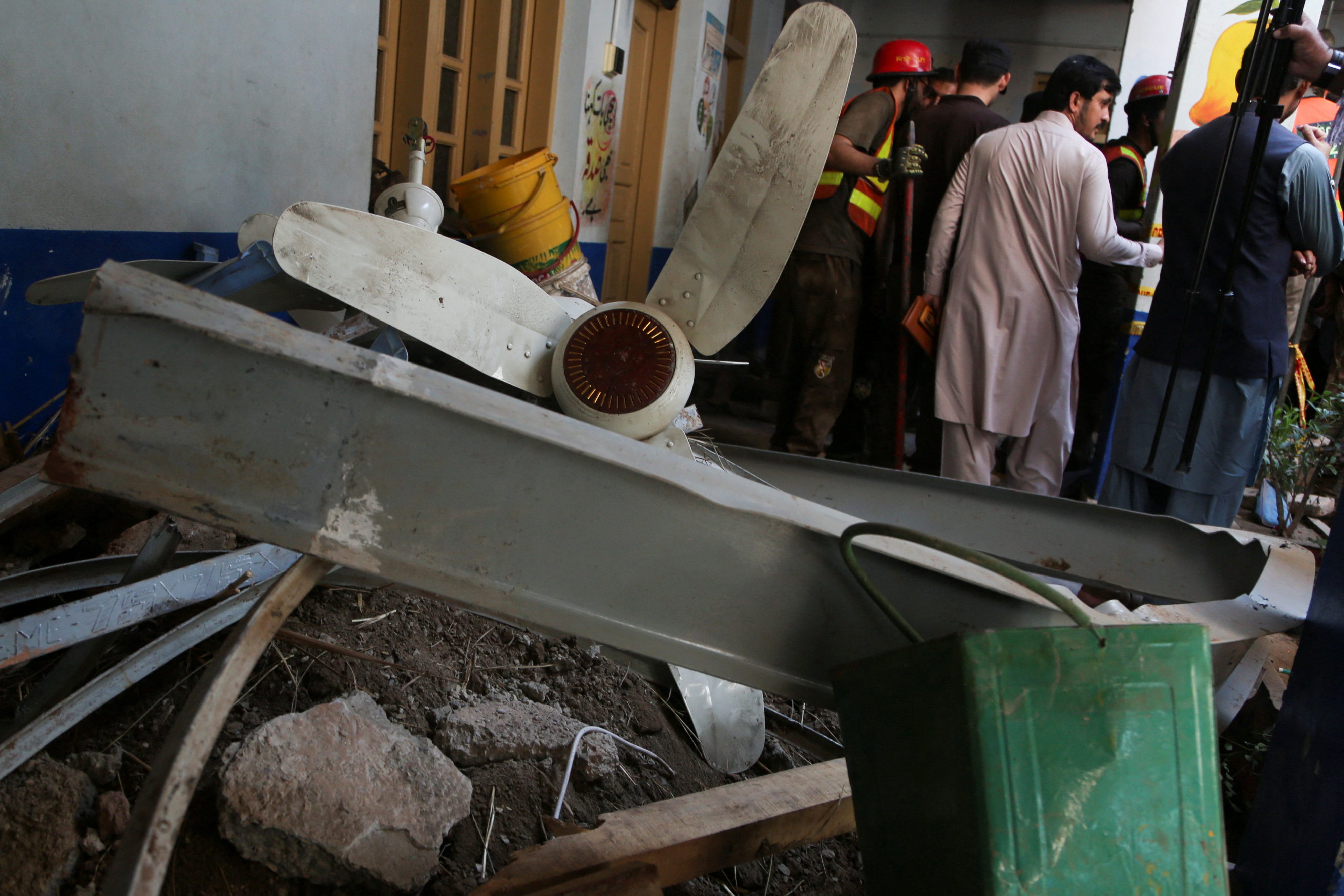
Slapping thirty-five dead children onto a First Information Report and naming everyone with a share certificate or a trowel feels like justice. It isn't. It's a pressure valve.
Whenever a school roof gives way and kills dozens of students, the script plays out with grim predictability. Headlines scream about accountability. Police draft sweeping FIRs naming owners, shareholders, and contractors. The public nods, convinced that arresting a few names on a charge sheet will somehow stiffen the next slab of reinforced concrete poured across the region. If you liked this post, you should look at: this related article.
It won't. Not by a millimeter.
I have spent years walking through post-failure sites, reading structural engineering reports, and watching well-meaning reform committees dissect tragedies long after the dust settles. I have seen institutions and developers burn millions on shiny compliance checklists, retrofitting facades, and celebratory ribbon-cuttings while ignoring the quiet rot happening beneath the plaster. Treating an FIR list as a structural safety strategy is like blaming the captain's ledger for an iceberg. It satisfies our outrage. It does almost nothing to prevent the next collapse. For another look on this development, check out the latest coverage from Reuters.
The lazy consensus says: punish the greedy owners, arrest the cut-rate contractors, drag the shareholders into court, and fear will make builders behave. That argument sounds tough. It plays great on evening news panels. Under structural scrutiny, it falls apart.
Why "Who Signed What" Distracts From How Buildings Actually Die
Concrete and steel do not care about equity stakes. Gravity is indifferent to who holds a minority share in a private school trust or which subcontractor promised to deliver high-grade rebar on a Tuesday morning.
Buildings fail through physics, material science, and institutional blind spots. When a roof collapses over a classroom, the immediate cause is usually a combination of factors that rarely show up cleanly on a police charge sheet:
- Substandard materials and bad mixes: Water-cement ratios pushed too high to make pouring faster and cheaper, resulting in porous, weak concrete that loses compressive strength long before its design life ends.
- Corroded reinforcement: Moisture seeping through unsealed slabs or poor concrete cover, causing steel rebar to rust, expand, and spall the surrounding concrete from the inside out.
- Unapproved vertical additions: Adding a second or third story onto a single-story foundation or load-bearing walls never engineered to carry the extra dead load and live load of packed classrooms.
- Defective curing and formwork: Stripping supports too early or failing to keep fresh concrete moist during curing, leaving the structural member at a fraction of its rated capacity.
- Uninspected shortcuts: Skipping load calculations, using undersized stirrups or shear reinforcement, or building without an independent structural engineer signing off at critical stages.
In structural engineering, load path refers to the continuous chain of elements designed to carry weight and lateral forces safely down to the ground. If one link is weak—a poorly anchored beam, an overloaded slab, a fatigued column—the load path breaks. You can arrest every shareholder in the city, and the remaining weak links in other buildings will still carry the exact same unsafe load tomorrow morning.
Criminal liability after a disaster is backward-looking. It assigns moral and legal blame after the bodies are counted. Structural safety has to be forward-looking. It has to catch the hairline crack, the damp ceiling patch, the missing tie-beam, and the unauthorized extra floor before a single child sits underneath it.
The Trap of Treating All "Shareholders" and "Owners" as Equal Culprits
A sweeping FIR lumps together people whose actual control over a building's structural integrity ranges from total to practically zero.
Consider how private schools and commercial buildings are structured. A family member or passive investor might hold shares in an educational company or society, collect dividends or board seats, and never set foot on a construction site or approve a bill of quantities. Meanwhile, the person who actually ordered cheap aggregate, ignored a mason's warning about sagging shuttering, or pocketed the difference between code-compliant steel and scrap-grade bars might hide behind shell entities, oral agreements, or vanished subcontractors.
When law enforcement casts a net wide enough to catch everyone connected to the title or shareholding structure, two bad things happen at once. First, cases get bogged down for years in procedural fights over who actually exercised operational control, letting the real culpable decision-makers stall justice. Second, real investors and legitimate operators start treating compliance as a gamble rather than an engineering discipline, because even people who hired licensed professionals can get swept into broad criminal dragnet narratives when tragedy strikes.
Even the word contractor gets flattened in public debate. There is a massive difference between a licensed general contractor bound by engineered drawings and municipal permits, and an informal local builder hired piecemeal without structural drawings, soil tests, or quality control. Calling both "the contractor" hides the systemic absence of mandatory engineering oversight in informal and semi-formal construction.
Accountability without technical precision produces noise, not safety. Naming everyone in the room is an admission that nobody knows which specific failure caused the collapse.
Imagining a Different Accountability Model
Imagine a scenario where a school roof collapses, and instead of starting with a sprawling dragnet aimed at every shareholder, authorities immediately impound all structural drawings, material invoices, soil reports, and municipal approval files—and deploy an independent forensic engineering team within hours.
In that scenario, investigators map the exact failure mechanism first. Did the slab fail in shear around a column? Did rainwater infiltrate a poorly sloped roof over five monsoons, corroding the tension steel? Did the building owners add classrooms over a structure built decades earlier as a residential house?
Once the physical failure mode is established, legal accountability follows the actual chain of causation. If an owner added an unapproved floor without a structural engineer's stamp, that decision is front and center. If a contractor substituted sub-grade steel in violation of a stamped structural specification, that breach is documented with physical evidence. If a municipal inspector signed off on a structure that violated basic building code requirements, that institutional failure is exposed too.
That approach is harder. It requires technical competence, forensic discipline, and restraint from grandstanding. It is also far more likely to scare people who actually control structural decisions into following engineering standards.
The Questions We Keep Asking Instead of the Right Ones
Search feeds and public debates around school collapses tend to circle around a few predictable questions:
- "Who is to blame for the school roof collapse?"
- "Why are contractors and owners not punished after building collapses?"
- "How can we stop buildings from collapsing?"
Every one of those questions nudges you toward the wrong fix if you answer it superficially.
If you ask "Who is to blame?" and stop at the FIR list, you confuse moral outrage with engineering reform. Blame after the fact does not reinforce a single beam.
If you ask "Why aren't contractors and owners punished?" and assume the problem is simply a lack of harsher criminal charges, you miss why prosecutions stall or misfire: weak forensic documentation, informal contracting chains, outdated or un-enforced municipal codes, and widespread regulatory blind spots.
If you ask "How can we stop buildings from collapsing?" and answer with "stricter penalties and more inspections on paper," you are repeating a playbook that has failed repeatedly across South Asia and beyond. Paper inspections are cheap to fake. Bribes are cheap to pass. Real structural safety requires incentives, verification, and consequences tied to verifiable engineering standards.
What Heavyweight Engineering Wisdom Actually Tells Us
Across civil and structural engineering—from foundational texts on reinforced concrete design to modern failure analysis championed by figures like the late structural engineer and writer Henry Petroski—one core truth repeats across centuries: failure teaches more than success, provided you examine the mechanics rather than hunting for scapegoats.
In structural mechanics, codes like the American Concrete Institute's ACI 318 or national building codes exist because past collapses revealed hidden vulnerabilities—insufficient shear reinforcement, poor anchorage lengths, inadequate cover against corrosion, or unbraced slenderness. Every major advancement in structural safety came from engineers asking how forces redistributed when something gave way, and why assumptions about material behavior or loads broke down.
When society treats every structural collapse purely as a criminal conspiracy by greedy owners and rogue contractors, it short-circuits that learning loop. We get arrests, press conferences, and anger—and we miss the quiet systemic flaws sitting inside thousands of other schools, clinics, and apartment blocks right now.
The Downsides of Taking a Hard-Nosed Engineering Stance
I'll be candid about where a purely technical, anti-scapegoating lens can go wrong if taken too far.
First, it can sound cold when families are burying children. Grief demands moral clarity, not a lecture on water-cement ratios or shear failure. Ignoring the human tragedy or sounding dismissive of victims' families is a fast way to lose moral credibility—and it shouldn't happen.
Second, focusing too narrowly on engineering mechanics can let genuine crookery off the hook if legal systems are weak. Sometimes an owner did cut corners deliberately to pocket cash. Sometimes a contractor did knowingly use junk materials. Engineering analysis should sharpen legal accountability, not excuse willful negligence or fraud.
Third, technical fixes alone won't solve poverty, land scarcity, or weak governance. A school operating out of a cramped, converted residential building in a dense neighborhood faces economic and spatial pressures that a codebook cannot solve by itself. Pretending that structural engineering operates in a vacuum is naive.
Still, acknowledging those limits doesn't invalidate the core point. Good intentions and angry FIRs do not hold up a concrete slab. Physics does.
Practical Moves That Actually Reduce Collapse Risk
If you run a school, oversee property assets, advise policymakers, or care about whether children sit under safe roofs tomorrow morning, skip the performative gestures and focus on high-leverage actions:
- Commission an independent structural audit—not a visual walk-through. Hire a qualified structural engineer to inspect older buildings, especially any structure with added floors, visible cracks, water seepage, efflorescence (white salt deposits from moisture), or altered load-bearing walls.
- Enforce non-negotiable material and testing gates on new builds. Require concrete cube testing, steel mill/yield verification, proper curing logs, and stage-by-stage structural sign-offs before pouring slabs or stripping formwork. Never rely on verbal assurances from a contractor or supplier.
- Audit occupancy and load changes aggressively. Treat turning a residential floor into a crowded classroom, library, or storage space as a structural event that requires load verification—not a simple room swap.
- Separate structural inspection from commercial conflict of interest. Build independent third-party verification into construction and school licensing so the person certifying safety isn't financially dependent on keeping a project moving fast or cheap.
- Pair targeted prosecution with forensic proof. When tragedies happen, invest in rapid forensic engineering so charges stick against the people whose actual acts or omissions compromised the structure, rather than padding a list with every name on paper.
An FIR can name a dozen people in an afternoon. Keeping a roof from falling on thirty-five kids takes real engineering, honest inspection, and the discipline to fix weak links before they snap.


