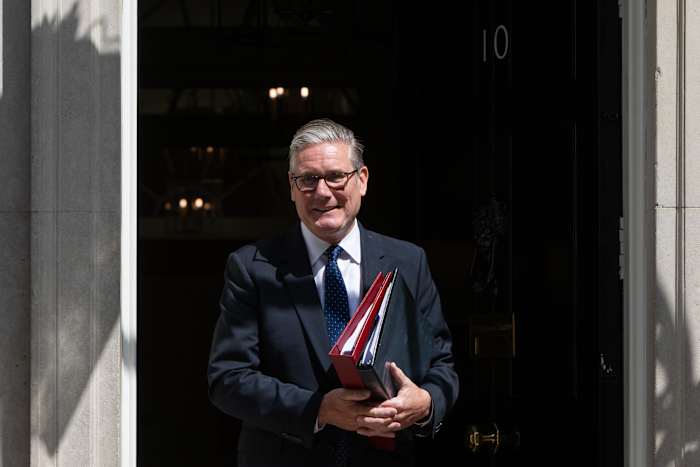
The Westminster press pack is currently hyperventilating over Keir Starmer's latest high-stakes appearance at the dispatch box. They frame it as a crucial test of leadership, a defining moment of political theater, and the ultimate showcase of British democratic accountability.
They are lying to you. Or worse, they genuinely believe their own hype.
The mainstream media treats Prime Minister’s Questions (PMQs) as if it is the intellectual engine room of British democracy. It is not. It is a performative circus, a loud, shallow schoolyard brawl that actively degrades the quality of British governance. The obsessive coverage of Starmer's parliamentary performances misses the entire point of how power is wielded, checked, and abused in modern Britain.
If we want actual accountability, we need to stop celebrating this weekly pantomime and dismantle it entirely.
The Illusion of Accountability
The central myth of PMQs is that it forces the executive to answer to the legislature. The reality is that the entire thirty-minute session is heavily choreographed, thoroughly scripted, and intellectually dead.
I have spent years advising politicians and preparing briefing documents for these exact sessions. The public sees a spontaneous, fiery debate. What actually happens is a cynical exercise in risk management and soundbite production.
The process is entirely formulaic:
- The Planted Questions: Government backbenchers are handed pre-written prompt cards by the Whips. These "syndicated questions" are designed solely to allow the Prime Minister to list highly selective, often misleading statistics about economic growth or local funding.
- The Gotcha Trap: The Leader of the Opposition does not ask questions to gain information. They ask questions designed to create a six-second clip for social media or the evening news.
- The Defensive Dodge: The Prime Minister’s dispatch box folder is stuffed with hundreds of pages of defensive lines, compiled by overworked civil servants. The goal is never to answer the question, but to run down the clock and pivot to a pre-packaged attack on the opposition's record.
This is not scrutiny. It is an expensive, taxpayer-funded shouting match where actual policy detail is actively suppressed in favor of performative noise.
Inside the Prep Room: How the Sausage is Actually Made
To understand how destructive this spectacle is, you have to look at how a Prime Minister's team prepares for it.
Every Wednesday morning, the Downing Street machine grinds to a halt. The country’s most powerful officials, special advisers, and communications directors crowd into a room to run mock sessions.
They do not spend this time analyzing systemic failures in the National Health Service or dissecting the structural flaws in the housing market. Instead, they obsess over optics. They draft sharp insults. They predict the exact wording of the opposition’s attack lines so they can deploy a pre-written, highly partisan counter-punch.
"I have seen brilliant policy minds waste entire mornings trying to turn complex, nuanced economic challenges into a single, punchy insult that can be delivered in under fifteen seconds. It is an astonishing waste of public-sector brainpower."
While the Prime Minister is memorizing defensive statistics about waiting lists, the actual work of running departments is put on hold. The entire apparatus of government is warped to serve a thirty-minute television show.
The Tragedy of the Lawyer Politician
Keir Starmer’s tenure at the dispatch box highlights the fundamental mismatch between actual competence and PMQs theater.
As a former Director of Public Prosecutions, Starmer is a man trained in evidence, cross-examination, and methodical detail. In any rational system of governance, these skills would be highly valued for executive scrutiny. Yet, for years, Westminster commentators have criticized him for being "boring" or "too forensic" at the dispatch box.
The media-industrial complex demanded that he stop acting like a serious prosecutor and start acting like a stand-up comedian.
Instead of demanding that the Prime Minister answer Starmer’s detailed, evidence-based queries, the press gallery graded the exchange on "energy," "wit," and "theability to dominate the room." The system successfully dragged a serious legal mind down into the mud, forcing him to adopt the same cheap, rhetorical tricks as his predecessors.
When the system rewards performance over substance, we end up with leaders who are excellent at performative theater but utterly incapable of long-term strategic planning.
Where Real Scrutiny Goes to Die
The tragedy of the obsession with PMQs is that it draws attention away from the only parts of Parliament that actually work.
While the cameras are focused on the shouting match in the main chamber, the real work of accountability happens in quiet, wood-paneled committee rooms. House of Commons Select Committees are the true heroes of British democracy, yet they receive a fraction of the media coverage.
| Feature | Prime Minister's Questions | Select Committees |
|---|---|---|
| Tone | Hostile, loud, partisan | Collaborative, evidence-based |
| Duration | 30 minutes | Hours of deep questioning |
| Format | Scripted soundbites | Direct cross-examination of experts |
| Media Coverage | Front-page news | Barely a mention in specialized press |
| Outcome | Political points scored | Detailed, bipartisan policy reports |
In a Select Committee hearing, MPs from all parties sit down for hours to question ministers, civil servants, and external experts. There are no cheering backbenchers, no pre-written script-cards, and no time limits that allow ministers to easily run down the clock.
Because there is no theatrical value, the television cameras rarely show up. The public is left believing that British politics is defined by the childish theater of the main chamber, while the actual, rigorous scrutiny of government policy remains entirely invisible.
The Actionable Solution: Dismantle the Show
We do not need to reform PMQs. We need to kill it.
Replacing the weekly circus with a system that prioritizes actual executive accountability is remarkably simple, but it requires breaking the addiction to political drama.
1. Replace the Shouting Match with Committee Grilling
Instead of a weekly thirty-minute session in the main chamber, the Prime Minister should appear before the Liaison Committee—comprising the chairs of all the Select Committees—for a two-hour, televised questioning session every single week. No cheering crowds, no scripted backbench questions, just deep, policy-focused cross-examination.
2. Ban Reading from Scripted Folders
Ministers should not be allowed to stand at the dispatch box and read directly from defensive briefing documents prepared by civil servants. If a Prime Minister does not know the basic facts of their own policies without relying on a team of handlers to write down their excuses, they should not be in office.
3. Penalize Direct Evasion
We must empower the Speaker of the House to actively intervene when a Prime Minister refuses to answer a direct question. If a question is asked about a specific statistic, and the Prime Minister responds with a pre-prepared attack on the opposition, the Speaker should cut off their microphone and force them to address the query.
The political class will tell you that PMQs is a vital tradition, a unique feature of the British constitution that other nations envy. Do not believe them. It is a protective shield for incompetent leaders and a profitable circus for the media.
It is time to turn off the cameras, silence the shouting backbenchers, and demand a system that prioritizes the boring, difficult, and essential work of actual governance.
:max_bytes(150000):strip_icc():focal(749x0:751x2)/auschwitz-2-691cb034ee9e43cfa45a0969012c6337.jpg)