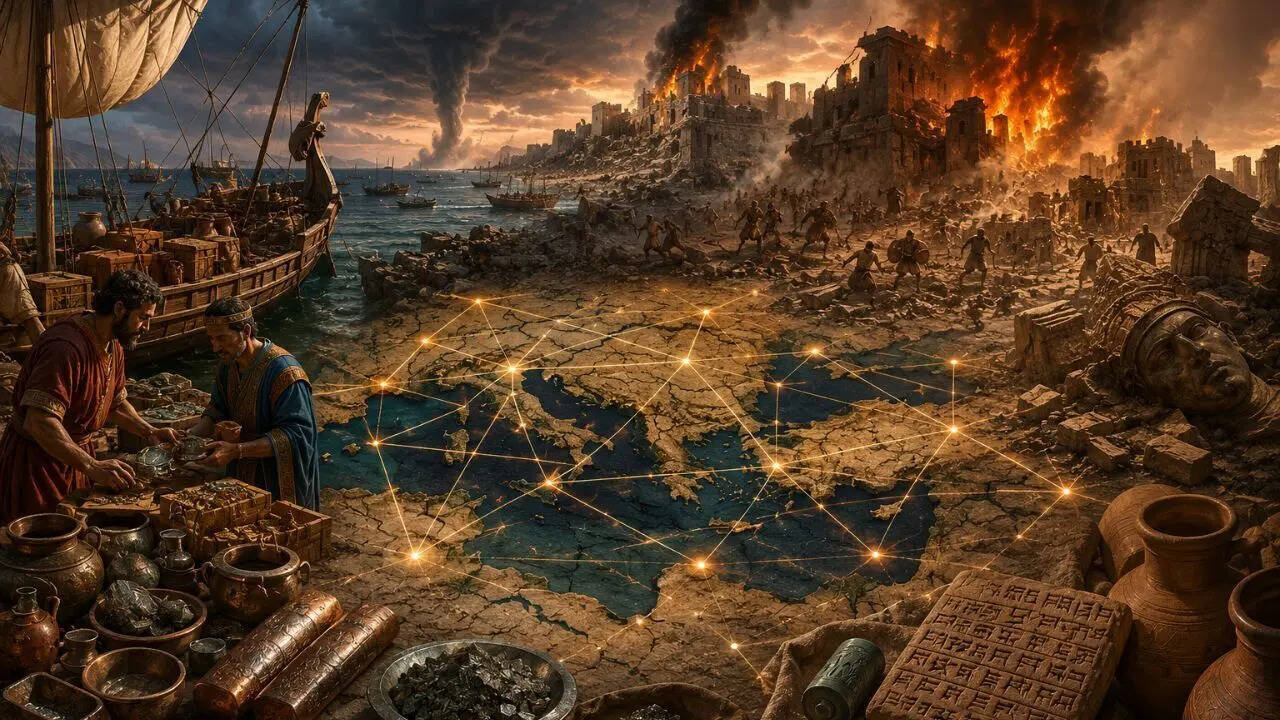
The Late Bronze Age collapse around 1177 BC was not a singular catastrophic event driven by a lone invading force, but rather the systemic failure of an hyper-integrated, globalized economic network. For centuries, the eastern Mediterranean functioned as a complex adaptive system. Kingdoms such as New Kingdom Egypt, the Hittite Empire, Mycenaean Greece, and the Kassite Babylonian kingdom operated as interdependent nodes. When a series of exogenous shocks fractured key supply chains, the network's high degree of coupling triggered a cascading failure. The system could not absorb the disruption because its structural efficiency had eliminated its redundancy.
Understanding this collapse requires moving past romanticized narratives of the "Sea Peoples" and instead analyzing the structural vulnerabilities, supply chain bottlenecks, and feedback loops that transformed localized disruptions into a regional systemic reset.
The Three Pillars of Late Bronze Age Interdependence
The stability of the Late Bronze Age economy rested on three structural pillars: specialized regional production, centralized palatial command economies, and an absolute reliance on long-distance maritime and terrestrial trade routes.
1. Resource Asymmetry and the Bronze Supply Chain
Bronze was the foundational military and agricultural technology of the era. Producing it required a precise metallurgical ratio: roughly 90% copper and 10% tin. While copper was relatively abundant—primarily sourced from the island of Cyprus (Alashiya)—tin was an extraordinarily scarce commodity.
The primary sources of tin for the Near East and Aegean lay thousands of miles away, predominantly in the Badakhshan region of modern Afghanistan and Uzbekistan, and potentially via western European maritime routes. This geographic separation created a permanent state of resource asymmetry. No single empire was self-sufficient. To maintain military readiness and agricultural output, every state had to participate in the international trade network.
2. The Palatial Command Economy
The internal economic architecture of these empires was highly centralized. The palace acted as a clearinghouse, redistribution hub, and administrative core.
- Surplus Extraction: Elite administrations extracted agricultural surpluses from rural populations to fund specialized craft production (textiles, chariots, luxury goods).
- Monopolistic Control: The state controlled the acquisition of prestige goods and raw materials. Foreign trade was not a free-market venture but a state-managed enterprise conducted by royal agents.
- Rigid Supply Lines: Because production was hyper-specialized and managed from the top down, local economies lacked the agility to adapt to sudden resource scarcity or market shifts without palace intervention.
3. Diplomatic and Commercial Hyper-Integration
The "Amarna Letters" outline a highly sophisticated geopolitical framework where rulers referred to each other as "brothers." This was a formal trade cartel. International relations were stabilized through strategic marriages, gift exchange, and a shared elite culture that normalized the flow of goods. This high level of diplomatic integration reduced transaction costs and secured long-distance trade routes, but it also tightly coupled the political survival of one regime to the economic health of its neighbors.
The Cost Function of Network Efficiency
In system dynamics, a network that optimizes for maximum efficiency frequently sacrifices resilience. The Late Bronze Age civilizations built a highly efficient supply chain optimized for a stable environment. This optimization created specific systemic vulnerabilities.
[Exogenous Shocks: Climate, Earthquakes]
       │
       ▼
[Supply Chain Fractures (Tin/Copper/Grain)]
       │
       ▼
[Palatial Administrative Collapse]
       │
       ▼
[Hyper-Dependent Node Failure] ───► [Cascading Network Collapse]
The Just-In-Time Imperial Inventory
Palace economies did not maintain multi-decadal stockpiles of raw materials like tin or strategic commodities like grain. Storage facilities were designed for seasonal redistribution and annual tax cycles. When trade routes were disrupted for even a few consecutive seasons, the lack of buffer stock immediately halted the manufacturing of bronze weaponry and tools. The cost of maintaining a vast, non-productive inventory was deemed too high, leaving the empires vulnerable to prolonged supply interruptions.
The Linear Nature of Bronze Production
The production function of bronze can be modeled as a strict linear sequence:
$$\text{Mining} \rightarrow \text{Long-Distance Transport} \rightarrow \text{Palatial Refining} \rightarrow \text{Alloying} \rightarrow \text{Distribution}$$
Because the inputs were non-substitutable—iron metallurgy was still in its infancy and structurally unable to match the scale of bronze production—a stoppage at the transport phase caused an immediate operational freeze at the refining and alloying phases. The system lacked alternative pathways. If the trade route from the East broke, the entire metallurgical industry of the West collapsed.
The Cascading Failure Trigger Mechanisms
Systems collapse occurs when localized failures breach internal containment mechanisms and propagate through shared linkages. Between roughly 1200 and 1150 BC, a series of synchronous and asynchronous shocks hit the eastern Mediterranean node network.
Megadrought and Agricultural Deficits
Palynological and geological data indicate that the Mediterranean experienced a prolonged dry period starting around the 13th century BC. This was not a brief weather anomaly but a multi-decade mega-drought.
The impact on the Hittite Empire in central Anatolia was catastrophic. The Hittites were perpetually vulnerable to grain shortages and relied heavily on grain imports from Egypt and northern Syria to feed their urban centers. When localized agricultural production failed across multiple nodes simultaneously, the surplus-sharing mechanism of the international network broke down. Egypt, facing its own lower Nile floods, could no longer export sufficient grain surpluses to stabilize the Hittite state.
The Earthstorm Phenomena
Archaeological evidence from sites like Mycenae, Tiryns, Troy, and Ugarit reveals a high concentration of destruction layers dating to this period that are consistent with seismic activity. While ancient societies regularly rebuilt after earthquakes, the occurrence of an "earthquake storm"—a series of high-magnitude seismic events over several decades—placed an unsustainable tax on palatial reconstruction budgets. Labor forces had to be diverted from agriculture and military defense to structural rebuilding, weakening the state's capacity to project power and secure trade routes.
Internal Insurgency and Socio-Economic Polarization
The palatial system’s hyper-extraction of wealth created severe domestic stratification. As the economy contracted due to drought and trade stoppages, the burden fell disproportionately on the agrarian peasantry.
Deprived of palace-distributed rations and facing starvation, large segments of the population fled the urban centers, becoming detached from the state apparatus. This led to internal rebellions, the burning of palatial archives, and the growth of marginalized, non-state actors who survived by raiding—including the diverse coalition known as the Sea Peoples.
Distinguishing Fact from Historiographical Hypothesis
Evaluating the Late Bronze Age collapse requires separating hard archaeological metrics from historical narratives written by the survivors.
| Metric / Element | Known Archaeological Fact | Educated Historiographical Hypothesis |
|---|---|---|
| Destruction of Ugarit | Bureaucratic tablets found baked in ovens detailing imminent invasion; city completely burned and never reoccupied. | The invaders were exclusively the Sea Peoples acting as a unified military armada. |
| Climate Shift | Stable isotope data from Mediterranean seed samples and lake sediments show a distinct, prolonged arid phase. | The drought caused immediate, widespread famine that directly forced populations to migrate. |
| The Sea Peoples | Egyptian inscriptions at Medinet Habu name specific groups (Peleset, Tjekker, Denyen, Shardana) attacking the delta. | These groups originated from a singular geographic homeland displaced by an ecological disaster. |
| Systemic Collapse Length | The breakdown of elite trade networks and palatial structures took approximately 50 to 100 years to fully execute. | The collapse was a sudden, synchronized event occurring precisely in the year 1177 BC. |
The historical record demonstrates that while external raids occurred, they were a symptom of a destabilized system rather than the root cause. The Sea Peoples were both refugees and opportunists, displaced by the same systemic failures they accelerated.
Node-by-Node Degradation Analysis
The collapse did not manifest uniformly across the region. The specific vulnerabilities of each geopolitical node dictated its speed of degradation and capacity for recovery.
Mycenaean Greece: The Fragile Periphery
The Mycenaean palatial centers (Mycenae, Pylos, Tiryns) were highly decentralized relative to Egypt but hyper-specialized internally. They relied heavily on the export of perfumed oils and high-end ceramics to fund luxury imports.
When international maritime trade contracted, the economic rationale for the palatial elite vanished. The Mycenaean states collapsed rapidly into a decentralized, non-literate agrarian society. The loss of Linear B script indicates the complete destruction of the administrative class.
The Hittite Empire: The Continental Bottleneck
The Hittites operated a continental land empire with a vulnerable maritime lifeline via northern Syria (Ugarit) and Cilicia. They were geographically exposed to both western Anatolian raiders (the Kaska) and internal dynastic instability.
When the grain supply chains from Egypt and Syria failed due to drought and piracy, the Hittite state dissolved from within. The capital, Hattusa, was largely evacuated by its elite administration before being burned, indicating a structural abandonment rather than a sudden military sack.
New Kingdom Egypt: The Resilient Hydraulic Node
Egypt survived the collapse as a political entity, though severely weakened. Its geographic advantage lay in the Nile River, a highly resilient, self-renewing hydraulic system that provided a baseline of agricultural productivity unmatched by rain-fed agricultural zones.
Egypt successfully repelled the military incursions of the Sea Peoples under Ramesses III. However, the cost of victory was severe. The loss of Asian trade monopolies, the disruption of internal grain wages (leading to history's first recorded labor strike under Ramesses III), and the depletion of the royal treasury caused Egypt to lose its imperial holdings in Canaan and enter a long period of domestic stagnation and political fragmentation known as the Third Intermediate Period.
Strategic Implications for Modern Supply Networks
The structural collapse of the Late Bronze Age serves as an historical baseline for analyzing modern globalized supply networks. The transformation of an integrated economic system into a series of isolated, lower-tech components highlights the vulnerabilities inherent in complex networks.
The Fallacy of Single-Source Dependencies
The Late Bronze Age reliance on localized tin sources parallels modern industry dependencies on specific rare-earth elements, advanced semiconductor manufacturing facilities, or localized logistics chokepoints like the Straits of Malacca or the Suez Canal. When a critical, non-substitutable input is bottlenecked at a single geographic node, the vulnerability scales exponentially with the number of downstream industries dependent on that input.
Redundancy as a Non-Negotiable Capital Cost
The transition from bronze to iron metallurgy during the subsequent Dark Ages was not driven by iron’s technological superiority; early iron was softer and harder to work than high-quality bronze. Iron succeeded because it was a decentralized, highly redundant resource. Iron ore was available in almost every local region, eliminating the need for long-distance, high-risk supply chains.
Modern enterprise strategy must treat diversification and inventory buffers not as lost efficiencies, but as the fundamental insurance premium required to survive systemic volatility. The optimization of supply lines to the point of zero redundancy guarantees that the occurrence of an inevitable, low-probability, high-impact event will trigger a cascading network failure rather than a localized operational delay. Focus must shift from maximizing the immediate velocity of capital to securing the baseline survival capability of the network architecture.

:max_bytes(150000):strip_icc()/Logistics-db9279223e6c4ccbbdd7b891f20a056e.jpg)