The smell of burning rubber does not leave a kitchen easily. It clings to the curtains. It wedges itself into the microscopic grooves of the countertops, a stubborn reminder that peace is sometimes just a fragile veneer stretched thin over old, jagged fault lines.
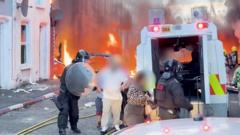
On a Tuesday night that should have been defined by the mundane rhythms of late-August life—the clatter of dinner dishes, the hum of the television, the soft sighs of a neighborhood settling into sleep—a residential street in Belfast became a furnace. It started with a pop. Not a gunshot, but the distinct, sharp crack of a car window yielding to a brick. Then came the accelerant. Within minutes, the orange glow reflecting off the living room windows was not the soft warmth of a streetlamp, but the violent, dancing shadows of a neighborhood on fire.
For those who live in the pockets of the city where tension still simmers like a low-grade fever, the reaction to sudden violence is dictated by muscle memory. You do not look out the window to satisfy your curiosity. You grab what matters, and you move.
The Anatomy of an Escape
Consider a woman we will call Sarah. She is a composite of the mothers and grandmothers who found themselves clutching dressing gowns to their throats in the damp midnight air, watching their predictable lives go up in acrid smoke. Sarah had just turned off her bedside lamp when the first explosion rattled the glass in her frame.
It was a petrol bomb, crude and efficient.
The heat generated by a vehicle fire is immense, capable of reaching over one thousand degrees Fahrenheit within minutes. When multiple cars are targeted in a confined residential space, the street effectively becomes an open-air kiln. The paint on nearby front doors begins to blister and peel before the flames even touch the wood. The air grows thick, starved of oxygen, replaced by a toxic cocktail of vaporized plastic, synthetic upholstery, and heavy fuel smoke.
Sarah did not think about the politics of the micro-conflict unfolding outside her gate. She thought about her grandson sleeping in the back room. She thought about her medication on the kitchen counter. In the end, she left the pills. She took the boy.
When she opened her front door, the street was unrecognizable. The tarmac was slick with melted tires and running water from the early efforts of neighbors with garden hoses—brave, if entirely futile, attempts to hold back a chemical inferno. Two family sedans, the vehicles used for grocery runs and school drop-offs, were fully engulfed, their frames twisting under the intense thermal stress.
The sky above the rooftops was a bruised, unnatural purple.
The Invisible Stakes of the Ordinary
Media reports covering the civil unrest in Belfast often rely on a familiar lexicon. They speak of factions, of historic grievances, of localized disturbances and police cordons. They show the footage—the erratic, handheld video of youths in tracksuits, the sudden burst of fire, the armored police Land Rovers idling at the end of the block.
But standard news reports rarely calculate the weight of the aftermath.
A burned car is not merely a statistic or a piece of property damage to be settled by an insurance firm. For a family living on the economic margins, that vehicle represents employment. It is the ability to reach a shift job across town when the public transport system cuts off after dark. It is the independence of an elderly relative. When that car is reduced to a blackened, hollowed-out skeleton, a family’s economic stability evaporates alongside the fuel tank.
The damage radiates inward, past the brickwork. The psychological toll of having the sanctuary of a home breached by the heat of a stranger's malice is a quiet, enduring kind of trauma.
The next morning, the adrenaline fades. What remains is the smell. It stays in the hair, in the back of the throat, a constant physical trigger that forces the heart to race at every sudden sound outside. A car door slamming too hard makes people jump. A motorbike revving its engine causes a momentary intake of breath. The community enters a state of hyper-vigilance, an exhausting mental tax paid by people who did nothing to provoke the taxman.
The Rhythm of the Street
Violence in these quarters is rarely a sudden, unprompted storm. It builds in a crescendo that locals can read like a barometer. It begins with an increase in graffiti, a hardening of rhetoric on social media feeds, the appearance of pallets and tires stacked in vacant lots.
Then, the tipping point arrives.
On this particular night, the escalation was swift. Emergency services, tasked with entering areas where community tensions are boiling over, must navigate a complex matrix of risk. Fire crews cannot simply rush to a burning building or vehicle if they are pelted with bricks and petrol bombs. They require police escorts. Police escorts require tactical planning.
While the administrative machinery of public safety turns its heavy gears, the fire grows.
Firefighters are caught in an impossible vice. They are men and women from these same wider communities, arriving in heavy, cumbersome turnout gear to drag hoses through narrow alleyways while the air around them crackles with hostility. Every second spent waiting for a security clearance is a second where a fire can leap from a burning bonnet to a dry fascia board, and from a fascia board into a roof space where people are sleeping.
The line between property damage and a tragedy of historic proportions is terrifyingly thin. It depends entirely on the direction of the wind and the speed of a low-pressure water line.
Beyond the Scorched Tarmac
By dawn, the immediate danger had passed, leaving behind a gray, washed-out landscape. The rain, characteristic of a Northern Irish morning, arrived too late to do anything but dampen the ash and wash the soot into the storm drains.
The recovery process on a street like this does not begin with political statements or community dialogue. It begins with the arrival of the flatbed recovery trucks. The winch cables groan as they drag the ruined, rusted shells of cars onto the beds, the metal screeching against metal in a harsh, industrial postscript to the night's chaos. Residents stand on their doorsteps, mugs of tea cooling in their hands, watching the debris of their week being hauled away.
The physical scars on the road are permanent. The intense heat of a vehicle fire alters the chemical structure of the asphalt, leaving deep, pitted craters that crumble under the tires of passing milk delivery vans and council lorries. The street becomes a patchwork of coarse gravel and black grease marks.
The real challenge is not resurfacing the road. It is rebuilding the sense of safety that allowed children to play on the pavements just twelve hours prior.
Look closely at the doorframes of the houses closest to the burn sites. You can see the faint, dark outlines where the smoke licked the PVC. A neighbor uses a sponge and a bucket of soapy water, scrubbing at the soot with a rhythmic, determined motion. The water in the bucket turns black instantly. They empty it into the gutter, fill it up again, and return to the doorframe.
It is a small, defiant act of restoration against a tide of senseless destruction, a quiet insistence that the street belongs to the people who sleep there, not the ones who bring the fire.