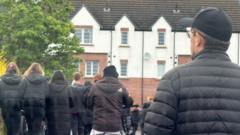
The smell of burnt plastic lingers long after the smoke clears. It hangs in the damp Belfast air, a sharp, chemical reminder of a bus caught in the crossfire just twenty-four hours earlier. For two straight nights, this particular stretch of asphalt wasn't a road. It was a fault line.
Then came the third night.
Silence is rarely newsworthy. When nothing happens, reporters usually pack up their tripods, turn off their glaring camera lights, and go home. But in a city where the past is never truly past, a night where nothing happens is a monumental event. It is a collective holding of the breath.
To understand why a peaceful Tuesday night in Northern Ireland matters, you have to look past the dry news wires that briefly noted the lack of trouble. You have to stand on the interface gates—the massive steel structures that still separate neighborhoods—and look at the people who live in their shadow.
The Weight of the Peace Lines
Imagine a woman named Fiona. She is a hypothetical composite of the dozens of mothers who live along the peace walls in West Belfast, but her anxiety is entirely real. For two nights, Fiona didn’t sleep. She sat in her living room with the lights switched off, watching the reflection of blue police strobes dance across her ceiling. She listened to the rhythmic, metallic thud of stones hitting armored police Land Rovers. She knew the sound of a petrol bomb igniting before it even hit the ground—a soft, suffocating whoosh followed by the sudden, angry orange glow against her window panes.
This is the hidden cost of unrest. It isn’t measured just in the financial damage to burned-out vehicles or the number of bricks cleared by street sweepers the next morning. It is measured in the adrenaline that floods a mother's system as she wonders if she needs to drag her children to the back of the house to sleep on the bathroom floor.
When the violence erupted over those two previous evenings, it felt like a familiar film being replayed. Young men, some barely old enough to shave, stood on street corners with their hoods pulled tight, trading their futures for a few hours of adrenaline. They threw fireworks. They dragged bins into the middle of the road and set them ablaze. To an outsider, it looks like mindless rioting. To those who study the region’s complex social landscape, it is the bubbling over of a deep, generational frustration that the post-1998 peace dividend never quite reached these specific doorsteps.
Then, the script changed.
The Invisible Peacekeepers
Peace does not happen by accident. It is manufactured, hour by hour, by people whose names never appear in a headline.
On that third night, as the sun began to dip below the Black Mountain and the air turned cold, the usual crowd didn't materialize. The reasons why reveal the true mechanics of how communities heal and protect themselves.
Behind the scenes, an invisible network of community workers, youth leaders, and local politicians had spent the daylight hours working the phones. They walked the estates. They spoke to the parents. They stood on the very corners where the petrol bombs had been mixed the night before, intercepting young people before the momentum of the crowd could swallow them whole.
Consider the courage it takes to stand between a group of angry teenagers and a police line. These youth workers don't have armor. They don't have batons. They have authority earned through years of buying football kits, running drop-in centers, and listening to kids whom the rest of society has largely written off. They used an intuitive analogy that resonated with the youth: burning down your own neighborhood to protest your lack of opportunity is like tearing down your own roof because you're angry it's raining.
It worked. The crowds thinned. The older figures who often orchestrate these flares of violence from the safety of the shadows realized the community wasn't behind them this time. The energy fizzled out.
The Anatomy of the Quiet
By midnight, the streets were eerie.
The Police Service of Northern Ireland (PSNI) maintained a heavy presence, their gray Land Rovers parked in strategic formations, engines idling with a low, rumbling hum. But the officers inside stayed inside. The flashing lights were turned off.
A single plastic bottle rolled across the empty tarmac, caught by a gust of wind. That was the only sound.
For Fiona, sitting in her dark living room, the silence was initially terrifying. In Belfast, a sudden quiet can sometimes be the preamble to something worse—the lull before an ambush. She kept her ears strained, waiting for the shout, the smash, the siren.
One o'clock passed. Then two.
Slowly, the tension in her shoulders began to ease. She didn't go to bed immediately; the adrenaline of the past forty-eight hours takes time to drain from the human body. But she did something she hadn't done since Sunday. She made a cup of tea, sat by the window, and looked out at a street that was perfectly, beautifully boring.
The Fragile Normal
It is easy to look at a night without incident and assume the problem is solved. That is the mistake global onlookers often make when viewing Northern Ireland. They see the absence of violence and mistake it for the presence of a deep, settled peace.
The truth is much more fragile, a reality that is both confusing and unsettling to live through. The underlying issues—the political stagnation, the economic deprivation in working-class areas, the unresolved trauma of a conflict that officially ended decades ago—remain completely untouched by a single quiet night. The kindling is still dry. It is just that, for twenty-four hours, nobody threw a match.
But we must celebrate the small victories. A night without violence means a bus driver goes home safely to his family at the end of his shift. It means a business owner doesn't arrive in the morning to find their livelihood reduced to ash and rubble. It means a generation of children wakes up without the smell of smoke in their hair.
As the first gray light of dawn began to break over the city, the streetlights flickered off. A lone milk carton sat on a doorstep. A man walked his dog past a wall scarred by the soot of Sunday's fires, the animal sniffing indifferently at the blackened concrete.
The city was waking up to a normal Wednesday. In most places in the world, a normal Wednesday is a given. In this corner of the world, it is a hard-won masterpiece, painted in the colors of an empty street, a closed gate, and a neighborhood that finally got to sleep.


