The concrete hums beneath rubber tires long after the sun goes down. If you have ever stood near the 6th Street Bridge in Los Angeles at dusk, you know the sound. It is not the monotonous drone of commuter traffic. It is a high-pitched, buzzing chord—dozens of small two-stroke engines and electric motors winding up, mixing with the laughter of teenagers and the sharp scent of unburned fuel.
For the riders, it is freedom. For the city, it is a logistical headache that finally snapped.
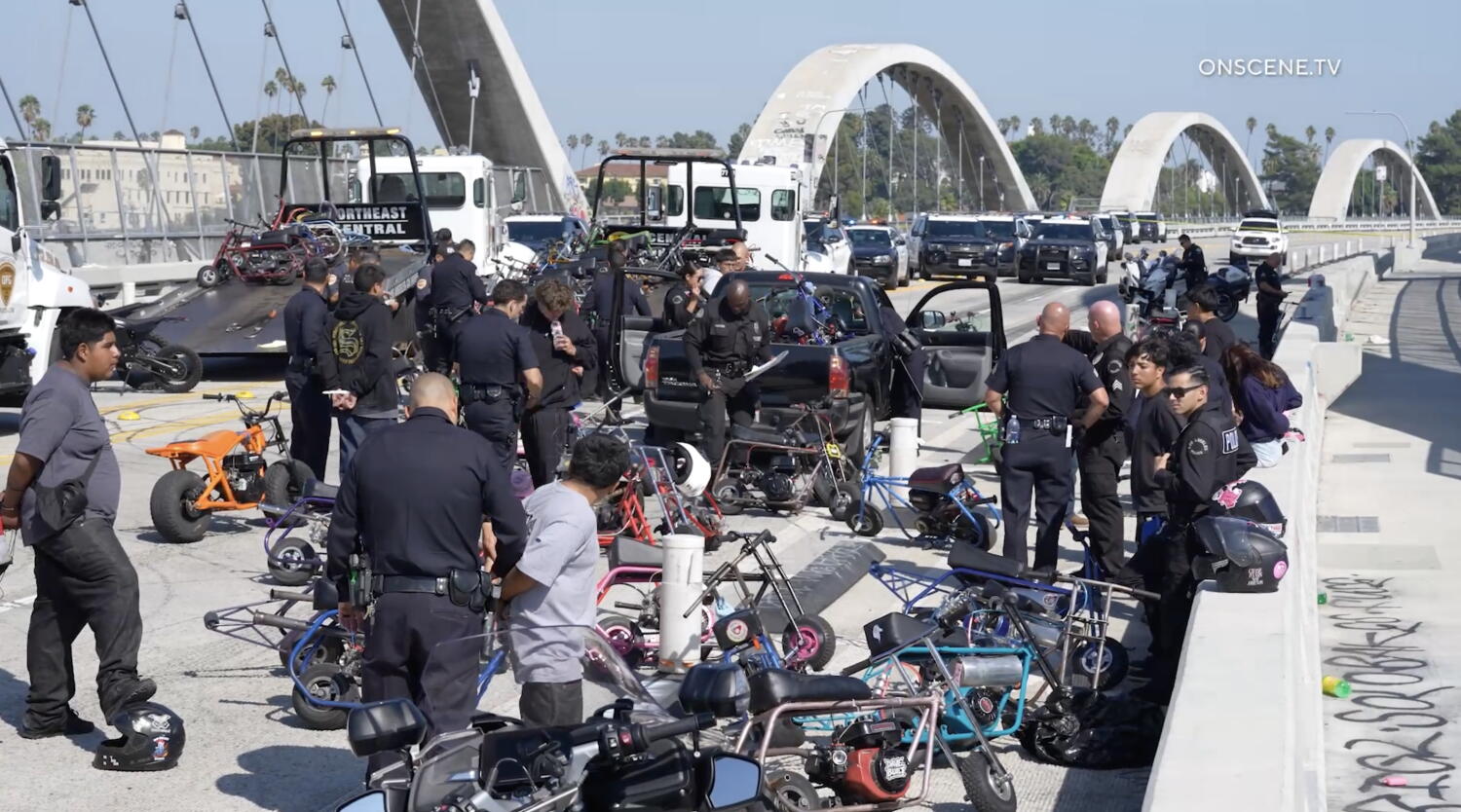
Scores of minibike and dirt bike riders found themselves pinned between cruisers, flashlights, and the cold steel of law enforcement barriers on a stretch of asphalt that has quickly become a battleground for public space. They did not just receive tickets. They lost their machines.
To understand why a swarm of minibikes can paralyze an intersection and trigger a massive police containment operation, you have to look past the flashing lights and examine what these machines represent to the people riding them.
The Anatomy of the Swarm
Picture a teenager from East LA or South Central. Call him Marcus, though he could be any kid tired of staring at a bedroom ceiling or navigating a city built entirely for cars.
Marcus does not own a car. He cannot afford insurance, gas prices that fluctuate like stock tickers, or the steep barrier of entry to traditional motorsports. But he has a pocket-sized pocket bike or a modified Coleman minibike picked up off Marketplace for a few hundred dollars. It runs on grit and YouTube-tutorial mechanics.
When hundreds of riders converge via social media ping alerts, individual isolation vanishes. They become a collective organism. They weave through traffic, pull wheelies past stalled sedans, and turn industrial corridors into temporary tracks.
It looks chaotic from the outside. To the participants, it is a symphony of belonging.
"You feel like you own the street for five minutes," a former rider once told me, his voice a mix of nostalgia and lingering defiance. "Nobody is looking past you. For once, everybody has to look at you."
That visibility is intoxicating. It is also flammable.
When Public Space Becomes a Cage
Urban infrastructure is designed to keep things moving. Cars flow. Pedestrians cross. Police departments react when the flow is violently disrupted.
On the 6th Street Bridge—that soaring, cable-stayed architectural marvel linking Boyle Heights to the Arts District—the friction between spontaneous street culture and municipal order reached a boiling point. The bridge has long served as a magnet for illegal street takeovers, sideshows, and unsanctioned gatherings.
When law enforcement units coordinated to trap the minibike riders, they did not just disperse a crowd. They executed a classic containment maneuver. Police vehicles blocked both ends of the bridge, turning the modern engineering feat into an old-fashioned cul-de-sac.
Escape routes evaporated.
Imagine the sudden shift in the air. The engines cut out one by one, dying down from a roar to an embarrassed sputter. Flashlights cut through the twilight, bouncing off chrome frames and nervous eyes. Some riders tried to lift their bikes over concrete medians, only to find more badges waiting on the other side.
The enforcement was swift and uncompromising. Officers impounded scores of minibikes, dirt bikes, and ATVs. Flatbed tow trucks lined up to haul away what, to an outsider, looked like toys, but to their owners represented months of saved allowance, late-night garage tinkering, and identity.
The Cost of the Ride
The headlines the next morning focused on public safety, traffic disruption, and the headaches of urban policing. Those concerns are real. When dozens of unlicensed, unregistered vehicles weave through multi-lane traffic at high speeds without helmets, the probability of tragedy is terrifyingly high. A single patch of gravel or a distracted driver can turn an adrenaline rush into a funeral.
Cities have a duty to keep roads safe. No one disputes that.
Yet, the confiscation of the bikes points to a deeper, unresolved tension. Where do young people go when they want speed, community, and mechanical expression in a metropolis that has paved over every vacant lot and skatepark?
Skateboarding faced this exact moral panic in the 1980s and 90s. Every downtown ledge was a crime scene; every security guard was an antagonist. Eventually, cities built skateparks. They realized that prohibition without alternative outlet only drives the culture underground, making it more defiant and more dangerous.
Minibikes occupy that same volatile frontier right now. They are loud, obnoxious, and illegal on public thoroughfares. They are also symptoms of a generation seeking adrenaline in an increasingly sanitized, expensive urban landscape.
The Quiet Aftermath
On the 6th Street Bridge today, the rubber marks have faded under street sweepers. The traffic flows smoothly, predictably, boringly.
Down in the garages and backyards, however, the wrenches are still turning. New frames are being welded together from spare parts. Group chats are pinging with coordinates for the next meetup, shrouded in tighter privacy settings, hidden from the algorithms that tipped off the authorities last time.
The bridge was cleared. The bikes were crushed or locked away in municipal impound lots. But the impulse that brought hundreds of kids to that stretch of concrete at sunset—the desperate, universal human need to feel fast, free, and visible—cannot be towed away by a flatbed truck.
It is waiting for the next weekend. It is waiting for the sun to go down.