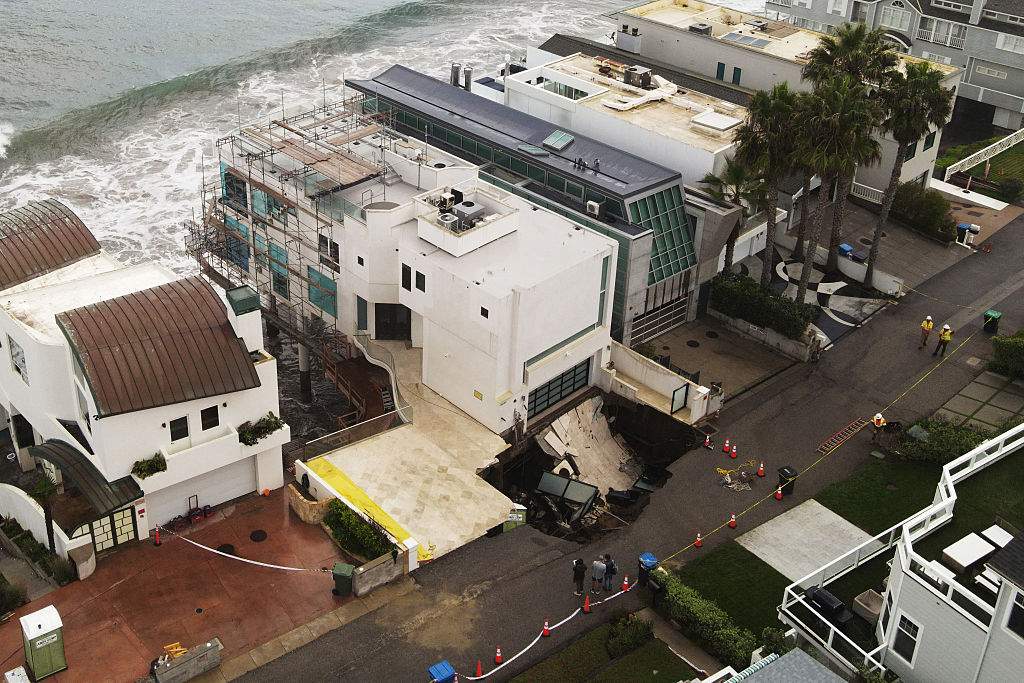
The pavement outside doesn't just break; it surrenders.
Gravity is an indifferent accountant, keeping a ledger we rarely look at until the ink bleeds through the page. We walk on asphalt as if it were a covenant, an eternal promise poured by human hands that the solid earth beneath our boots will remain just that: solid. We build our lives, our sprawling brick facades, our idiosyncratic choices, and our quiet domestic routines on top of an ancient, breathing underworld. And every so often, the floor drops out.
Ask Nicolas Cage. Or, more accurately, ask the quiet stretch of residential concrete that suddenly decided it had enough.
It starts with a sound you cannot categorize. Not a crash, not a boom, but a long, tearing sigh. The kind of noise a house makes when it realizes it is sitting on a secret.
Geology does not care about Academy Awards. It does not care about national treasures, ghost riders, or the particular cadence of a whispered, frantic line delivered in a candlelit room. When water carves through limestone over millennia, dissolving rock into subterranean hollows like sugar in a hot cup of tea, the roof of the cavern eventually gets tired. It thins. It whispers to the weight above: Hold me up. And then, inevitably, it lets go.
Sinkholes are the ultimate equalizer. You can own the most distinctive property in the zip code, fill your halls with strange antiquities, cultivate an aura of cinematic mythology, and still wake up to find your driveway violently redecorated by the abyss.
Picture the scene. It is a quiet morning, the kind where the air smells faintly of damp leaves and cooling car engines. A neighbor steps out for the morning paper. They look down. And where a neat, gray rectangle of concrete used to lead to the garage, there is now only a jagged throat of raw earth, a dark bowl breathing up the scent of damp clay and forgotten stone. A car sits at an awkward, drunken angle, its front wheels dangling over nothingness, staring into a throat it never knew was there.
Panic has a specific flavor. It tastes like cold copper and sudden silence.
For the people whose driveways vanish, the shock isn't just financial. It is existential. We invest so much of our psyche into the illusion of footing. To lose your driveway is to lose the boundary between your private sanctuary and the raw, unpolished chaos of the planet's core. It is a rude awakening, a reminder that we are all camping on crusts of earth that float over liquid fire and ancient drainage pipes.
Urban infrastructure is a silent partner in these dramas. Beneath our manicured lawns and suburban cul-de-sacs lies a complex, rusting anatomy of iron and clay. Pipes weep. Joints fail. Water finds a path where no path should be, eroding the foundation grain by grain until a cavern blooms beneath the asphalt. By the time the surface breaks, the disaster has been quietly under construction for years.
When the news cycle catches hold of a celebrity’s driveway collapsing, we laugh. We turn it into a meme. We attach the imagery to a punchline about eccentric cinema or cinematic curses, as if the earth opened up simply to provide a fitting backdrop for a gothic thriller. Only him, we say, shaking our heads with a wry smile. Only in the world of Nicolas Cage does the ground itself reject the premise.
We use the humor as a shield. If it happens to a man who once bought a dinosaur skull at a Hollywood auction, it feels safely detached from us. It is a spectacle. A movie trailer playing out in real life.
But strip away the marquee name, and you are left with a universal human terror.
Consider what happens next in the quiet aftermath of the spectacle. The cameras leave. The gawkers drive away. The yellow police tape flutters in the afternoon breeze like a tired ribbon. Now comes the real work: the engineers with their ground-penetrating radar, the insurance adjusters with their careful, clipped tones, the heavy machinery churning up the lawn to pour truckloads of controlled-density fill into a mouth that cannot be reasoned with.
You stand at your front door, coffee mug growing cold in your hand, looking out at a patch of ground that has been temporarily branded as radioactive by municipal caution tape. You realize you are parking on the street. You realize your home is a punctuation mark in a larger, uncontrollable sentence written by water and stone.
This is the hidden cost of living on a living planet. We tame it, we pave it, we draw property lines across it in bright white paint, but the earth retains the ultimate right of eminent domain.
The story of a swallowed driveway isn't really a story about a famous actor. It is a parable about fragility. We spend our lives building bulkheads against chaos—savings accounts, deadbolts, retaining walls, insurance policies, iron gates. We curate our little domains and pretend that the chaotic machinery of nature has been subdued by zoning laws and civil engineering.
Then the asphalt groans. The void opens its mouth. And for a terrifying, clarifying second, we remember that we are tenants, not owners.
The repair crews will come. They will pump slurry into the earth, pack it tight, lay down fresh mesh, and pour new concrete that dries to a pale, uniform gray. They will paint the lines fresh. Within a month, cars will roll over the spot again, tires humming against the smooth, unblemished surface, drivers listening to the radio, thinking about dinner, thinking about taxes, thinking about everything except the dark, wet quiet breathing just a few feet beneath their wheels.
We forget because we have to. Memory is a poor companion for living on the edge of an abyss. But down there, in the damp dark where the limestone dissolves and the ancient waters cut their silent trails, the earth keeps turning, patient and hungry, waiting for the next moment we forget where we are standing.