Walk into a modern data center at three o'clock in the morning, and the first thing that hits you is the sound. It is not a roar. It is a dense, vibrating hum that presses against your teeth. Millions of tiny fans are spinning, trying to keep stacks of silicon from melting under the weight of the world's digital desires.
To most people, this place is an abstraction. It is "the cloud." We treat it like weather—something that just happens above us. But it is not weather. It is steel, copper, concrete, and an unimaginable amount of electricity.
Recently, Jensen Huang, the leather-jacketed chief executive of Nvidia, stood alongside executives from LG Electronics to map out a partnership that sounds, on its surface, like standard corporate press release material. They talked about humanoid robots. They talked about the next generation of data centers. The business wires ran the dry facts: Nvidia’s AI computing platform is merging with LG’s manufacturing prowess to reinvent how things are made and how data is processed.
If you read only the financial headlines, you missed the real story. This is not a story about stock prices or quarterly earnings. It is a story about the moment the physical world and the digital world finally stopped being two different things.
The Ghost in the Assembly Line
Consider a hypothetical worker named Min-seo. For fifteen years, Min-seo has worked the line at a major electronics plant in South Korea. Her eyes are trained to spot a fraction-of-a-millimeter misalignment in a washing machine drum or a smartphone chassis before the automated camera even flags it. She knows the specific, metallic clink that means a pneumatic press is losing pressure.
Her expertise is brilliant, human, and entirely trapped inside her skull. When she retires, that thirty years of sensory wisdom walks out the door with her.
For decades, automation promised to solve this. But traditional factory robots are profoundly stupid. They are blind, deaf, and dumb. If a robot is programmed to weld a bracket at point A, and the chassis arrives two inches to the left because a conveyor belt slipped, the robot will happily weld the empty air, over and over, until a human hits the big red kill switch.
This is where the Nvidia and LG alliance shifts from a corporate handshake into something radical.
LG makes things. Millions of things. Appliances, screens, vehicle components. They possess the physical blueprint of modern daily life. Nvidia makes the brains. By injecting Nvidia's Omniverse—a platform that creates terrifyingly accurate digital twins of the real world—into LG’s industrial empire, they are building something entirely new.
They are building a robot that can see the mistake, understand why it happened, and fix it on the fly.
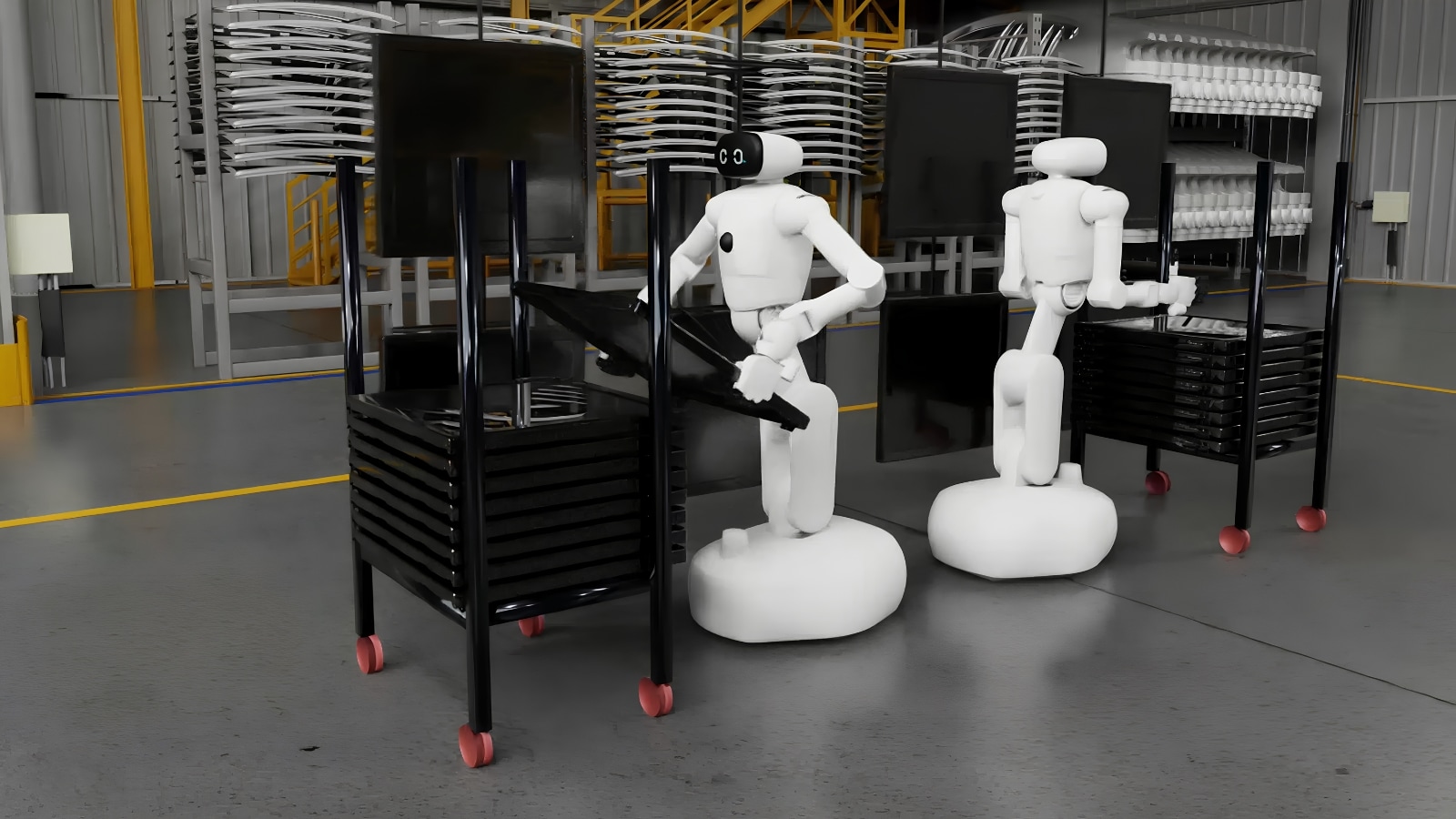
This is not a mechanical arm bolted to a concrete floor. It is a humanoid machine. It has two legs, two arms, and a face full of sensors. Why build a robot shaped like a human? Because our entire world was built by humans, for humans. Every door handle, every staircase, every assembly line workstation was designed for a creature that stands about five-to-six feet tall with two opposable thumbs. To change the world, you do not redesign every factory on Earth. You build a machine that fits into the empty spaces we already left behind.
The Brains Inside the Moving Metal
But a humanoid body without an immense mind is just an expensive mannequin.
To make a robot walk through a crowded factory floor without crushing a human coworker's foot, it requires an astronomical amount of real-time computation. It has to calculate gravity, friction, momentum, and the unpredictable path of a human being carrying a coffee mug. Every second, it processes terabytes of spatial data.
That data cannot travel to a distant cloud server and back. If a robot trips, it cannot wait fifty milliseconds for a server in Virginia to tell it how to catch its balance. It will already be on the floor, shattered into a million dollars of scrap metal.
The computation must happen at the "edge." It has to happen right there, in the room, inside the walls of the factory itself.
This requirement flips our entire concept of infrastructure on its head. Suddenly, a factory is no longer just a place where steel is bent and components are soldered. A factory becomes a living data center. The walls themselves must be packed with liquid-cooled graphics processing units.
When you look at the Nvidia-LG partnership through this lens, the strategy becomes crystal clear. LG needs Nvidia's computational architecture to make their machines autonomous. Nvidia needs LG's massive industrial footprint to deploy their chips in the physical world. It is a closed loop. The digital twin trains the robot in a virtual world where it can fail a billion times without breaking anything. Then, the perfected software is downloaded into the physical robot on the actual factory floor.
The Hidden Cost of the Frictionless World
It is easy to get swept up in the techno-optimism of it all. The vision of a perfectly oiled, silent, autonomous world where machines build machines while humans sit in cafes and write poetry is a beautiful lie we have been told since the dawn of the steam engine.
The reality is messier. It is heavier.
To power this future of walking robots and intelligent factories, we are going to need more energy than we have ever generated before. These new AI-centric data centers do not sip electricity; they gulp it. They require specialized power grids and cooling systems that can handle the intense heat generated by thousands of chips grinding through neural network calculations simultaneously.
We are entering an era of intense friction between our desire for intelligent machines and the physical limits of our planet. Every time a humanoid robot learns to articulate a finger with the grace of a concert pianist, a power plant somewhere hums a little louder.
We must be honest about this trade-off. We are trading human muscle for silicon heat.
The people who build these systems often talk about efficiency as if it is a holy virtue. But efficiency is cold. It does not care about the social fabric of a town that exists entirely because an appliance factory employs four thousand people. It does not care about the quiet dignity of a worker who spent thirty years mastering a physical craft.
The Shift We Cannot Undo
Yet, the momentum behind this transition is unstoppable. The math is simply too compelling for corporate balance sheets to ignore.
The true transformation will not happen on a stage in Taipei or Seoul during a keynote address. It will happen quietly, in places like Tennessee or Changwon, where LG operates massive manufacturing hubs.
Imagine walking into one of those facilities five years from now. The harsh overhead fluorescent lights might be dimmed, because the workers on the floor do not use human eyes to see. The temperature might be lower, optimized for machine longevity rather than human comfort.
You will see them moving down the aisles. Not cars on a track, but figures. They will possess a strange, fluid grace, moving crates, checking tolerances, communicating with the building itself through silent, invisible bursts of data.
A machine will look at a piece of unformed plastic, and through the collective memory of a million simulated lifetimes stored in its silicon brain, it will know exactly how to shape it. It will not be tired. It will not have a bad day. It will never miss its family.
In the corner of that factory, perhaps there will be an office where a human supervisor sits, watching a wall of monitors. They will not be managing people; they will be managing a synthetic ecosystem. They will be the conductor of an orchestra that plays without a single instrument ever touching human lips.
The hum of the data center and the rattle of the assembly line are merging into a single, continuous note. We are no longer just building tools to help us work. We are building a world that works without us, leaving us to figure out what we are supposed to do with the silence that follows.