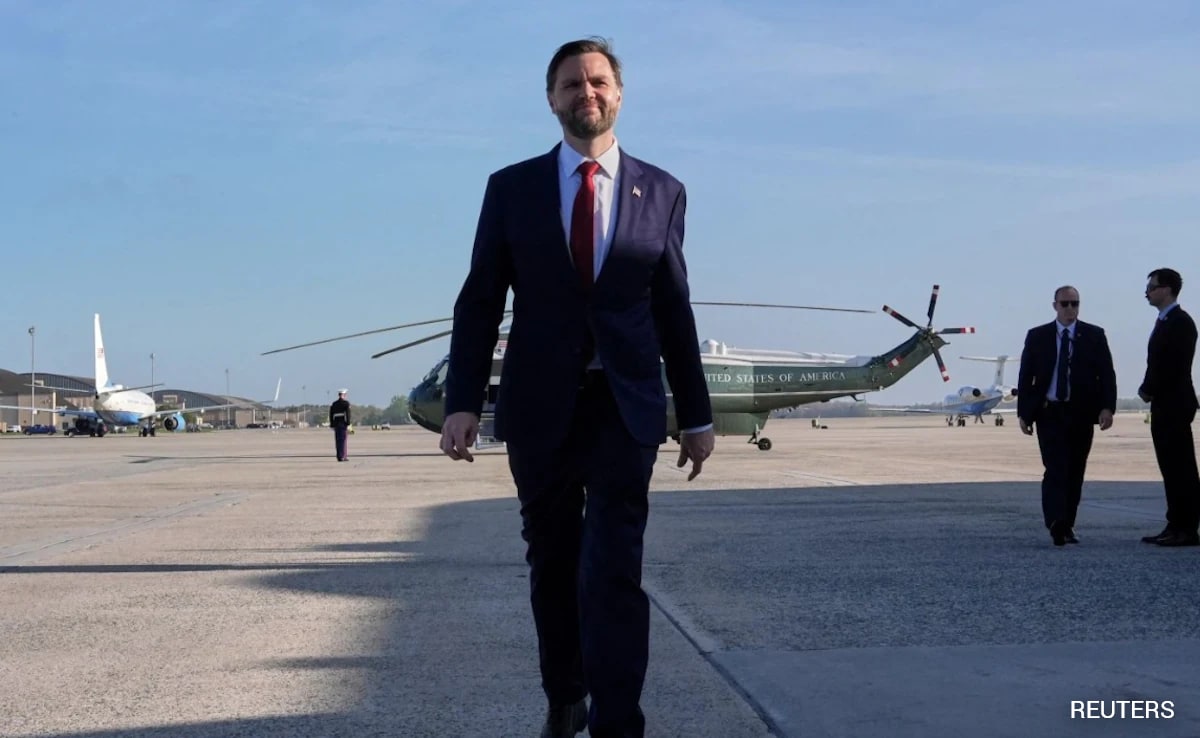
The cabin of a modified C-32 is not a place for luxury. It is a place of fluorescent hums and the smell of stale coffee and recycled air. Somewhere over the dark expanse of the Hindu Kush, the Vice President sat hunched over a stack of intelligence briefings that would make a lesser man’s eyes bleed. JD Vance was not looking for data points. He was looking for an exit. Not from the plane, but from a decades-long cycle of brinkmanship that has kept the world’s finger hovering over a very specific, very permanent red button.
When the wheels touched the tarmac in Islamabad, the air was thick. Not just with the humidity of a South Asian spring, but with the atmospheric pressure of two nations—the United States and Iran—waiting to see who would blink first. This wasn't a standard diplomatic junket. This was a high-stakes gamble played out in the shadow of the Margalla Hills, where the silence between Washington and Tehran has grown so loud it’s begun to deafen the rest of the planet.
The Architect of a New Friction
To understand why Vance is the one stepping off that plane, you have to look past the political theater. Diplomacy used to be the province of the "gray men," the career bureaucrats who spoke in riddles and moved at the speed of eroding limestone. But the old ways failed. The old ways gave us forty years of proxy wars, frozen assets, and a Middle East that feels like a powder keg buried in a furnace.
Vance represents a shift toward a more jagged, populist realism. He isn't there to offer the flowery language of the 1990s. He is there because he understands the math of the American heartland. He knows that every billion dollars spent on a standoff in the Persian Gulf is a billion dollars that never makes it to a factory floor in Ohio or a school in Pennsylvania. The "human element" isn't just a phrase here; it’s the literal cost of conflict.
Imagine a father in Isfahan, wondering if the medicine his daughter needs will be available next week because of a new round of sanctions. Now imagine a mother in a small town in Iowa, watching the news and wondering if her son’s National Guard unit is about to be deployed to a desert she can’t find on a map. These are the ghosts in the room when Vance sits down with the Pakistani mediators and the back-channel representatives from Tehran. They are the invisible stakeholders.
The Pakistan Pivot
Why Islamabad? The choice of venue is a story in itself.
Pakistan has spent years walking a razor’s edge, balancing its relationship with the West against its geographic reality as Iran’s neighbor. It is the world’s diplomatic "black box." By choosing this ground, the administration is signaling a break from the European-led talks that have stalled in Vienna for years.
Islamabad provides a different kind of gravity. It is a city that understands the cost of instability better than almost any other. The Pakistani officials facilitating these talks aren't just doing it for prestige. They are doing it for survival. If the U.S. and Iran slide into an open kinetic conflict, the fallout won't stop at the border. It will pour across the region like spilled acid.
The stakes are hidden in the dry technicalities of uranium enrichment percentages and centrifuge counts, but the reality is much simpler. It’s about energy. It’s about the Strait of Hormuz. It’s about the fact that 20% of the world’s oil passes through a narrow choke point that could be closed with a handful of well-placed mines. If that happens, the global economy doesn't just slow down. It breaks.
The Ghost of 1979
Every conversation Vance has is haunted by history. To the Iranians, the U.S. is the power that backed a coup in 1953 and turned a blind eye to a chemical weapons attack in the 80s. To the Americans, Iran is the revolutionary state that took hostages and exports chaos.
Breaking that cycle requires more than a signature on a piece of paper. It requires a psychological breakthrough.
Vance is betting on a "transactional peace." It is a cold, hard-eyed approach that asks: What do you want that you can’t get through war? Iran wants an end to the economic strangulation that has turned their currency into confetti. They want to be part of the modern world again. The U.S. wants a guarantee that the nuclear shadow is lifted and that the regional shadow-boxing ends. It’s a trade. Not a friendship, but a deal.
Consider the hypothetical case of a shipping magnate in Dubai. For him, peace isn't an abstract ideal. It’s the difference between his insurance premiums staying at $50,000 or spiking to $500,000 overnight. When those costs go up, the price of the plastic in your toothbrush goes up. The price of the fuel in your car goes up. We are all connected to these talks by a thousand invisible threads of commerce and consequence.
The Room Where It Happens
The reports coming out of the initial sessions describe a tense, almost monastic atmosphere. There are no cameras in the inner sanctum. There are no grandstanding tweets. There is only the low murmur of translators and the scratching of pens.
Vance’s challenge is to convince the Iranian hardliners that this is their last, best chance for a graceful exit. He has to convince them that the U.S. isn't looking for "regime change," but for "behavior change." It is a subtle distinction, but it is the difference between a deal and a disaster.
Critics say he is too green, too untested for this level of geopolitical chess. They argue that the Iranians will eat him alive. But there is an advantage to being the outsider. He doesn't carry the baggage of the previous three administrations. He doesn't have a legacy to protect, only a future to build. He can say the things that a career diplomat wouldn't dare to say. He can be blunt.
The Arithmetic of Peace
Let’s look at the numbers that don't make it into the headlines.
- The Iranian Rial has lost over 90% of its value against the dollar in the last decade.
- Over 40 million Iranians have fallen below the poverty line.
- The U.S. has spent an estimated $8 trillion on wars in the Middle East since 2001.
These aren't just statistics. They are a roadmap of failure. Vance is in Islamabad to see if he can find a new route.
The strategy is focused on "de-escalation through integration." If you can tie a nation’s economic health to the stability of the region, they are much less likely to set the neighborhood on fire. It’s the same logic that kept Europe from tearing itself apart after World War II. It’s about making peace more profitable than war.
The Long Walk Back
As the talks stretch into the late hours, the physical toll becomes apparent. You see it in the way the aides carry themselves, the dark circles under their eyes, the frantic pacing in the hallways.
The human element is also present in the fear. There is a very real fear that a single misstep, a single misunderstood phrase, could send everything spiraling. In this environment, trust isn't built on handshakes. It’s built on "verifiable transparency."
Vance is reportedly pushing for a "phased " approach. You give a little, we give a little. You stop the enrichment, we release the frozen assets. It’s a slow, agonizing process. It’s like trying to defuse a bomb while the timer is ticking and the room is filling with smoke.
But what is the alternative?
The alternative is a return to the "Maximum Pressure" campaign that, while damaging to Iran, failed to stop their nuclear progress. The alternative is a "shadow war" that eventually steps into the light.
The Weight of the Moment
As the sun rises over the Islamabad skyline, the city begins to wake up. Millions of people go about their lives, oblivious to the fact that their future is being negotiated in a quiet room nearby.
The Vice President is scheduled to fly out in forty-eight hours. Whether he leaves with a framework for a deal or just a polite "no" will determine the trajectory of the next decade.
This isn't about political points. It’s about whether we want to live in a world defined by the walls we build or the bridges we manage to scrap together out of the wreckage of the past.
Vance knows that when he returns to Washington, he will face a wall of skepticism. The hawks will call him weak. The doves will say he didn't go far enough. But the reality of leadership is that you rarely get to choose between a good option and a bad one. Usually, you are choosing between a disaster and a difficult path forward.
He is choosing the path.
The plane sits on the runway, fueled and ready. The pilots are resting. The security detail is on high alert. Inside the embassy, the lamps are still burning. JD Vance takes a sip of water, looks at the man across the table, and starts again.
There is no music playing. There are no flags waving. There is only the quiet, desperate work of trying to keep the world from breaking in half.
The silence in the room is heavy. It’s the sound of history being written in real-time, one tentative sentence at a time, while the rest of us wait to see if we’ll finally be allowed to breathe.